Best PPC Tools for Chiropractors and Med Spas (2026)
By the AdFlint research team · We run live campaigns on these platforms; every screenshot is from our own sessions · Published August 3, 2026 · Updated August 3, 2026
TL;DR
- Best for a practice owner running their own Google + Meta ads: AdFlint (our product — full disclosure throughout). AI writes, launches, and optimizes campaigns inside your own ad account, you approve every ad before it goes live, and the fee is flat: $40-$109/mo covers the $1,000-$5,000/mo budgets most clinics actually run.
- Best if a PPC professional — in-house or a fractional consultant — drives your account: Optmyzr, which we tested hands-on July 30-31 and August 3, 2026. It is the deepest optimization toolkit here, but it optimizes campaigns that already exist and assumes an operator who knows what a search-term audit is. Its pricing renders only through its own on-page calculator, so get a current quote from the source rather than from any roundup, including this one.
- Best for a Meta-heavy med spa comfortable writing its own automation rules: Birch (formerly Revealbot), also tested hands-on. Know the real price: automated rules are not in the $49/mo Essential plan — they require Pro at $99/mo, about 4% of a $2,500 budget and 10% of a $1,000 one.
- Marketing 360 and WordStream (LOCALiQ) are services wearing software branding. Marketing 360 is quote-only software-plus-fulfillment; WordStream's famous self-serve software no longer exists, though its free Google Ads grader is still worth running before you buy anything — including our product.
- Before any tool: Meta prohibits before-and-after photos in ads and has restricted pixel data for health-and-wellness accounts since January 2025; Google limits prescription-drug terms like Botox in ad copy and blocks health-condition remarketing. No tool on this page can make policy-violating creative run.
- The free baseline — Google Ads Editor plus the native Google and Meta managers — costs $0 and roughly 5-10 hours of your month. That time is what every paid tool here is really priced against.
Search "best PPC tools for chiropractors" or "med spa PPC software" and the current page one is ten agencies telling you the best tool is hiring them. Every result we opened was a "why choose us" pitch with a contact form — not one compared actual software a practice owner could sign up for and drive. If you typed "tools" because you want to run your own ads, or at least understand what you would be paying an agency to do, this page is the comparison that search was supposed to return.
We cover both verticals on one page deliberately, and not as a template trick. Chiropractic clinics and med spas advertise in nearly identical conditions: budgets that mostly land between $1,000 and $5,000 a month, a 5-15 mile service radius, a phone-first funnel where the conversion that matters is a booked appointment rather than a pageview, and conversion volume low enough — often fewer than ten new-patient leads a week — that it breaks the automated bidding assumptions most software makes. We also went looking for chiropractic-specific or med-spa-specific PPC software and found none; the vertical-branded companies that surface are agencies or practice-management suites. Both verticals draw from the same generalist tool market, so the honest comparison is one list with the vertical-specific judgment layered on top.
That judgment is mostly about policy, and it is the part no agency page has an incentive to write down. Med spas live on before-and-after photos — and Meta's personal health and appearance ad policy prohibits before/after imagery in ads outright. Since January 2025, Meta has restricted what pixel data ad accounts categorized as health and wellness can share, which can silently break optimizing for your booked-appointment event. Google treats Botox as a prescription-drug term that can get ad copy limited, and prohibits remarketing based on health conditions — which rules out the retargeting playbook every generic PPC guide assumes you can run. A tool that bulk-produces creative your platform will reject, or that optimizes toward an event your pixel is no longer allowed to send, is worse than no tool. We evaluate every entry below with those constraints in view.
One more thing the agency SERP will not tell you: two of the six entries below are agencies in software clothing, and we say so plainly in their entries. We also mark exactly which products we tested with our own hands and which we only researched — the methodology section is the contract for the whole page.
AdFlint
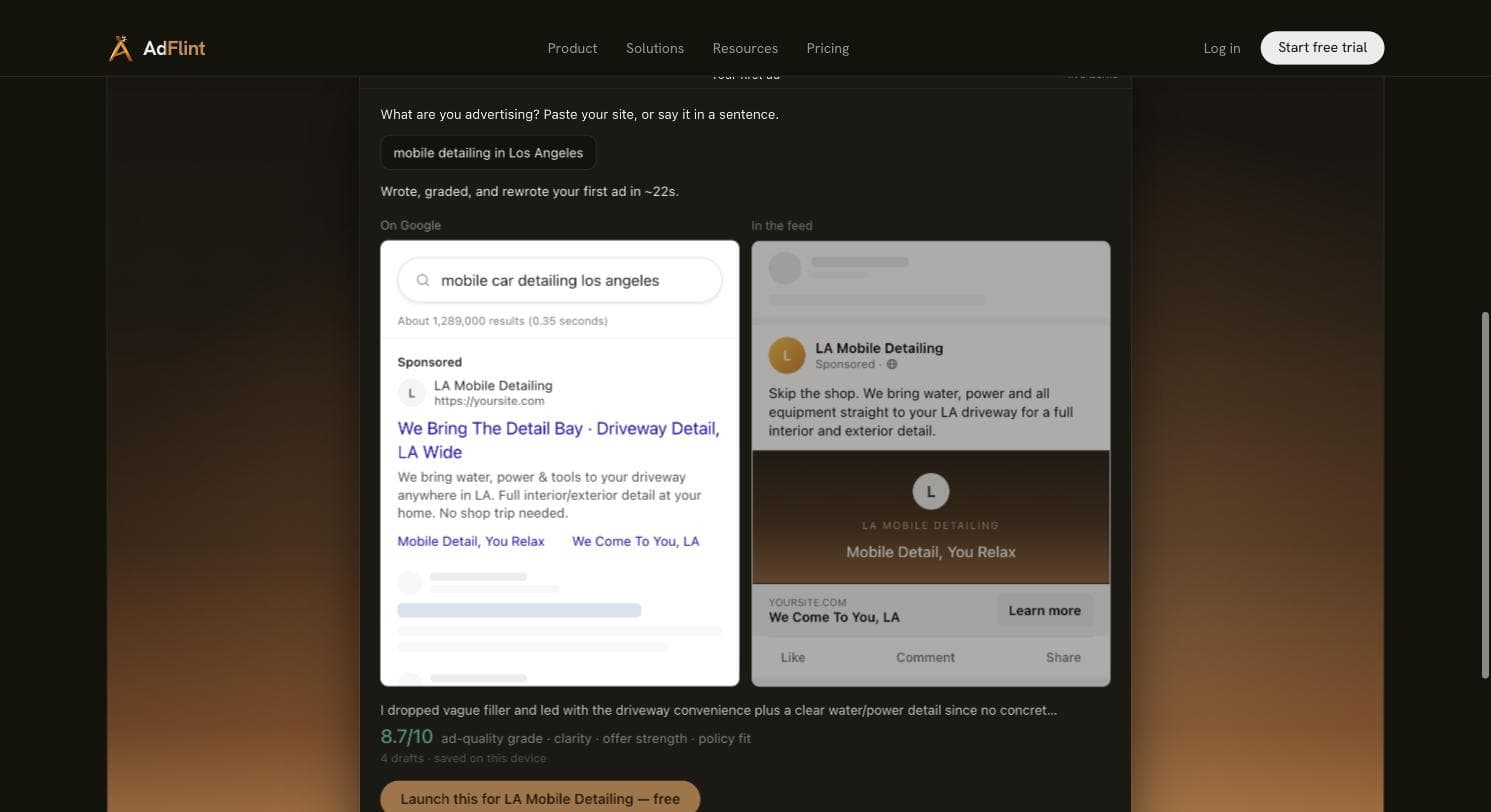
Best for owner-run Google + Meta ads at clinic budgetsOur product — disclosureFull disclosure first: AdFlint is our product, and we rank it #1 for a specific buyer — the practice owner who typed "tools" into this search and meant it. AdFlint's AI writes your Google Search and Meta ads, launches them, and optimizes them, inside an ad account you own: you connect your existing Google Ads or Meta account with one-click OAuth, your card pays the ad platforms directly, and nothing launches until you approve it. For a chiropractor or med spa owner whose marketing department is the front desk, that is the whole job — ad writing, launch, and ongoing optimization — handled, with you as the sign-off.
The approval gate matters more in these two verticals than almost anywhere else. Health and aesthetics creative operates under rules that get accounts flagged — no before/after imagery on Meta, no "struggling with back pain?" personal-attribute phrasing, no prescription-drug names in copy without certification — and an automation tool that launches without a human checkpoint is a liability here. AdFlint's workflow puts every ad in front of you before it spends a dollar, with hard budget caps so a campaign can never outrun the number you set. To be equally clear about what we do not claim: AdFlint does not certify your creative as policy-compliant — the checkpoint gives you the chance to apply the policy notes on this page before launch, and that review is still your job.
The economics are the other argument. Self-serve pricing is a flat fee with 0% of ad spend taken on top: at the $2,500/mo a typical established clinic spends, AdFlint's Growth plan is $89/mo — about 3.6% of budget, versus the 10-20% of spend (or $500-$1,500 retainers) common in the agency proposals this SERP is full of. The entry point is a 7-day free trial, and our live homepage demo shows the core loop in public: given nothing but a one-line business description, it wrote, graded, and rewrote a search ad and a Meta feed preview in about 22 seconds. That demo is a generic local-service example — not a chiropractic or med-spa campaign — and we would rather tell you that than imply a track record we do not have.
Which is the honest close: AdFlint is a young product. We have no chiropractic or med-spa case studies, no third-party review base to point you to, and no sustained live-spend performance data of our own. What we offer instead is a fit — flat pricing sized to clinic budgets, ads written for you, your account, your approval — and this page's policy homework built by the same team. If you already employ someone who knows Google Ads well, Optmyzr below is the better buy, and we say so in its entry.
Pros
- + Writes, launches, and optimizes both Google and Meta campaigns — the two platforms that matter for local clinics — with human approval on every ad
- + Flat fee with 0% of ad spend taken on self-serve: $40-$109/mo covers the $1,000-$5,000/mo clinic budget band
- + You own the ad account and pay platforms directly; cancelling costs you nothing but the subscription
- + Hard budget caps and pre-launch approval — the control points that matter most under health-vertical ad policy
- + 7-day free trial to see it write your actual ads before paying
Cons
- − Google Ads and Meta only — no TikTok, where many med spas now find patients, and no Microsoft, LinkedIn, Pinterest or X
- − No chiropractic or med-spa case studies and no vertical track record; our policy guidance comes from platform documentation, not from campaigns we have run in these verticals
- − Young product with no independent G2 or Trustpilot review base yet, and no sustained live-spend performance data we can show you
- − Self-serve tiers cap ad spend ($89 Growth covers up to $2,500/mo; $109 Scale up to $5,000/mo), so a growing clinic will climb the ladder
- − Does not verify creative against health ad policies for you — approval is your checkpoint, not a compliance engine
- − Nowhere near Optmyzr's analytical depth: no search-term audit suite, no anomaly detection, no account blueprints
Ideal for
- Solo and small-practice owners spending $500-$5,000/mo who want ads written and run without hiring anyone
- Clinics burned by an agency retainer who still do not want to learn campaign building
- Owners who want veto power over every ad that could touch a policy line
Pricing: Self-serve flat fee, 0% of ad spend: Launch $40/mo (up to $1,000/mo ad spend), Growth $89 (up to $2,500), Scale $109 (up to $5,000), Accelerate $119 (up to $10,000), Performance $219 (up to $20,000), Premium $319 (up to $30,000), custom above that. Managed done-for-you service is separate: a $249/mo floor plus a share of managed spend. Ad spend is billed by Google and Meta directly to your own card. Entry point is a 7-day free trial. As of August 2026.
Try AdFlint freeOptmyzr
Best when a PPC pro runs your accountOptmyzr is the professional's PPC toolkit, and it is the entry here we can speak about with the most first-hand authority: we ran a real trial July 30-31 and again August 3, 2026. Signup is more demanding than anything else on this page — five mandatory qualification fields, then a phone number and SMS verification before you see the product (no credit card, at least). Those qualification brackets ask for your monthly ad spend starting at "Under $10,000/mo" and running to "$500,000+," which tells you where a chiropractic clinic or med spa sits in its world: the bottom bracket. From there, though, the trial impressed us. A five-step wizard has you pick exactly three of ten goals, choose a working mode — including an MCP connector that lets Claude or ChatGPT drive Optmyzr, a genuinely forward-looking option — and then generated an accurate business profile from nothing but a URL in about ten seconds.
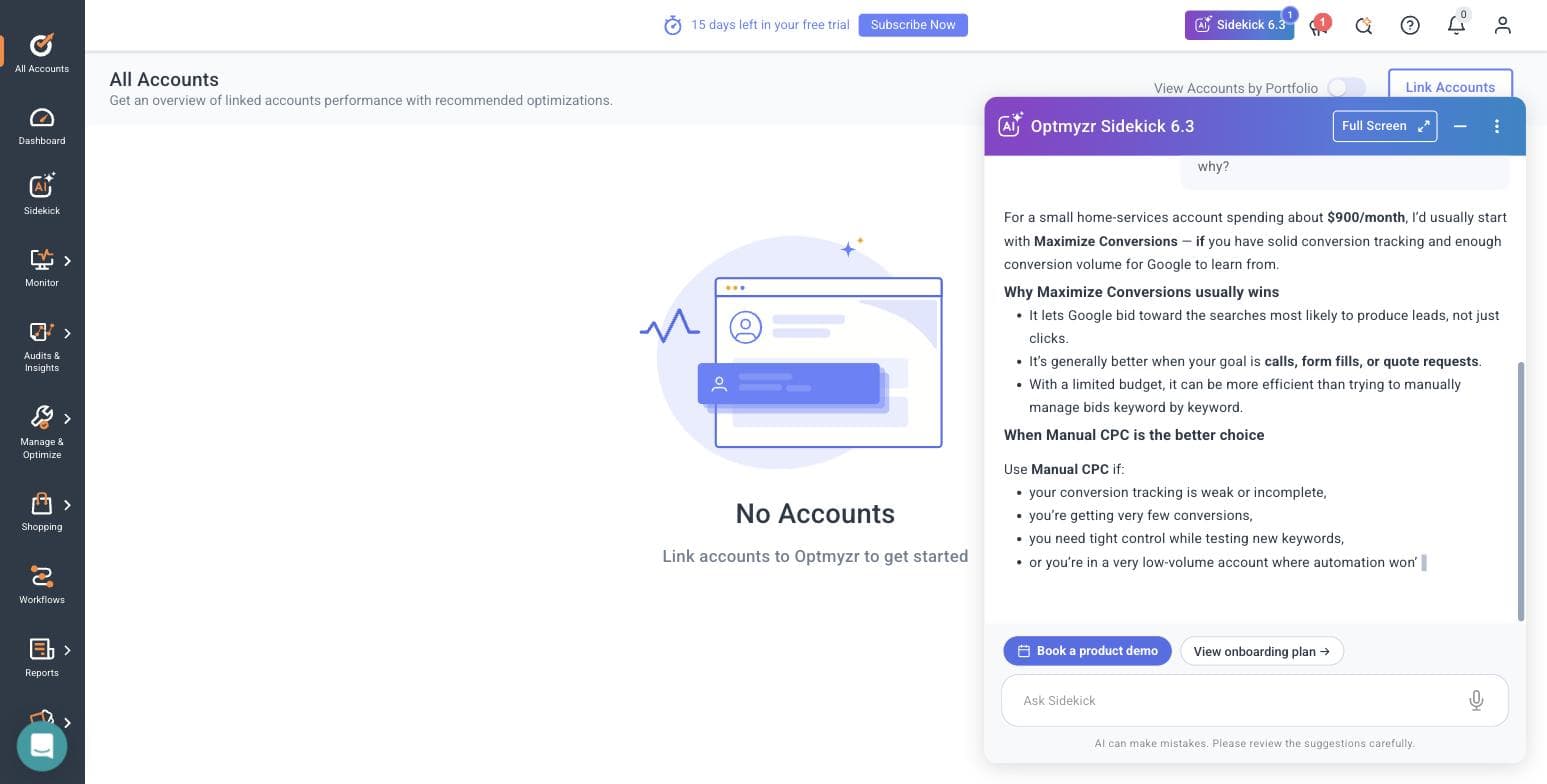
The moment most relevant to a clinic owner came from Sidekick, its AI assistant. Before we had connected any ad account, we asked a real bidding question — Maximize Conversions versus Manual CPC — and it answered correctly and specifically: get conversion tracking clean first, use Maximize Conversions on core lead campaigns, fall back to Manual CPC at low volume, with a rule of thumb of 3-5 conversions per week. That threshold is precisely the line most solo practices straddle. A clinic getting six new-patient calls a week can feed Google's automated bidding; one getting two cannot, and Optmyzr's own AI told us so unprompted. It also let us into the full app with no ad account connected — rare among trials, and useful if you want to inspect the toolkit before granting access — though every tool that would touch a campaign bounced us back to the account-connection screen, so real evaluation ultimately requires linking your account.
What you get inside is depth an owner-operator will mostly never use: PPC Investigator, spend projection, account health audits, search-term analysis, competitive and auction insights, a Monitor suite with KPI alerts and an anomaly detector, AI-generated account blueprints, and a Rule Engine of pre-built optimization strategies. Two caveats from our sessions matter for this page. First, the pre-built Rule Engine strategies we saw covered Google, Microsoft, and Amazon Ads — not Meta, where a med spa's prospecting lives (Meta is among its 11 integrations, but the automation library's center of gravity is search). Second, Optmyzr optimizes campaigns that exist; it does not write and launch your first campaign for you. It makes a competent operator faster — which is exactly why our recommendation is conditional: if you have a fractional PPC consultant or a staff member who genuinely knows Google Ads, Optmyzr is the strongest toolkit on this page. If you do not, you are buying a cockpit with no pilot.
On price, we are going to disappoint you deliberately. Optmyzr's tiers (Essentials, Premium, Enterprise) scale by monthly ad-spend bracket, and the figures render only through the calculator on its own pricing page; our trial required no credit card, so we never saw a checkout number we could stand behind. Rather than repeat a price from another roundup, we are telling you to pull the current number from Optmyzr's pricing page for your spend level. What we can say from the trial is directional and consistent: five qualification fields, an SMS gate, and brackets reaching $500,000+ in monthly spend are not the apparatus of a product priced for a solo clinic. Budget accordingly, and check the fee against your ad budget as a percentage before you commit. Two trial trivia points worth knowing before you sign up: Optmyzr's own /free-trial/ URL 404s (enter through the main site), and the in-product banner told us we had 15 days while the marketing site says 14.
Pros
- + Deepest optimization toolkit on this page: audits, spend projection, anomaly alerts, search-term analysis, AI blueprints, and a pre-built rule library
- + Sidekick AI gave a correct, appropriately cautious answer to a low-volume bidding question in our test — directly relevant to clinics under 5 conversions/week
- + Lets you into the full app without connecting an ad account, so you can inspect before granting access
- + 11 integrations including Google, Microsoft, Meta, LinkedIn, and Amazon — room to grow if a clinic group scales
- + MCP connector lets Claude or ChatGPT operate the toolkit — the most credible AI-assistant story we saw in this market
Cons
- − Priced for professionals managing real spend, and the number is not published in plain text — it renders through a calculator on its pricing page, so you cannot comparison-shop it at a glance
- − Assumes an operator: it optimizes existing campaigns rather than writing and launching your first one
- − The pre-built Rule Engine strategies we saw covered Google, Microsoft, and Amazon Ads — not Meta, where med-spa prospecting lives
- − Phone number and SMS verification wall before you ever see the product
- − Its own qualification brackets start at 'Under $10,000/mo' and run to '$500,000+' — a solo clinic is its smallest customer, not its target
Ideal for
- Clinics with a fractional PPC consultant or genuinely Google Ads-literate staff member
- Multi-location chiropractic or med-spa groups spending $5,000+/mo
- Owners who want to audit what an agency has been doing to their account
Pricing: Tiered as Essentials, Premium, and Enterprise, scaling by monthly ad-spend bracket. We are not quoting a figure: prices render only through the calculator on Optmyzr's own pricing page, and our trial required no credit card, so we never saw a number we could source. Get the current price for your spend level from optmyzr.com/pricing. The trial itself is free with no card — 14 days per the marketing site, though the in-product banner told us 15 — and signup requires five qualification fields plus phone and SMS verification. Product verified in-product July 30-31 and August 3, 2026.
Visit OptmyzrBirch (formerly Revealbot)
Best for Meta-heavy med spas that live on offersBirch is the automation engine formerly known as Revealbot, and we tested it hands-on in the same July 30-31 and August 3, 2026 sessions. Practical note first: the rebrand left broken links everywhere — revealbot.com and even bir.ch/signup both 404; the working signup is app.bir.ch/signup. Once there, it was the friendliest signup on this page: under two minutes to a logged-in screen, no phone, no card. Then the wall: Birch gates everything on connecting a live ad account. There is no sandbox and no demo data, and the rule builder — the product's entire reason to exist — is inaccessible until you hand over a real account. All we could see unconnected was the empty state listing three example action types: increase bid, duplicate, notify. If you want to evaluate Birch, budget for connecting your actual ad account on day one of the trial.
Post-rebrand, Birch is three products. The rules engine automates actions on your campaigns around the clock — the classic use being guardrails and scaling moves executed while you run a clinic. Stage turns a planning Google Sheet and a Drive folder of creative into bulk-launched ads for Meta, TikTok, and Snapchat (with read-only Drive access, a sensible permission scope). Hub is a Signals Gateway implementation for server-side, first-party tracking. For a med spa, Stage is the sleeper feature: an aesthetics practice runs a rolling calendar of offers — seasonal packages, event-season injectable promotions, holiday gift-card pushes — and a sheet-to-ads pipeline is a genuinely efficient way to produce that volume of variants. The vertical caution is that scale cuts both ways: Meta's health and appearance policies (no before/after imagery, no personal-attribute phrasing) apply to every variant you bulk-launch, and Birch will not check a single one. It executes your judgment; it does not supply any.
That is also the honest frame for the whole product. Rules like "pause when frequency passes 4" or "duplicate the winner into a new ad set" are powerful for a small-radius local audience that fatigues fast — but you have to know which rules to write, and a wrong rule executes just as reliably as a right one. Birch writes no copy, chooses no audiences, and has no concept of a booked appointment versus a click. For a chiropractor whose budget is mostly Google Search, Birch is a weaker fit: Google Ads is supported, but the integration list — Meta, Google Ads and Drive, Snapchat, TikTok, YouTube, Google Analytics, Google Sheets, Slack, AppsFlyer, Adjust (beta), Hyros, Wicked Reports, with no Microsoft, Amazon, or LinkedIn — tells you its DNA is Meta-first ecommerce and apps, not local search.
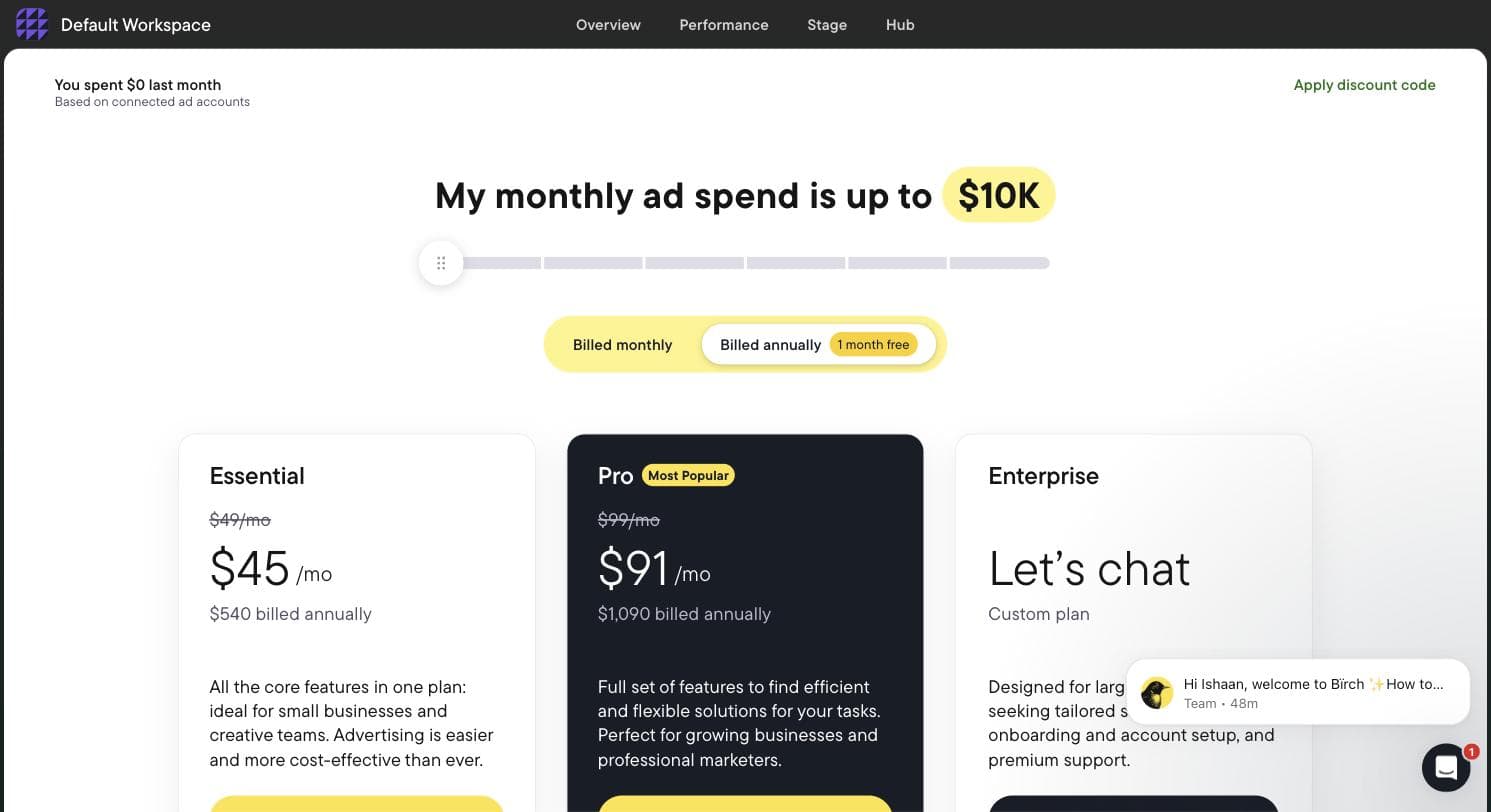
Finally, the pricing honesty this SERP lacks: the $49/mo Essential plan does not include automated rules. Rules are Pro-only — $99/mo at the ≤$10K spend tier every clinic occupies — along with Explorer, Launcher, Stage, custom audiences, and the Sheets/AppsFlyer/Hyros integrations. The real price of the product everyone means by "Revealbot" is $99, which is 4% of a $2,500 clinic budget and about 10% of a $1,000 one, and when the 14-day trial expires, rules and reports are disabled.
Pros
- + Fastest, cleanest signup we tested: under two minutes, no phone, no card
- + Rules engine executes guardrails and scaling moves 24/7 — genuinely useful for small local audiences that fatigue fast
- + Stage's sheet-to-ads bulk flow fits the rolling offer calendar med spas actually run (Meta, TikTok, Snapchat)
- + Hub adds server-side first-party tracking via Signals Gateway
- + Transparent in-app spend-tier pricing — we read every tier off the billing slider ourselves
Cons
- − Automated rules are not in the $49 Essential plan — Pro at $99/mo is the real price, and trial expiry disables rules and reports
- − Hard-gates on connecting a live ad account: no sandbox, no demo data, rule builder invisible until you hand over a real account
- − Writes nothing and decides nothing — you supply every rule, every audience, every ad; bulk tools will happily scale policy-violating creative
- − Meta-first DNA: no Microsoft, Amazon, or LinkedIn, and Google coverage is not its center of gravity — a weak fit for search-led chiropractic budgets
- − Post-rebrand link rot: revealbot.com and bir.ch/signup both 404; signup only works at app.bir.ch/signup
Ideal for
- Med spas spending $2,000+/mo on Meta with a steady offer calendar and someone comfortable writing automation rules
- Multi-location aesthetics groups producing creative variants at volume
- Clinics that also run TikTok or Snapchat, which nothing else on this page touches
Pricing: Read off Birch's own in-app billing slider (August 3, 2026): at ≤$10K/mo ad spend — the tier every clinic on this page occupies — Essential is $49/mo and Pro $99/mo (annual $540/$1,090). Higher tiers: ≤$30K → Essential $149 / Pro $249 (annual $1,640/$2,740); ≤$75K → $299/$499 (annual $3,290/$5,490); ≤$150K → $499/$799 (annual $5,490/$8,790); ≤$300K → Pro only at $1,299 (annual $14,290); $500K+ is Enterprise only. Automated rules, Explorer, Launcher, Stage, custom audiences, and the Sheets/AppsFlyer/Hyros integrations are Pro-only. Annual buys 12 months for the price of 11; overages bill via Stripe. 14-day trial; on expiry, rules and reports are disabled.
Visit Birch (formerly Revealbot)Google Ads Editor + native Ads Managers (manual baseline)
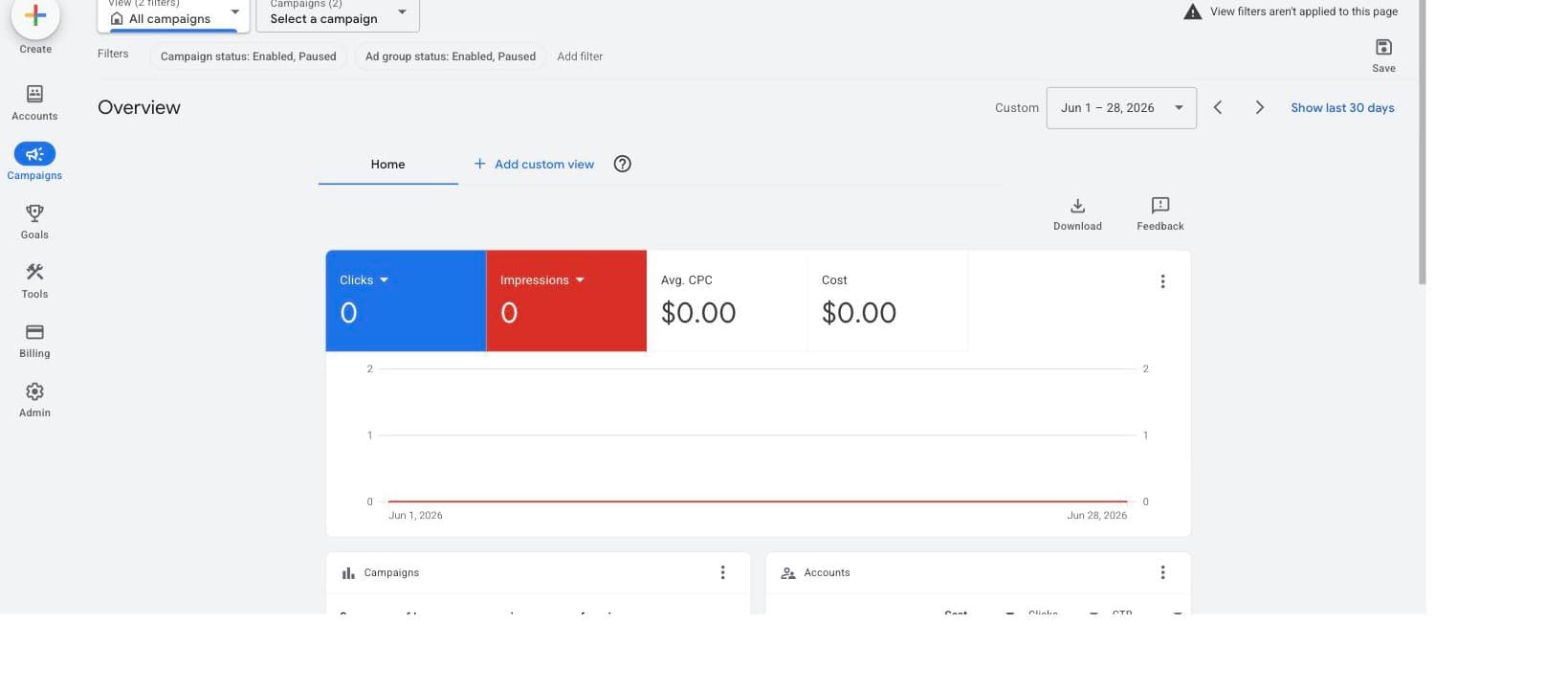
Best $0 baseline every paid tool must beatEvery clinic should price the free option before paying for anything, because it is what every tool on this page is actually competing against. Google Ads Editor is Google's free desktop application for building and bulk-editing campaigns offline; the native Google Ads and Meta Ads Manager web interfaces now include recommendation engines, AI-assisted creative tools, and automated campaign types (Performance Max, Advantage+) that did not exist when the paid-tool category was born. For a single-location clinic running one or two campaigns in a tight radius, the honest question is whether you need third-party software at all — or whether you need eight focused hours a month and this page's policy notes.
The vertical-specific catches are where the free option costs you. Google's auto-apply recommendations will, if left on their defaults, broaden your match types — and a broad-matched "chiropractor" happily buys massage, physio, and back-brace shopping queries your front desk cannot convert; audit your auto-apply settings before trusting any spend numbers. Meta's Advantage+ audience expansion pulls the same direction, loosening a deliberately tight 7-mile med-spa radius in pursuit of cheap clicks. And the natives will not warn you when policy quietly degrades your setup: if Meta categorizes your pixel as health and wellness and restricts your booked-appointment event, or Google limits your ad for a prescription-drug term, you find out by noticing performance sag — there is no anomaly detector, no alert, no Sidekick. Detection is a real part of what the paid tools sell.
Our recommendation: run the baseline math regardless. If your total ad budget is under roughly $1,000/mo, the natives plus deliberate weekly attention is a defensible answer, and any tool fee is a large fraction of your budget. Above that, count your real hours — most owners we are writing for run clinics, not campaigns, and 5-10 hours of owner time a month is worth more than any subscription on this page. That, not features, is the case for paying anyone.
Pros
- + Free forever — the entire budget goes to media
- + Native automated campaign types (Performance Max, Advantage+) now do some of what paid tools once charged for
- + Google Ads Editor makes bulk edits and campaign duplication genuinely fast once learned
- + No third-party access to your ad accounts at all — the simplest possible security posture
Cons
- − Costs 5-10 owner-hours a month to run properly — usually the most expensive line item on this page once priced honestly
- − Auto-apply recommendations and Advantage+ expansion defaults actively work against tight-radius, exact-intent clinic campaigns unless policed
- − No alerts or anomaly detection: policy-driven degradation (restricted pixel events, limited ads) surfaces only when you notice performance sag
- − Writes nothing for you; the blank-page problem is fully yours
- − No cross-platform view — Google and Meta stay in separate cockpits
Ideal for
- Clinics spending under $1,000/mo, where any subscription is a large fraction of budget
- Owners with a genuine interest in learning PPC as a skill
- Anyone who wants a baseline to measure a paid tool's trial against
Pricing: Free. Google Ads Editor, the Google Ads web interface, and Meta Ads Manager cost nothing; you pay only ad spend — plus the 5-10 hours a month of your own time that every paid tool on this page is really priced against. As of August 2026.
Visit Google Ads Editor + native Ads Managers (manual baseline)Marketing 360
Done-for-you marketing with dashboards — a service, not a toolMarketing 360 earns a place on this page because it is the entry a clinic owner is most likely to be pitched when searching this term, and because it is the clearest example of the category confusion this page exists to fix. We have not tested it: no trial account, no demo. Everything here comes from its own website, checked August 3, 2026, and you should weight it accordingly.
The important clarification is category. Marketing 360 is a marketing platform — CRM, websites, listings, reputation, social, and ads — paired with a fulfillment team that does the work. In its own positioning, you get software dashboards and marketing success managers who run campaigns for you. That is a legitimate model, but be clear-eyed about what it means: if you arrived at this page fleeing ten agency results, Marketing 360 is closer to those ten than to the four entries above it. The dashboards are the wrapper; the product is people running your marketing, on their platform. On vertical fit, be skeptical of how it is often described: on our check its site markets to broad industry categories including medical practices and health and wellness, rather than to chiropractors and med spas as named specialties. If a rep tells you they specialize in your vertical, ask for clinic references in your specialty and metro before you believe it.
Pricing is quote-based — we found no plan prices published anywhere on its site, only routes to a signup or sales conversation and a "how plans and pricing work" explainer (checked August 3, 2026), which makes it the only entry above the free baseline you cannot price without talking to someone. We are not going to characterize its public reviews, because we did not audit them and it would be unfair to summarize a real company's reputation from a skim; read recent reviews for your own vertical yourself. If you evaluate it, do it the way you would any agency: ask who owns the ad accounts, what happens to your website and CRM data if you leave, what the itemized split is between platform fee, fulfillment, and ad spend, and get the cancellation terms in writing before signing. For a practice owner who genuinely wants done-for-you across web, reviews, and ads with a single throat to choke, it may fit — but that is a different purchase than the software this page is about.
Pros
- + One accountable vendor across websites, CRM, listings, reputation, and ads — a real convenience for a practice with zero marketing staff
- + Software dashboards plus a human fulfillment team, so campaign work does not depend on your hours
- + Markets to medical practices and health-and-wellness businesses, so its team is likelier than a generalist tool vendor to have seen clinic advertising
Cons
- − Not software you drive: it is a managed service with dashboards, closer to the agencies dominating this SERP than to the tools above it
- − No published pricing — we found no plan prices on its site and every path leads to signup or a sales conversation, so you cannot comparison-shop it (checked August 3, 2026)
- − Vertical specialization is asserted at the category level (medical, health and wellness), not as named chiropractic or med-spa specialties — ask for in-specialty references
- − We have not tested it — this entry is researched from its own site, not hands-on
- − Platform lock-in questions (website, CRM, ad accounts) need answering in writing before you sign
Ideal for
- Practices that want one vendor for website, reviews, listings, and ads — and accept the trade-offs of a service relationship
- Owners who have already decided against running their own campaigns but want dashboards over the work
- Multi-service clinics consolidating scattered marketing vendors
Pricing: Quote-based. We found no plan pricing published on Marketing 360's site; paths lead to a signup flow or sales conversation, plus a 'how plans and pricing work' explainer (checked August 3, 2026). Budget for a platform fee plus fulfillment plus ad spend, and get all three itemized in writing before signing.
Visit Marketing 360WordStream (LOCALiQ)
Best free account grader — the software itself is goneWordStream is the name a practice owner researching PPC tools is most likely to recognize, which is exactly why its entry matters: the self-serve software that made the name famous no longer exists. On our August 2026 check, WordStream Advisor is absent from the site's navigation and tool pages; the brand now operates as the free-tools and education arm of LOCALiQ, the managed marketing services company under Gannett/USA TODAY. We have not tested LOCALiQ's service — this entry is researched from the companies' own sites — but the category fact does not need a trial to verify: type this page's query, land on WordStream expecting software, and the paid path you will actually be offered is a managed-service sales conversation. For this SERP, that makes it an eleventh agency result wearing a software brand.
What survives is genuinely worth your time, and free. The Google Ads Performance Grader audits an existing account for wasted spend, Quality Score problems, impression share, and account structure; there is a Facebook Ads grader and a free keyword tool alongside one of the deepest free PPC education libraries anywhere. For a chiropractor or med spa owner who has been running ads — or paying an agency to — the grader is the single best free due-diligence step available: run it before buying anything on this page, including our product, and run it again on whatever an agency has been doing in your account. Go in knowing the grader is also lead generation: it wants an email and a Google sign-in, and it funnels toward a LOCALiQ conversation.
LOCALiQ itself publishes no pricing — every path ends at a demo or consultation — so like Marketing 360 it cannot be comparison-shopped from its website. If you want a human team running your ads, get its quote and compare it against a local agency's and against the managed tiers of the tools above. One more reason WordStream appears on this page at all: its published cross-advertiser benchmark reports are the source of most of the healthcare CPC and cost-per-lead figures quoted across the industry, including the directional figures we cite in the FAQ below.
Pros
- + The free Google Ads Performance Grader is the best zero-cost audit of an existing clinic account — ideal before buying any tool or firing any agency
- + Deep, genuinely useful free PPC education library
- + Its published benchmark reports are the industry's standard reference for healthcare CPC and cost-per-lead context
Cons
- − The self-serve WordStream software no longer exists — there is nothing here to subscribe to and drive
- − The paid path is LOCALiQ managed services: quote-only, no published pricing, sales-led (checked August 2026)
- − The free graders require an email and Google sign-in and funnel into a sales conversation
- − Point-in-time audits, not ongoing management — nothing here runs your campaigns
- − We have not tested LOCALiQ's managed service; this entry is researched, not hands-on
Ideal for
- Any clinic with an existing Google Ads account that has never been independently audited
- Owners deciding between self-serve software and a managed service who want a free data point first
- Practices verifying what an agency has actually been doing in their account
Pricing: WordStream's graders, keyword tool, and education library are free. LOCALiQ managed services are quote-based with no published pricing — engagement starts with a sales consultation (checked August 2026).
Visit WordStream (LOCALiQ)Side by side.
| Tool | Best for | Cost at $2,500/mo clinic spend | Hands-on tested? | Writes your ads? | Standout limitation |
|---|---|---|---|---|---|
| AdFlint (our product) | Owner-run Google + Meta ads | $89/mo flat (3.6% of budget) | It is our product | Yes — AI drafts, you approve every ad | Google + Meta only; no clinic case studies yet |
| Optmyzr | Clinics with a PPC pro in-house or on retainer | Tiered by spend bracket; price renders only in its own calculator — we do not quote one | Yes — July 30-31 & Aug 3, 2026 | No — optimizes what an operator builds | Assumes real PPC skill; built for professionals managing large spend |
| Birch (ex-Revealbot) | Meta-heavy med spas running offer calendars | $99/mo Pro, 4% of budget (rules are not in $49 Essential) | Yes — July 30-31 & Aug 3, 2026 | No — executes your rules; Stage bulk-builds from your sheet | Everything gated until a live ad account connects; Meta-first DNA |
| Google Ads Editor + natives | Owners trading time for money | $0 + 5-10 hours/month | n/a — free native tooling | No — the blank page is yours | Auto-apply defaults fight tight-radius clinic campaigns |
| Marketing 360 | Done-for-you across web, reviews, and ads | Quote-only (no published pricing) | No — researched only | Yes — its fulfillment team does | A service with dashboards, not software you drive |
| WordStream (LOCALiQ) | Free account grading before any purchase | Grader free; managed service quote-only | No — researched only | No — grader audits; LOCALiQ's team is a managed service | The famous self-serve software no longer exists |
How we chose.
Hands-on: we created real trial accounts in Optmyzr and Birch and worked inside both products on July 30-31, 2026 and again on August 3, 2026 — full signup, onboarding, and every module we could reach on a trial. The Optmyzr and Birch screenshots on this page are from those sessions.
AdFlint is our own product. We build it, we rank it #1 here for a specific buyer, and we state real limitations in its cons — including that it covers only Google and Meta and has no chiropractic or med-spa case studies.
Not tested: Marketing 360 and WordStream/LOCALiQ. Those entries are built from the vendors' own websites and public documentation, checked August 3, 2026, and each entry says so. We did not create accounts or sit through their sales demos.
We have never run ad campaigns in these verticals — or in any vertical — for a client. Every vertical-specific claim on this page (creative policy, pixel restrictions, drug-term rules, seasonality) comes from Google's and Meta's published advertising policies and from published cross-advertiser benchmark reports, not from our own campaign data.
AdFlint has not run sustained live ad spend at scale, so this page contains no ROAS figures, client results, or testimonials for our product — and we treated competitor performance claims with the same skepticism. There are no review quotes on this page because we did not verify any.
Pricing rules we held ourselves to: Birch's ladder was read directly off its in-app billing slider at every spend tier on August 3, 2026. Where a vendor does not publish a price we can source — Optmyzr's calculator-rendered tiers, Marketing 360, LOCALiQ — we say so instead of quoting a number. We would rather leave a gap than print a competitor's price wrong.
- — Total cost at real clinic budgets. We priced every tool we could price at $1,000-$5,000/mo in ad spend — the band most chiropractic clinics and med spas actually occupy — and treated the fee as a percentage of that budget, not as an abstract number. Birch Pro at $99/mo is 10% of a $1,000 budget and 4% of a $5,000 one; that difference decides rankings.
- — Does it create ads, or assume an operator? An owner-run practice needs software that writes and launches; a clinic with a PPC pro on retainer needs depth, not hand-holding. We say which side of that line every tool sits on.
- — Fit for regulated health creative. Before/after bans, restricted drug terms, and health-account pixel restrictions are daily reality for these two verticals. We favored tools whose workflow includes a human checkpoint before anything goes live, and we flagged where automation could bulk-produce creative Meta or Google will reject.
- — Fit for low conversion volume. Clinics generating under roughly 3-5 conversions a week break Maximize Conversions-style automated bidding. Tools were judged on whether they help or hurt in that regime.
- — Account ownership and exit cost. Who holds the ad account, whose card pays the platform, and what you lose on cancellation — the questions the agency-dominated SERP never raises.
- — Disclosure over polish. Hands-on entries (Optmyzr, Birch, our own product) are labeled hands-on with dates; researched entries (Marketing 360, WordStream/LOCALiQ) are labeled researched. No entry pretends to testing we did not do, and no entry carries a price we could not source.
Common questions.
Can my med spa use before-and-after photos in Facebook or Instagram ads?
No. Meta's personal health and appearance ad policy prohibits before-and-after imagery, along with photos implying unexpected or unlikely results, close-up "problem area" shots, and idealized-body imagery. This removes the med spa's best-converting organic asset from paid social entirely — plan for it rather than fighting it. What works within policy: office and treatment-room creative, provider introduction videos, process explainers, and offer-led creative for consultations. Your before/after galleries belong on the landing page and your organic profiles, where ad creative policy does not govern them. Bulk-creative tools deserve extra care here: a sheet-to-ads pipeline like Birch Stage will launch a policy-violating variant just as efficiently as a compliant one, and repeated rejections damage the ad account's standing. Policies change — verify against Meta's current advertising standards before you build a creative library around this.
Why did my booked-appointment pixel event stop working for Meta ads optimization?
In January 2025 Meta rolled out data-sharing restrictions for ad accounts and data sources it categorizes as health and wellness. Affected businesses — chiropractic clinics and med spas are squarely in scope — can find lower-funnel pixel and Conversions API events like purchases or scheduled appointments blocked from ads optimization, often with no louder signal than performance quietly degrading. Check the categorization of your domain and pixel in Meta Events Manager. Common responses are optimizing to higher-funnel events like landing-page views and keeping detailed booking data out of what you send Meta entirely. Note that server-side tracking products (Birch's Hub, for example, which implements Meta's Signals Gateway) change how data is sent, not what a restricted category is allowed to send — they are not an exemption.
Can I say "Botox" in my Google ads?
Treat it as restricted. Botox is a prescription drug, and Google's healthcare and medicines policy restricts prescription-drug terms in ad copy to certified advertisers, which is why med spa ads that name it often serve limited or get disapproved — and why so many competitors' ads say "wrinkle relaxers," "tox," or "anti-wrinkle injections" instead. Bidding on the keyword is a separate question from putting the word in your ad text; the copy is where clinics most often get flagged. The same logic applies more strictly to weight-loss prescription drugs (see the GLP-1 question below). This is a policy summary, not legal or regulatory advice — check Google's current healthcare and medicines policy for your specific service list, because enforcement details change.
My med spa added a semaglutide / GLP-1 weight-loss program. Can I advertise it?
Not without certification. Google requires advertisers promoting prescription weight-loss drugs to be certified — LegitScript certification is the standard route — before ads naming drugs like semaglutide will run, and Meta has similarly tightened restrictions on weight-loss drug promotion. Running drug-name ads without certification is one of the faster ways for a med spa to collect disapprovals and put the whole ad account at risk. If the program is a significant revenue line, the certification process is worth the effort; until then, advertise the consultation and the supervised-program framing rather than the drug name, and keep drug names out of ad copy and keywords. Separately, Meta's before/after ban and personal-attribute rules apply with full force to weight-loss creative. Confirm current requirements with each platform's policy center before launching.
Can my clinic run remarketing to people who visited my website?
Mostly no, and this surprises every clinic owner who reads a generic PPC guide. Google's personalized-advertising policy prohibits remarketing based on health conditions and treatments — a list built from visitors to your sciatica or CoolSculpting pages is exactly what the policy targets — and Meta's health data restrictions push the same direction. Plan your funnel accordingly: your Google budget works hardest on high-intent search ("chiropractor near me," "med spa near me") where no remarketing is needed, and your Meta budget does cold-audience prospecting in your radius with offer-led creative. The retargeting layer most industries rely on is simply not reliably available to you, which makes strong landing pages and fast phone follow-up matter more, not less.
How much should a chiropractor or med spa budget for PPC?
Published cross-advertiser benchmarks (LOCALiQ/WordStream's healthcare category, 2023-2024 editions) put Google Search CPCs for healthcare in roughly the $3-4 range with cost per lead around $60 — directional figures that blend all of healthcare, so treat them as a starting frame, not a forecast. Competitive med-spa metro terms like body contouring or GLP-1 programs run meaningfully higher, and a tight local radius can run lower. At $1,500/mo on Google Search, that benchmark math implies roughly 20-25 leads; your front desk's booking rate turns those into patients. The economics work because both verticals have strong patient lifetime value — a chiropractic care plan runs to four figures over its course, and an injectables patient returning every three to four months is recurring revenue — so one or two retained patients typically cover a month's budget. A sane start: $1,000-$2,500/mo, one service line, one tight radius, tracked phone calls, and no expansion until cost per booked appointment is known.
Is there PPC software built specifically for chiropractors or med spas?
We looked and found none — and knowing that saves you from a category of sales pitch. The chiropractic-branded and med-spa-branded marketing companies you will find are agencies or all-in-one platforms with fulfillment teams (Marketing 360 is the closest thing in this roundup, and it is a service), and practice-management software like ChiroTouch or Jane handles scheduling and EHR, not advertising. The actual stack available to you is generalist ad software plus vertical knowledge: the platform policies, the phone-first conversion setup, and the local-radius economics covered on this page. That is not a gap any vendor is likely to close soon — the vertical is too small to justify purpose-built ad software — so pick the generalist tool that fits how you want to operate.
Do HIPAA rules affect which of these tools I can use?
They affect how you configure whichever one you use. Chiropractic clinics are typically HIPAA covered entities, and a med spa may be depending on its medical director and services. The ad-relevant rule of thumb: Google and Meta do not sign business associate agreements for their ads products, so nothing that could constitute protected health information — appointment types, conditions, patient identifiers — should ever ride along in pixel events, Conversions API payloads, or uploaded audience lists. Regulators have pursued healthcare organizations over web-tracking data sent to ad platforms. None of the tools on this page makes you compliant or non-compliant by itself; what matters is keeping PHI out of what your website and booking flow send to ad platforms. If you are unsure where your booking software sends data, that audit is worth doing before you scale spend — and this is a summary, not legal advice.
When should each service line get its budget?
The two verticals have real, different seasonality. Med spa: laser hair removal is a winter product — packages take six-plus monthly sessions and treated skin should avoid sun exposure, so the "summer-ready" buyer needs to start in fall or winter, which is when your laser budget belongs. Injectables spike ahead of event seasons — weddings in spring, holidays in November-December — and gift cards make Q4 its own campaign. Body contouring demand builds in late winter and spring. Chiropractic: Q4 brings use-it-or-lose-it insurance-benefit patients before deductibles reset; January brings resolution-driven wellness demand even though fresh deductibles make out-of-pocket conversations harder; and acute-injury demand follows the calendar — snow shoveling in winter, yard work and sports in spring. Practical implication for tooling: this is why an offer-rotation workflow (Birch's Stage, or AdFlint regenerating creative per offer) earns its keep in these verticals — the ad that runs in October should not be the ad that runs in March.
Keep reading
- Who Owns Your Ad Account, Pixel, and Audiences?
- DIY vs Agency vs AI: What Ad Management Costs
- Radius Targeting on Google and Meta, Compared
- Conversion Tracking Setup for Google and Meta
- Google or Meta Ads First? Decide by Budget
- AI Ad Tool Pricing in 2026: What It Really Costs
- How to Fire Your Ad Agency Without Losing Data
- What a PPC Retainer Actually Buys You Each Month
- Free tool: Ad Management Cost Calculator
- Free tool: Ad Budget Calculator
- Free tool: Cost Per Acquisition Calculator
- Free tool: Google vs Meta Budget Split Calculator
- Free tool: Landing Page Ad Readiness Checklist