Best PPC Software for Medical Practices (2026)
By the AdFlint research team · We run live campaigns on these platforms; every screenshot is from our own sessions · Published August 3, 2026 · Updated August 3, 2026
TL;DR
- The direct answer: if you want ads written, launched, and optimized for you inside accounts you own, use AdFlint (our product — full disclosure throughout), a flat fee priced by ad-spend tier from $40 per month. If someone at the practice will drive optimization themselves, Optmyzr is the strongest toolkit we tested hands-on, at $299 per month month-to-month or $209 billed annually.
- Spending under roughly $1,000 per month on ads and willing to put in an hour a week? Skip paid software. Google Ads Editor plus the native Ads Manager, configured with the compliance settings in this guide, is the right answer — and it is free. Paid tools earn their fee when nobody at the practice will do that hour.
- Almost everything ranking for this query is EHR or practice-management software. None of it runs ads. This page compares actual ad software, and it labels which tools we ran inside real trial accounts (Optmyzr and Birch, July 30-31 and August 3, 2026) versus researched from vendor documentation.
- Before you buy any tool, fix tracking. A default Meta Pixel or Google tag on a practice website is a legal exposure, not a marketing setting — HHS guidance, FTC enforcement against GoodRx and BetterHelp, and a running class-action wave against providers say so. The HIPAA-safe checklist is in the FAQ below.
- Two platform rules reshape this whole category for medical: Google prohibits personalized ads (including remarketing) based on health conditions, and since January 2025 Meta restricts ad accounts it categorizes under health and wellness from optimizing on lower-funnel events. Tools built around retargeting and custom-event rules lose much of their value for a practice.
- Birch is worth it only if Meta is your proven growth channel — and note that automated rules require its Pro plan at $99 per month, not the advertised $49. Marketing 360 and WordStream are service funnels rather than software you operate; both are covered honestly below, and neither was tested hands-on.
This page is for the practice owner or office manager who runs — or is about to run — the practice's own Google and Meta ads, and typed 'best PPC software for medical practices' expecting a list of advertising tools. What the current search results deliver instead is a wall of EHR and practice-management platforms; run the search yourself and Google appends 'Missing: ppc' under several page-one results, which is the algorithm quietly admitting the pages answer a different question. Patient scheduling software does not write ads, set bids, or tell you what a new patient costs you. We could not find another page for this query that compares actual ad-management software.
Disclosure before anything else: AdFlint, our product, appears on this list, ranked first for one specific buyer and marked clearly. To keep the rest honest, we did something none of the ranking pages did — we created real trial accounts and worked inside Optmyzr and Birch on July 30-31 and again August 3, 2026, reading Birch's pricing off its own in-app billing screens. Marketing 360 and WordStream we have not tested; those entries are built from the vendors' own sites and documentation and say so. And one thing we will state plainly rather than imply away: we have never run campaigns for a medical practice — or for any other vertical. Every healthcare-specific claim here traces to HHS and FTC materials or Google's and Meta's published ad policies, not to client war stories.
Medical PPC is genuinely different from generic small-business PPC in three ways that decide which software is worth paying for. First, the conversion that matters is a booked appointment, and for most practices it arrives by phone — which means low conversion volume: a practice getting 10-15 appointment requests a month sits below the threshold where automated bidding learns well, and below where most 'AI optimization' features have anything to optimize. Second, the platforms have amputated the standard toolkit for this vertical: Google's personalized-advertising policy bans health-condition remarketing outright, and Meta began restricting health-and-wellness-categorized ad accounts from lower-funnel event optimization in January 2025 — so any tool whose pitch is retargeting funnels or custom-event rules is selling features you largely cannot use. Third, conversion tracking itself is regulated territory: HHS's Office for Civil Rights warned in December 2022 that tracking pixels on patient-facing pages can transmit protected health information, and although a federal court narrowed that guidance in June 2024, the class actions against providers over the Meta Pixel kept coming, and state laws like Washington's My Health My Data Act now reach where HIPAA does not.
So this guide does three jobs: it ranks the software that actually exists for this buyer, it gives you the HIPAA-safe conversion-tracking checklist that no agency page has an incentive to publish, and it draws the self-serve-versus-agency line with real numbers so you can tell which side of it your practice is on.
AdFlint
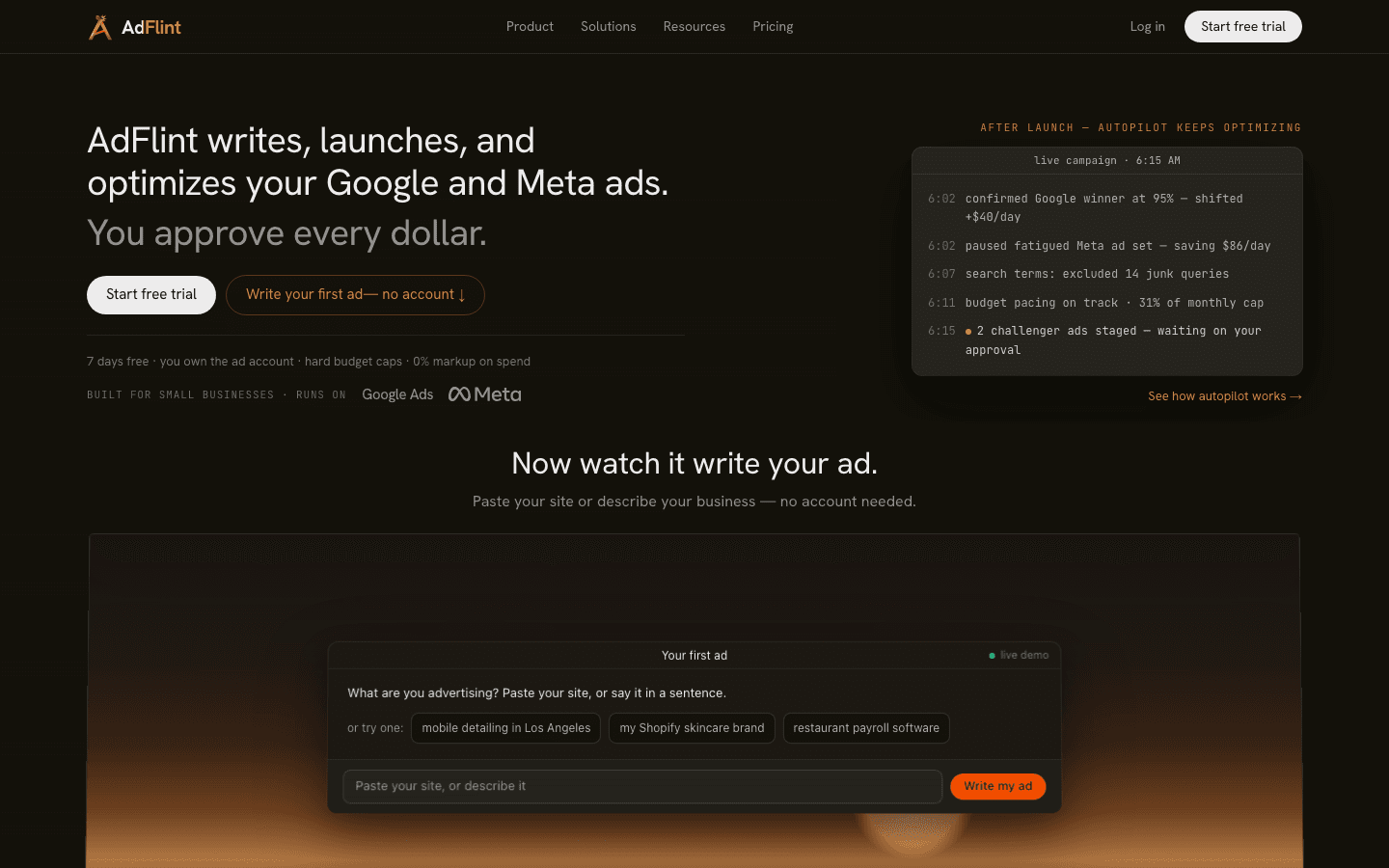
Best for practice owners who want the ads written and managed for themOur product — disclosureDisclosure first: AdFlint is our product and this page is on our site. We have ranked it first for one specific buyer — the practice owner or office manager with no PPC background who wants the ads created, launched, and optimized rather than a dashboard full of suggestions — because among the tools on this page, it is the only one built for that person. If that is not you, Optmyzr or the free native stack below is the better answer, and we say so in those entries.
The model matters more than the features for a medical buyer. AdFlint works inside ad accounts you own: you connect your own Google Ads and Meta accounts with one-click OAuth, your card pays Google and Meta directly, and if you cancel, everything — the account, the history, the conversion data — stays yours. The AI writes the campaigns, but nothing goes live without your approval, and hard budget caps are enforced in software. For a practice, that approval gate is quietly a compliance feature: you review every headline before it runs, which is your chance to keep treatment claims, guarantees, and before/after language out of your ads — the categories that trigger Google's healthcare policy reviews. Self-serve pricing is a flat monthly fee with zero percentage of spend, which at medical CPCs is not a small distinction: an agency charging 15% of a $4,000 monthly budget costs $600 every month forever.
Now the honest limits, and for this vertical they are real. We have never run campaigns for a medical practice — or any healthcare business — so our vertical guidance is policy research, not experience; you are reading it on this page, not buying it inside the product. AdFlint has no BAA and no HIPAA-specific tracking features: the safe-tracking configuration in the FAQ below is your responsibility regardless of which tool you choose, ours included. Coverage is Google and Meta only, which excludes Microsoft Ads and its older, Medicare-heavy search demographic. And we are a young product with no third-party review footprint — there is no G2 or Capterra page to check us against, so judge the live demo on our homepage instead: it wrote, graded, and rewrote an ad in about 22 seconds from the prompt 'mobile detailing in Los Angeles,' producing a Google search ad and a Meta feed preview across four self-graded drafts. Note the example — a detailing shop, not a dermatology clinic — because we would rather show you exactly what we have than imply experience we do not.
Pros
- + AI writes, launches, and optimizes campaigns instead of handing you a to-do list — built for owners without PPC skills
- + Runs inside your own ad accounts: you keep the account, the data, and the direct billing relationship with Google and Meta
- + Human approval required on every ad before launch — which doubles as your checkpoint for health-claim compliance — plus hard budget caps
- + Flat fee priced by ad-spend tier with no percentage of spend on self-serve, starting at $40 per month; 7-day free trial
- + Low-budget economics agencies cannot match: at $500-$2,000 per month in ad spend, the software fee is $40-$89
Cons
- − We have never run campaigns for a medical practice — or in any vertical; our healthcare guidance is policy research, not client history
- − No BAA and no HIPAA-specific tracking features — the compliant tracking configuration is on you, same as every tool here
- − Google and Meta only: no Microsoft Ads, where older Medicare-age patients still search
- − Young product from the company publishing this list, with no independent G2 or Capterra reviews to verify us against
Ideal for
- Independent practices spending $100 to $10,000 per month who want ads handled, not another dashboard to learn
- Owners and office managers with no time to learn Ads Manager but a hard requirement to approve what runs
- Practices burned by percentage-of-spend agency retainers
Pricing: Our own pricing, checked August 3, 2026: self-serve ladder by monthly ad spend — Launch $40/mo (up to $1,000 ad spend), Growth $89 ($2,500), Scale $109 ($5,000), Accelerate $119 ($10,000), Performance $219 ($20,000), Premium $319 ($30,000), custom above. Managed done-for-you starts at $249/mo plus a share of managed spend. Entry point is a 7-day free trial; self-serve carries no percentage of spend — your card pays Google and Meta directly.
Try AdFlint freeOptmyzr
Best full toolkit if someone at the practice will actually drive itOptmyzr is the tool we would hand to a practice manager, in-house marketer, or part-time consultant who is willing to be the strategist — it audits, monitors, and suggests with real depth, but a human steers. We ran a full trial July 30-31 and August 3, 2026. Getting in requires five mandatory qualification fields and then a phone number verified by SMS — no credit card, but no anonymous poking around either (and its own /free-trial/ URL 404s; enter through the main site). The five-step onboarding wizard is genuinely good: step two makes you pick exactly three of ten goals, step three offers three working modes including an MCP connector that lets Claude or ChatGPT operate Optmyzr, and step four generated an accurate business profile from just our URL in about ten seconds.
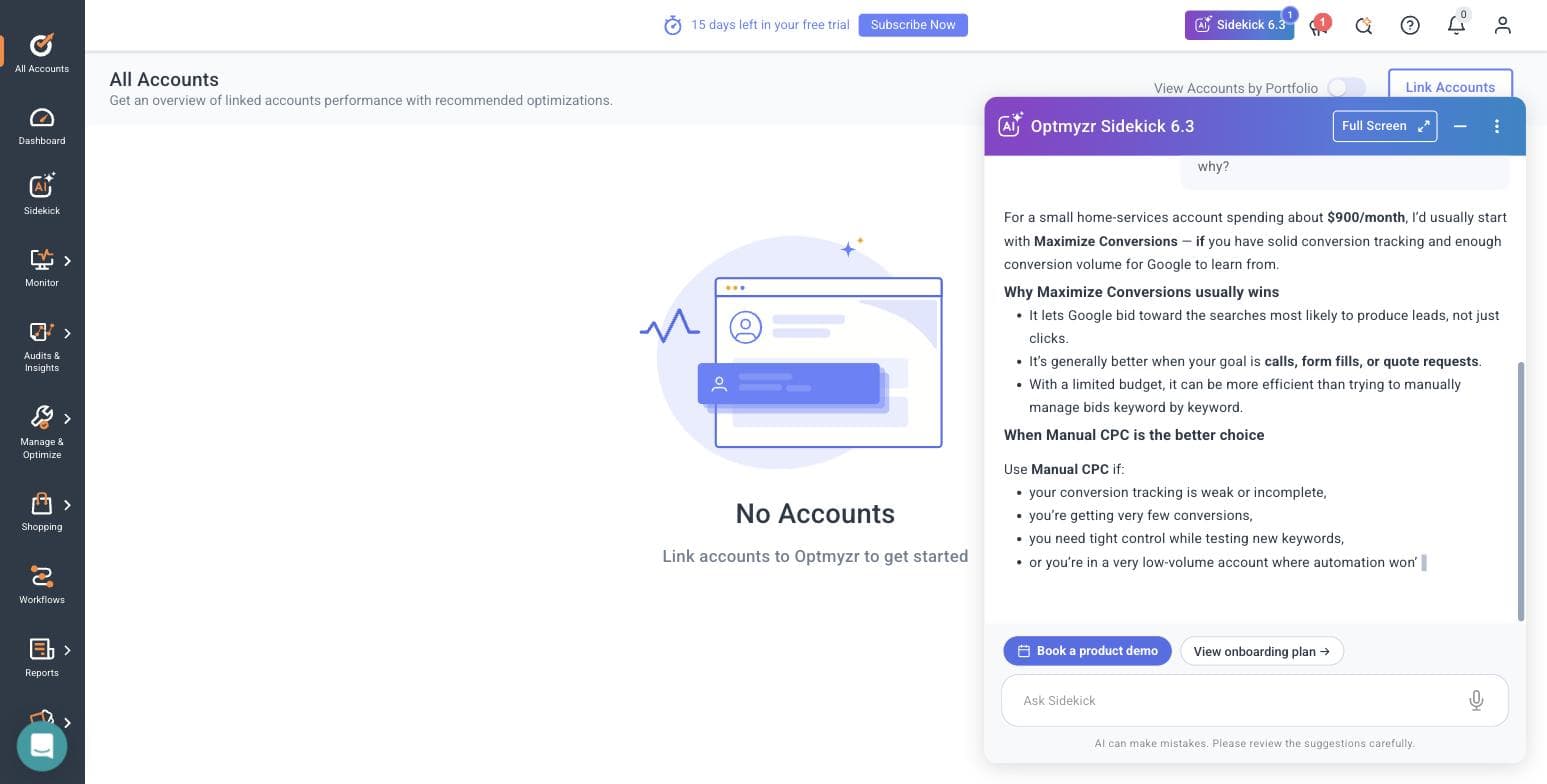
The most medically relevant thing we saw was an answer, not a feature. We asked Sidekick (v6.3) whether to use Maximize Conversions or Manual CPC — the exact dilemma of a low-volume practice account — and with no ad account even connected it answered correctly: fix clean conversion tracking first, run Maximize Conversions on core lead campaigns, keep Manual CPC as the fallback at low volume, and use roughly 3-5 conversions per week as the threshold where smart bidding has enough data to learn. Sit with that number, because it is the quiet verdict on half the automation features sold to this vertical: a practice booking 10-15 appointment requests a month is under that line, and no tool's AI bidding fixes it — only better tracking and consolidation do. Beyond Sidekick, the modules a practice would actually use are Account Health & Audits, Search Term Analysis (the highest-leverage report in medical PPC — it is where you find the informational symptom searches like recovery-time and cost-research queries that click but never book), KPI Tracking & Alerts, and the budget scripts under Monitor, which matter in a vertical where Q4 deductible-season demand should not be funded by a flat January budget.
Honest limits from inside the trial: every tool that would touch a campaign bounced us back to the All Accounts screen until a live ad account is connected — you can explore the full app unconnected (rare and welcome), but you cannot rehearse changes. The in-product banner said 15 days of trial while the marketing site says 14 — trivial, but sloppy. Its in-product spend brackets start at 'Under $10,000/mo,' so an independent practice at $1,000-$5,000 is at the very bottom of who this product is built for, paying $299 a month month-to-month for a toolkit whose depth it may never use. There are no healthcare-specific features. One detail worth knowing if a consultant shares your Google Ads access: the optional MCC-link dialog makes you type CONNECT to proceed and warns that Google automatically emails everyone with account access — Optmyzr itself flags this as not recommended without explicit client approval, which is the kind of candor we wish more vendors had.
Pros
- + Deepest audit and monitoring toolkit on this list: Account Health & Audits, Search Term Analysis, PPC Investigator, KPI alerts, budget scripts
- + Sidekick gave a correct, appropriately cautious answer to a real low-volume bidding question in our trial — before any account was connected
- + Full app explorable with no ad account connected, and an MCP connector lets Claude or ChatGPT drive it
- + Covers Google, Microsoft, Amazon, Meta, LinkedIn and more (11 integrations) — the only tool here reaching Microsoft Ads' older search demographic
- + No credit card required for the trial
Cons
- − $299 per month month-to-month ($209 billed annually), and its in-product spend brackets start at 'Under $10,000/mo' — an independent practice is the smallest fish in its pond
- − It optimizes what a skilled human tells it to; without someone owning the strategy, you are paying for reports nobody reads
- − No healthcare-specific features, policy checks, or HIPAA tooling
- − Signup requires phone and SMS verification, and every campaign-touching tool is inert until a live account is connected — no sandbox to rehearse in
Ideal for
- Practices with an office manager, in-house marketer, or fractional consultant who will log in weekly
- Multi-location groups spending $5,000+ per month across Google and Microsoft
- Anyone who wants audit-grade visibility before deciding whether to hire help
Pricing: Optmyzr's published entry plan, checked August 3, 2026: $299/mo billed monthly, or $209/mo billed annually — the widely quoted $209 is the annual-prepay rate, so budget $299 if you want to leave whenever. Pricing then scales by ad spend; the in-product brackets we saw run from 'Under $10,000/mo' to '$500,000+'. Free trial — the in-app banner said 15 days while the marketing site says 14. No credit card required; a phone number verified by SMS is.
Visit OptmyzrGoogle Ads Editor + native Ads Manager
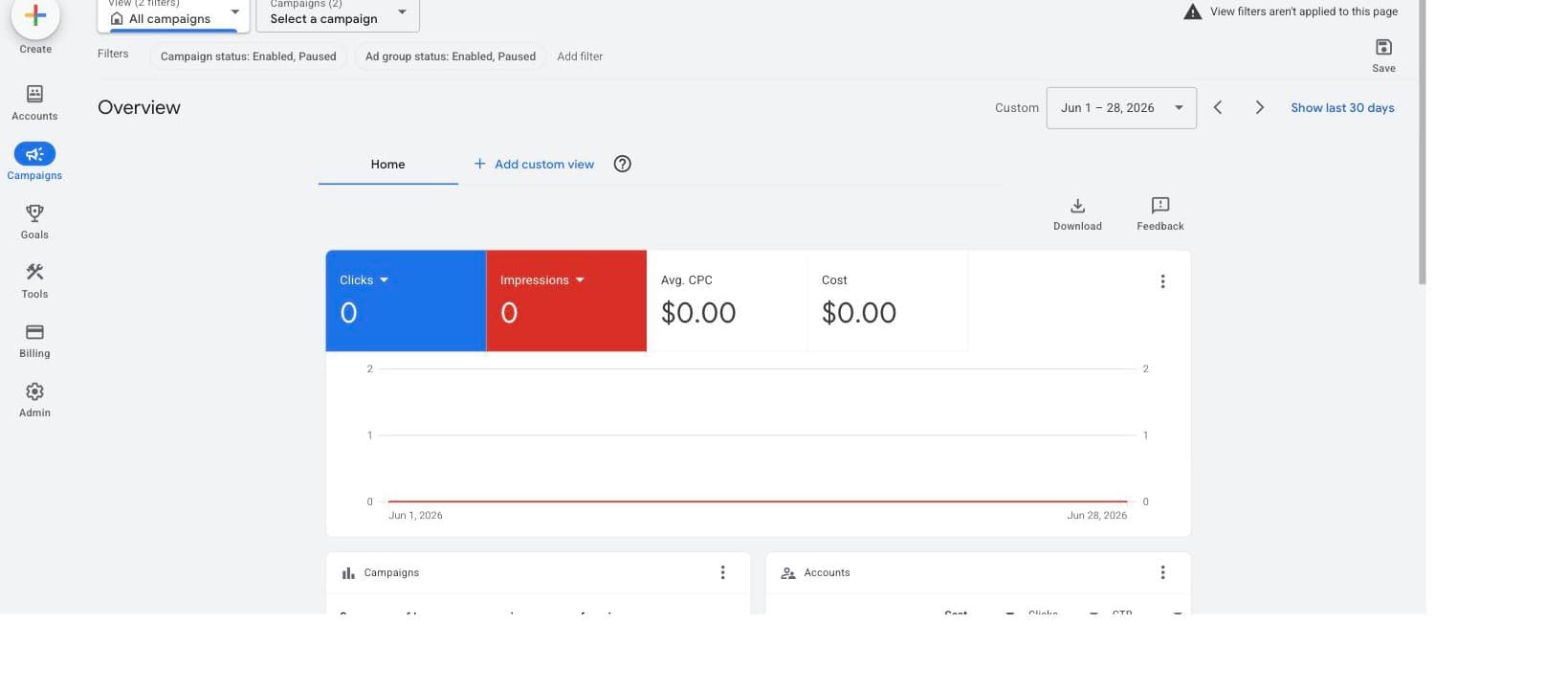
Best free baseline — and the compliance-safest place to startBefore paying for anything, know what free looks like, because for a practice spending under about $1,000 a month it is usually the right answer. Google Ads Editor is a free desktop app for building and bulk-editing campaigns offline; the native Google Ads and Meta Ads Manager interfaces handle everything else, including the two capabilities that matter most for a phone-first business: Google call assets with forwarding-number call reporting, and native conversion tracking you configure yourself. The screenshot below is the native Google Ads overview from our own account — an empty one, with zero spend, which we show deliberately rather than dressing up a stock image as evidence.
Here is the argument for the native stack that is specific to medical: the settings that matter most for a practice are compliance settings, and only you can set them — no third-party tool on this list sets them for you, and several actively pull the other way. In the native interfaces you directly control turning enhanced conversions and advanced matching off (they send hashed emails and phone numbers, which for a medical service is patient-identifying data — see the FAQ), declining remarketing audiences that Google's health personalization policy prohibits anyway, and keeping tags off patient-portal and intake pages. Owning those switches yourself, at least once, is the best compliance education available, and it costs nothing.
The honest cons: it is entirely manual, there is no cross-platform view, and the native 'recommendations' need discipline to resist — auto-apply will push broad match and Performance Max, which for a practice means budget bleeding into informational symptom searches ('how long does knee replacement recovery take') that never book an appointment. Turn auto-apply recommendations off, check the search-terms report weekly, and treat every native suggestion as a salesperson's suggestion. The moment that weekly discipline stops happening is the moment to move up this list — most practices that quietly waste ad budget are not using bad software; they are using no process.
Pros
- + Free — at sub-$1,000 monthly spend, every paid tool on this page struggles to earn back its fee
- + Direct control of the compliance switches that matter for medical: enhanced conversions, advanced matching, audience lists, tag placement
- + Call assets and forwarding-number call reporting cover the phone-first conversion path natively
- + Ads Editor makes bulk edits and campaign duplication across locations fast once you learn it
Cons
- − Entirely manual: no alerts, no cross-platform view, no one watching pacing during a Q4 deductible-season surge
- − Native recommendations and auto-apply push broad match and Performance Max, which bleed medical budgets into informational symptom searches
- − The learning curve is real, and the interfaces are built to serve Google's and Meta's revenue, not your discipline
- − No support beyond documentation and platform reps whose job is to increase your spend
Ideal for
- Practices spending under $1,000 per month on ads
- Anyone launching their first campaign and wanting to understand the machine before automating it
- Practices that want to own every compliance setting directly
Pricing: Free. Google Ads Editor is a free download; Google Ads and Meta Ads Manager are free to use — you pay only for ad spend. (Checked August 3, 2026.)
Visit Google Ads Editor + native Ads ManagerBirch (formerly Revealbot)
Best rule-based automation for Meta-led practices — with a health-category caveatBirch is the automated-rules engine formerly called Revealbot, and we ran its trial alongside Optmyzr's in late July and early August 2026. Practical note first: revealbot.com and bir.ch/signup both 404 after the rebrand — the working signup is app.bir.ch/signup. From there it was under two minutes to a logged-in screen with no phone number and no card, the fastest entry of anything we tested. The product is now three things: the rules engine (pause, scale, duplicate, notify based on conditions you write), Stage (a planning Google Sheet plus Drive folders that turn into bulk ads for Meta, TikTok, and Snapchat, using read-only Drive access), and Hub (server-side first-party tracking built on Signals Gateway).
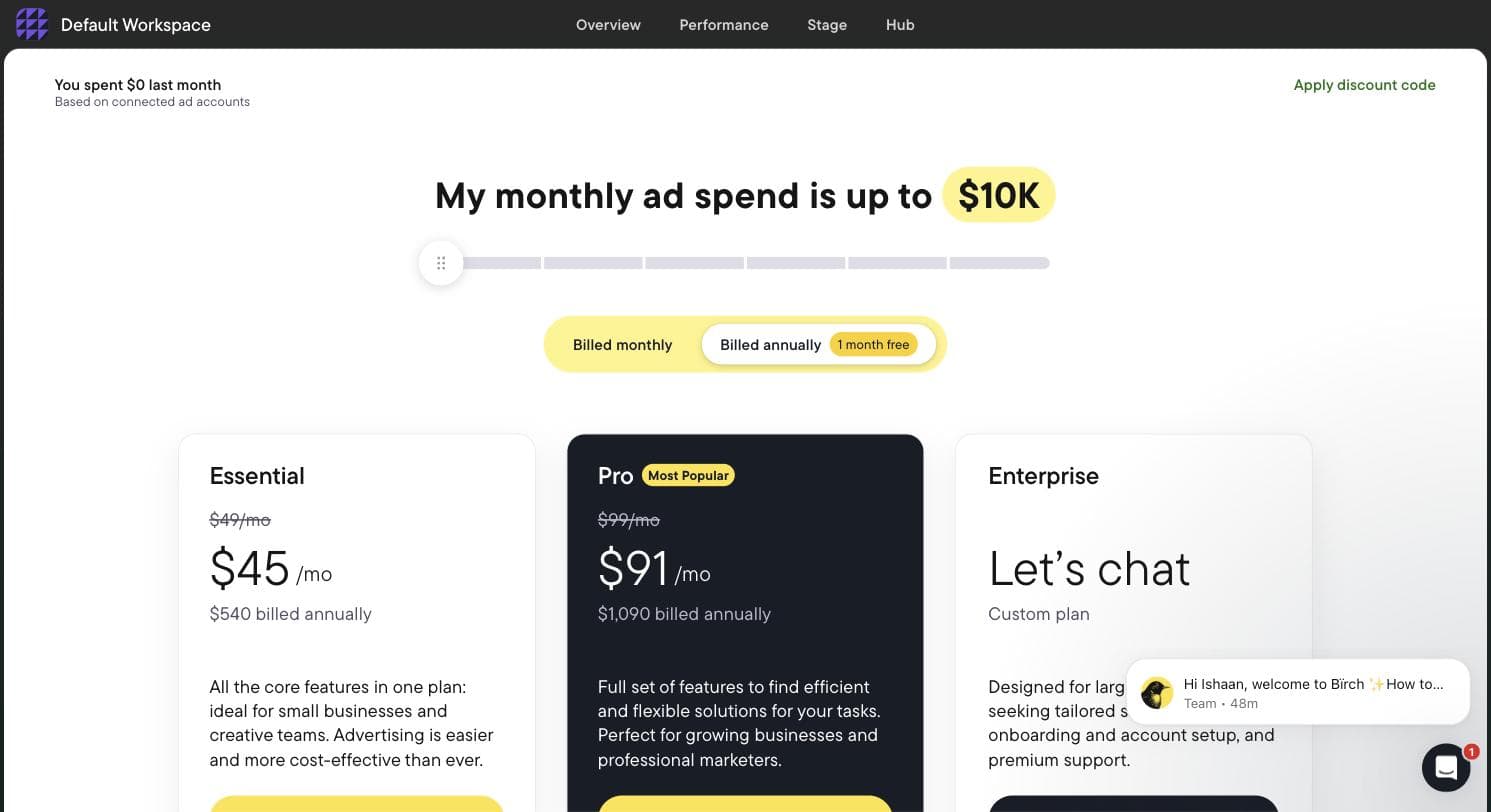
For a medical practice the caveat arrives before the value does. Birch gates everything behind connecting a live ad account — no sandbox, no demo data; the rule builder itself was inaccessible in our trial, with an empty state showing three action types (increase bid, duplicate, notify). And the deeper problem is what a practice's rules would key on: since January 2025, Meta restricts ad accounts it categorizes under health and wellness from optimizing on lower-funnel events — so the canonical Birch play, 'pause any ad whose cost per appointment-request exceeds $150,' depends on a conversion event that may be restricted in your account's category. Check what Meta's Events Manager shows for your account before paying for a rules engine to automate against it. Note also that automated rules are not in the $49 Essential plan — they require Pro at $99 per month, along with Stage and the Sheets integration.
Where Birch does fit: a practice whose growth channel is genuinely Meta — cash-pay, appointment-heavy, running always-on local campaigns — and whose upper-funnel events (landing-page views, link clicks, calls initiated from the site) remain trackable. Rules on spend pacing, frequency, and creative fatigue work regardless of event restrictions, and the Slack and Google Sheets integrations make a weekly owner's report automatic. On Hub: server-side tracking sounds like a HIPAA fix, and it is not — it routes the same data through infrastructure you control on its way to Meta, which helps you filter payloads but does not create compliance, and Meta signs no BAA. Treat Hub as an engineering convenience, not a legal answer; the checklist in the FAQ applies either way. Integrations are Meta, Google Ads and Google Drive, Snapchat, TikTok, YouTube, Google Analytics, Google Sheets, Slack, AppsFlyer, Adjust (beta), Hyros, and Wicked Reports — notably no Microsoft, no LinkedIn, no Amazon.
Pros
- + Fastest signup we tested: under two minutes, no phone, no card
- + Rules engine automates the tedious parts — pacing, fatigue, pause thresholds — around the clock
- + Stage turns a planning spreadsheet into bulk ads, useful for multi-location creative variants
- + Slack and Google Sheets integrations make automated owner-facing reports trivial
Cons
- − Everything is gated behind connecting a live ad account — no sandbox or demo data, so you cannot evaluate the rule builder before wiring in a real account
- − Meta's January 2025 health-category restrictions can strip the lower-funnel events a practice's rules would key on
- − Automated rules require the $99/mo Pro plan, not the $49 Essential tier — and on trial expiry, rules and reports are disabled
- − No Microsoft Ads, no LinkedIn, no Amazon; it also supplies no judgment or creative — you write the strategy it executes
Ideal for
- Practices whose proven growth channel is Meta (cash-pay and elective-service practices especially)
- Owners comfortable writing if-this-then-that logic against their own metrics
- Multi-location groups pushing weekly creative variants through Stage
Pricing: Read off Birch's own in-app billing slider, August 2026: at ≤$10K/mo ad spend, Essential $49/mo, Pro $99/mo (annual $540 / $1,090); ≤$30K — Essential $149, Pro $249 (annual $1,640 / $2,740); ≤$75K — Essential $299, Pro $499 (annual $3,290 / $5,490); ≤$150K — Essential $499, Pro $799 (annual $5,490 / $8,790); ≤$300K — Essential not offered, Pro $1,299 (annual $14,290); $500K+ — Enterprise only. Automated rules, Explorer, Launcher, Stage, custom audiences, and the Sheets/AppsFlyer/Hyros integrations are Pro-only. Overages billed via Stripe; annual pricing is 12 months for the price of 11. 14-day trial; on expiry, rules and reports are disabled.
Visit Birch (formerly Revealbot)Marketing 360
Closest to hiring an agency without calling it oneWe have not tested Marketing 360 hands-on — this entry is researched from Madwire's own site and documentation, checked August 3, 2026 — and it earns a place here because it is what a lot of searchers for this query actually want without knowing the word for it: a done-with-you service wearing a software interface. Marketing 360 bundles a marketing platform (site, CRM, reputation management, ads) with an assigned marketing team that does the work, and its own site maintains a dedicated healthcare vertical with practice-focused positioning. If your real requirement is 'someone else runs this and I look at a dashboard,' this is that — closer to an agency engagement than to any self-serve tool above.
Judge it accordingly. Pricing is not published anywhere on its site — plans are quote-based, bundling software and fulfillment, with ad spend billed on top — so you cannot comparison-shop it the way you can every other entry here; you can only take a sales call. And because you are buying people rather than software, the classic agency questions apply with full force: who owns the ad account, what happens to campaigns and data if you leave, what the contract term is, and how much of your monthly fee reaches the ad platforms versus the fulfillment team. Read current customer reviews and the contract terms before committing — the same diligence you would apply to any agency retainer, because functionally that is what this is. We have not run this diligence for you; we have not been a customer.
The comparison that matters for this page: against self-serve software, Marketing 360's advantage is that the work genuinely gets done without you; its disadvantages are opaque pricing, service-business economics, and less of the direct control that medical compliance rewards — with a service vendor, the tracking configuration on your site is still your legal exposure, but someone else's hands are on it. If you are choosing between Marketing 360 and hiring a healthcare-specialist agency, get quotes from both — they are the same species of purchase.
Pros
- + An assigned team does the work — the only entry here that fully removes the owner from execution
- + Its site advertises a dedicated healthcare vertical with practice-focused onboarding
- + Consolidates website, CRM, reputation, and ads under one vendor for practices that want one throat to choke
Cons
- − We have not tested it — and no published pricing exists to verify; plans are quote-based via a sales call
- − You are buying a service, not operating software — agency-style questions about account ownership, contract terms, and fee-versus-spend split all apply
- − Overkill if PPC is the only need; the bundle is the product
- − Less direct control of compliance-sensitive settings than any self-serve option above, while the legal exposure stays with the practice
Ideal for
- Practices that have already decided against self-serve and want execution handled
- Owners who want website, CRM, reputation, and ads consolidated with one vendor
- Practices comparing this against traditional healthcare-agency retainers
Pricing: Not published. Madwire's site (checked August 3, 2026) lists no prices; plans are quote-based, bundling platform software and a fulfillment team, with ad spend billed separately on top. Get the quote in writing alongside at least one healthcare-agency quote for comparison.
Visit Marketing 360WordStream (by LOCALiQ)
Best free audit before you spend anythingWe have not tested WordStream hands-on — researched entry, vendor site checked August 3, 2026 — and it appears here with an important correction to what most roundups still say: WordStream is no longer software you can buy. The WordStream Advisor subscription product that older lists still recommend has been retired; today the brand offers free tools — most usefully the Google Ads Performance Grader and its Facebook counterpart — and functions as the content and lead-generation arm of LOCALiQ, whose managed advertising services are the actual product being sold. Any page ranking 'WordStream' as purchasable PPC software in 2026 has not checked.
Used for what it now is, it earns its slot: the free grader is a genuinely useful first move for a practice that already has a running Google Ads account and suspects waste. It scores the account against benchmarks and surfaces the classics — no negative keywords, everything in one campaign, mobile bids never reviewed — in a few minutes, for nothing. For a practice owner deciding between 'keep DIY,' 'buy software,' or 'hire help,' running the grader before this page's paid options is simply correct sequencing: it tells you how much room for improvement exists, which is the number that determines whether $99-$299 a month of software can pay for itself.
Go in knowing the funnel: the grader's report naturally concludes that professional management would help, and the professional management on offer is LOCALiQ's quote-based service. That is not a scandal — free tools fund themselves somehow — but it means the output reads like a diagnosis from someone selling the cure. Take the findings, discount the prescription, and decide with this page open. One medical-specific caveat we would apply to any grader output: its benchmarks are cross-industry, so a cost per conversion that looks alarming next to a retail average may be entirely normal for a practice competing on procedure keywords.
Pros
- + The free Google Ads Performance Grader is a fast audit of an existing account, at no cost
- + Costs nothing and requires no commitment beyond OAuth access to read your account
- + Correct first step in sequencing: measure the waste before paying anyone to fix it
Cons
- − We have not tested it hands-on — and there is no software product left to test: WordStream Advisor is retired
- − The grader is a snapshot, not management — nothing changes in your account unless you change it
- − The whole experience funnels toward LOCALiQ's quote-based managed services, so the audit's conclusions skew toward 'hire us'
- − No healthcare-specific analysis in the grading, and cross-industry benchmarks can misread normal medical costs as waste
Ideal for
- Practices with an existing Google Ads account and a suspicion that budget is leaking
- Owners who want an independent-ish data point before choosing software or an agency
- Anyone still seeing WordStream recommended as software by older roundups
Pricing: Free graders and tools. The former WordStream Advisor software subscription is discontinued; LOCALiQ managed advertising services are quote-based with no published pricing (vendor site checked August 3, 2026).
Visit WordStream (by LOCALiQ)Side by side.
| Tool | Hands-on tested? | Best for | Price (checked Aug 2026) | Platforms | Medical-practice fit |
|---|---|---|---|---|---|
| AdFlint (our product) | Our product — never run for a medical practice, or any vertical, stated plainly | Owners who want ads written, launched, and managed with approval on everything | $40-$319/mo flat by ad-spend tier; 7-day trial; no % of spend on self-serve | Google, Meta | Approval gate doubles as a health-claim checkpoint; hard budget caps; no BAA — safe tracking config is on you |
| Optmyzr | Yes — trial July 30-31 + Aug 3, 2026 | A practice manager or consultant who will drive optimization weekly | $299/mo monthly, $209/mo billed annually; 14-15 day trial, no card | Google, Microsoft, Amazon, Meta, LinkedIn, Yahoo Japan (11 integrations) | Search Term Analysis catches symptom-research queries; Sidekick's 3-5 conversions/week rule matches practice reality; no health-specific features |
| Google Ads Editor + native managers | No campaigns run — our own account is empty, $0 spend (see screenshot) | Doing it yourself at under ~$1,000/mo spend | Free | Google, Meta (native) | Only route with direct control of every compliance switch: enhanced conversions, matching, audiences, tag placement |
| Birch (ex-Revealbot) | Yes — trial July 30-31 + Aug 3, 2026 | Rule automation for Meta-led, cash-pay practices | Rules require Pro: $99/mo at ≤$10K spend ($49 Essential excludes them) | Meta, Google, TikTok, Snapchat, YouTube + 7 more (12 integrations); no Microsoft/LinkedIn/Amazon | Meta's Jan 2025 health-category limits can strip the events rules key on — check Events Manager before buying |
| Marketing 360 | No — researched from vendor site | Done-with-you team wearing a software interface | Not published; quote-based bundle + ad spend on top | Multi-channel via assigned team | Healthcare vertical advertised; agency-style diligence on ownership and contract terms required |
| WordStream (LOCALiQ) | No — researched from vendor site | Free audit of an existing account before buying anything | Free graders; managed services quote-based; Advisor software retired | Google, Meta, Microsoft (graders only) | Good sequencing step; cross-industry benchmarks and findings that skew toward hiring LOCALiQ |
How we chose.
We created real trial accounts and worked inside exactly two third-party products — Optmyzr and Birch — on July 30-31, 2026 and again on August 3, 2026. That included the full signup flows (Optmyzr's phone-plus-SMS verification wall, Birch's under-two-minute signup), the onboarding wizards, every module we could open, and Birch's pricing read directly off its in-app billing slider at every spend tier.
We put a real question to Optmyzr's Sidekick assistant — Maximize Conversions versus Manual CPC — because it is precisely the decision a low-volume medical account faces, and we report its answer in that entry.
Marketing 360 and WordStream (LOCALiQ) were not tested hands-on. Those entries rely on the vendors' own websites and documentation, checked August 3, 2026, and are labeled as researched in the entry, the comparison table, and the cons.
The native Google Ads and Meta interfaces are the tools behind our own accounts, and the Google Ads screenshot on this page is one of them — empty, with $0 lifetime spend. We have not run live campaigns through it, and we say so on the image itself rather than passing an empty dashboard off as a track record.
We have never run ad campaigns for a medical practice, or in any other vertical, and we have not pushed sustained live ad spend through any tool on this list. Nothing on this page is a performance claim or a client result. The healthcare-specific guidance comes from HHS OCR bulletins, FTC enforcement actions, and Google's and Meta's published advertising policies.
AdFlint is our product. We rank it for the buyer it genuinely fits, and we wrote its cons list first — including the fact that our healthcare knowledge is policy research, not client history.
All prices were checked on August 3, 2026 against vendor pricing pages, in-app billing screens, or — where a vendor publishes no numbers (Marketing 360, LOCALiQ services) — we say that instead of guessing. No affiliate links anywhere on this page, and no vendor paid for placement or saw this ranking before publication.
- — Built for the person actually at the keyboard: a practice owner or office manager running their own campaigns — not an agency seat, which is who most PPC software is priced and designed for.
- — Health-policy stress test: for every tool we asked what survives Google's prohibition on health-condition personalized ads and Meta's January 2025 restrictions on health-categorized ad accounts. Features a practice cannot legally or practically use scored zero, whatever the demo shows.
- — Priced against real practice budgets: most independent practices this page serves spend $500-$5,000 per month. A tool's fee has to be recoverable from waste it eliminates at that scale, not at an agency's $100K under management.
- — Compliance surface: what patient-adjacent data does the tool move, and does anyone sign a BAA for ad data? (Answer across the board: no — which is itself a finding, and why the tracking checklist matters more than any feature.)
- — Account ownership and exit: what you keep when you cancel — the ad account, the conversion history, the creative — and whether leaving the tool means starting over.
- — Hands-on evidence over marketing pages: Optmyzr and Birch were judged from inside real trial accounts on July 30-31 and August 3, 2026; Marketing 360 and WordStream from their own published materials, and each entry says which.
Common questions.
Is it legal to put the Meta Pixel or Google tag on my practice's website?
It is legal territory, not a marketing setting — treat it that way. HHS's Office for Civil Rights warned in a December 2022 bulletin (updated March 2024) that tracking technologies on patient-facing pages can transmit protected health information; a federal court narrowed that guidance for unauthenticated public pages in June 2024, but the private lawsuits it fueled have continued, and The Markup's 2022 investigation that found the Meta Pixel on roughly a third of top US hospital websites is still generating settlements. Separately, the FTC has enforced against health businesses over ad-tracking data — GoodRx ($1.5M, Health Breach Notification Rule) and BetterHelp ($7.8M) both in 2023 — and state laws like Washington's My Health My Data Act create private rights of action that reach businesses HIPAA does not. The practical position: a default pixel installation on a practice site is an unforced risk. Use the checklist in the next answer, and have counsel review it — this page is research, not legal advice, and we are an ad-software company, not your lawyer.
What does a HIPAA-safe conversion tracking setup for ads actually look like?
Seven steps, in order. (1) Track the appointment request, not the condition: fire conversions on a generic thank-you page for form submissions and on call events — never on visits to condition or treatment pages. (2) Scrub URLs and event names: no condition terms in the pages where tags fire or in the conversion labels sent to ad platforms. (3) Turn OFF Google enhanced conversions and Meta advanced matching unless counsel approves them — both send hashed emails and phone numbers, and an identifier tied to a medical service is exactly the combination regulators flagged. (4) Keep all tags off authenticated and clinical pages: patient portal, intake forms, telehealth, payment. (5) Skip remarketing entirely — Google's personalized-ads policy prohibits health-condition remarketing anyway, and a visitor list from a practice website is a de facto patient-adjacent registry. (6) If you record calls for lead tracking, use a call-tracking vendor that signs a BAA, because callers name symptoms in the first sentence; note that Google and Meta sign no BAA for their ad platforms. (7) Document the review: who approved the configuration and when — the paper trail is half the protection. None of the tools on this page, ours included, does these steps for you.
Can my practice use remarketing or lookalike audiences?
Mostly no, and the tools that lean on them are the wrong tools for you. Google's personalized advertising policy prohibits remarketing based on health conditions — in practice, retargeting your website visitors is off the table for a medical practice. Meta removed detailed health-interest targeting options in 2022, and since January 2025 it restricts ad accounts categorized under health and wellness from lower-funnel event optimization, which also degrades lookalike quality. What still works: geographic radius targeting around your locations, age and gender where relevant, search intent on Google (the person typing 'pediatrician accepting new patients' needs no retargeting), and broad targeting on Meta with strong creative. Evaluate every tool on this page against that reality — a rules engine or 'AI audience' feature built on events and audiences you cannot use is shelf-ware for this vertical.
What should a medical practice count as a conversion?
A new-patient appointment request — a completed request form or a call over a minimum duration — and almost nothing else. Not pageviews, not 'engagement,' not directions clicks. Then run your own arithmetic, because it decides everything downstream. These are illustrative numbers, not our campaign results — we have not run medical campaigns in any specialty: at a $5 cost per click and a 4% landing-page conversion rate, an appointment request costs $125; at a 60% show rate, a kept new-patient appointment costs about $208. Use your own CPC, not that $5 — competitive specialties bid far above it, and a practice competing on procedure keywords will see a very different number than one advertising routine primary care. Whether the result is excellent or terrible depends entirely on specialty economics: against the multi-year revenue of a retained primary-care family it is very good; against a single low-margin visit it is not. Two implications for software choice: with 10-15 conversions a month you are below the roughly 3-5-per-week threshold where automated bidding learns reliably (Optmyzr's Sidekick volunteered that same rule in our trial), so consolidate campaigns rather than fragmenting them; and because most requests arrive by phone, call tracking is not optional — see the BAA note in the checklist above.
Do I need LegitScript certification to run ads for my practice?
Most practices, no. Google requires certification (via LegitScript) for specific categories: pharmacies, telehealth providers that prescribe, and addiction-treatment providers, among others — and it bans some categories outright regardless of certification, notably speculative or experimental treatments such as stem-cell therapies. A standard medical, dental, or specialty practice advertising appointments for conventional care does not need LegitScript for ordinary search campaigns. Where practices get tripped up is language, not licensure: superlative cure claims, guarantees, and before/after imagery draw policy disapprovals on both platforms. If your ads mention prescription drugs by name, or you operate in addiction treatment or telehealth prescribing, budget real lead time for certification before any software choice matters — and confirm current requirements on Google's own policy pages, which change more often than roundups like this one do.
When are CPCs and demand highest for medical practices?
The calendar for this vertical is insurance-driven, and it is a real software-selection criterion because flat monthly budgets waste it. Q4 is deductible season: patients who have met their deductible accelerate elective and procedure care before January 1, so procedure-heavy specialties should expect their strongest and most contested quarter. January brings insurance churn — plan changes turn into 'doctor near me, accepts [plan]' searches — and new-year health resolutions. Medicare's annual enrollment period (October 15 to December 7) concentrates 65+ search behavior, a demographic that disproportionately uses Microsoft's search network, which only Optmyzr among these tools reaches. Respiratory season drives urgent-care and primary-care volume from late fall; spring drives allergy-related searches. The software implication: whatever you use must make scheduled budget changes easy — Optmyzr's budget scripts, Birch's scheduled rules, AdFlint's pacing, or a recurring calendar reminder if you run the free native stack. A budget set in July and untouched through December funds your competitors' best quarter.
Should a practice buy software or hire a healthcare marketing agency?
Draw the line with three numbers: monthly ad spend, hours available, and the fee math. Published rates we have collected across this site put full agency retainers at roughly $2,000-$10,000 a month and freelance or small-shop retainers at $500-$3,000, with 10-20% of spend a common alternative structure. Under about $2,000 a month in ad spend, that retainer costs as much as the media itself, so self-serve software (or the free native stack) wins almost automatically. From $2,000 to $10,000 is the genuine gray zone: software plus two to four owner-or-manager hours a week usually beats a junior agency seat, but only if those hours actually happen — the honest question is not 'can we,' it is 'will we, every week, including December.' Above $10,000, specialist help competes well, and tools like Optmyzr are also what good consultants use, so hiring one does not waste this research. Two things no agency can absorb for you regardless: liability for your tracking configuration stays with the practice (you are the covered entity; your ad vendors are not), and account ownership should be non-negotiable in any engagement — if the agency owns the ad account, leaving them means starting your history from zero.
Do any of these tools make my ad tracking HIPAA-compliant?
No — and be suspicious of any vendor that implies otherwise. Compliance is a property of your configuration, your contracts, and your review process, not a feature you can buy on this page. Specifically: Google and Meta do not sign BAAs for their ad platforms; AdFlint (our product) has no BAA and no HIPAA-specific tracking features; Optmyzr optimizes whatever conversion data your account already collects; Birch's Hub routes events server-side, which improves your control over payloads but does not create compliance — the same data still reaches Meta. The division of labor is: the checklist in this FAQ (with counsel's sign-off) makes your tracking defensible; the software then works with the deliberately limited data that setup produces. Any tool that promises to restore the retargeting and granular tracking this vertical gave up is promising to reintroduce the risk, not remove it.
Keep reading
- Who Owns Your Ad Account, Pixel, and Audiences?
- Conversion Tracking Setup for Google and Meta
- Radius Targeting on Google and Meta, Compared
- DIY vs Agency vs AI: What Ad Management Costs
- Google or Meta Ads First? Decide by Budget
- Free tool: Ad Management Cost Calculator
- Free tool: Cost Per Acquisition Calculator
- Free tool: Ad Budget Calculator
- Free tool: Google vs Meta Budget Split Calculator
- Free tool: Landing Page Ad Readiness Checklist