Birch (Revealbot) Alternatives in 2026: 6 Options Actually Worth Considering
By the AdFlint research team · We built trial accounts on Birch (formerly Revealbot) and worked inside them ourselves; every screenshot below is from those sessions, and the rest is documentation and verified user reviews · Published July 28, 2026 · Updated July 30, 2026
TL;DR
- Revealbot now operates as Birch (bir.ch). Same rule-based automation product, restructured pricing: at the entry tier (ad spend up to $10K per month) Essential is $49 per month and Pro is $99 per month, and the price climbs with your spend - Essential is $499 per month at the $150K tier. Automated rules are a Pro feature, not an Essential one.
- Closest like-for-like replacement: Madgicx, if your spend lives on Meta. One plan, priced by spend bracket from $45 per month under $1,000 of monthly spend up to $329 per month in the $20K-$30K bracket.
- Smallest budgets have two honest paths: Meta's own automated rules are free with any ad account, and AdFlint (our product - disclosure) runs Google and Meta campaigns for a flat $40 to $89 per month with human approval on every ad and no percentage of spend.
- Google-first teams should look at Optmyzr (Essentials is $299 per month billed monthly, $209 per month billed annually); enterprise brand and agency teams at Smartly.io. AdEspresso still sells plans from $49 per month, but its blog has not published since January 2023.
If you searched for Revealbot alternatives and landed on a site called bir.ch, you did not mistype anything. Revealbot rebranded to Birch, and the product under the new name is the same thing media buyers have used for years: rule-based automation for Meta, Google, Snapchat and TikTok ads, plus bulk launching and reporting. What changed more visibly is pricing. Birch charges by the total monthly ad spend across every account you connect, in tiers that run $10K, $30K, $75K, $150K, $300K, $500K and above. At the $10K tier that is $49 per month for Essential and $99 per month for Pro; at the $150K tier Essential alone is $499 per month. Annual billing is cheaper and is marked on the pricing table as one month free (Essential $45 per month, $540 billed annually), and the trial is 14 days with no credit card.
People leave Birch, or decide against it, for a few recurring reasons. The spend-based tiers mean the software bill grows with your ad budget even when your workload does not, and exceeding your tier triggers an overage charge. Automated rules sit on the Pro plan, so the $49 entry price is not the price of the feature most people came for. The rule builder is powerful, but you are the one writing, testing and babysitting the rules - it automates execution, not judgment. And some advertisers, especially small businesses without a media buyer on staff, realize they never wanted a rule builder at all; they wanted the account managed.
This page covers six alternatives that actually compete with what Birch does: tools that create, automate or manage paid campaigns, not social schedulers or reporting dashboards. For each one we read the official pricing and product pages in July 2026, recorded the figures as displayed, and quoted real users from public review listings where we could reach and verify them. One entry is our own product, and it is labeled as such.
We got inside. Here is every screen.
We created real trial accounts, cleared the verification walls, and worked through the products. Every screenshot below is from those sessions — no vendor marketing imagery, no stock dashboards.
Birch (formerly Revealbot)
Walkthrough performed July 30, 2026Revealbot rebranded to Birch and moved to bir.ch. A lot of published roundups still send readers to revealbot.com, and the old /signup path 404s — the working signup is at app.bir.ch/signup.
We created an account, completed onboarding and worked through the product. The headline finding: Birch in 2026 is three products, not one. The automation tool everyone reviews is now sitting alongside a bulk creative launcher and a server-side tracking gateway, and it is priced against your ad spend.
- 01
Create the account
Email, a password of six or more characters, and your name — or one-click signup with Google. The page states a 14-day free trial, no credit card required, cancel anytime. A newsletter checkbox is present and unticked. No card was requested at any point, and no phone number either. Account creation to the connect screen took under two minutes.
- 02
Set up the company and declare your budget
Step two asks for company name, industry, monthly ad budget, and how you heard about them. Industry options are Agency, Services, Ecommerce, Mobile App, Lead Generation, and Other. The budget brackets run Below $10K, $10K-$30K, $30K-$75K, $75K-$150K, $150K-$300K, $300K-$500K, and Over $500K. As with Optmyzr, everything under ten thousand dollars a month is one undifferentiated bucket at the bottom — and it turns out that bracket is not just a survey question, it is the pricing.
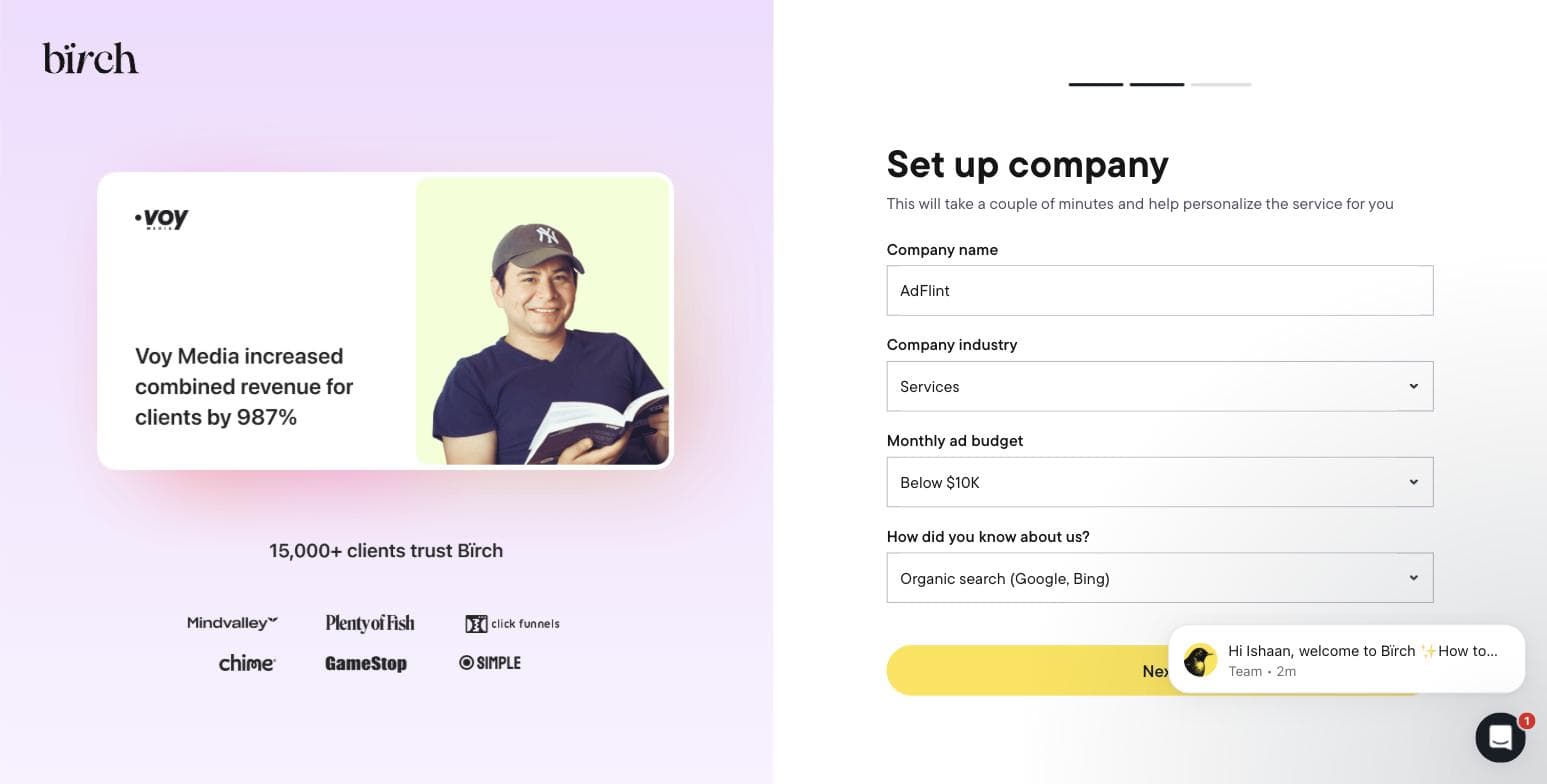
Step two of Birch's onboarding, captured during our own signup on 30 July 2026. - 03
Connect an ad platform — or don't, and see what breaks
Step three asks you to connect Meta Ads, TikTok, Google Ads, or Snapchat before you reach the product. Meta is presented first and most prominently, matching Birch's heritage. We skipped it deliberately, to find out how much of the product survives without granting a third party access to a live ad account. The answer is: the shell, but not the substance.
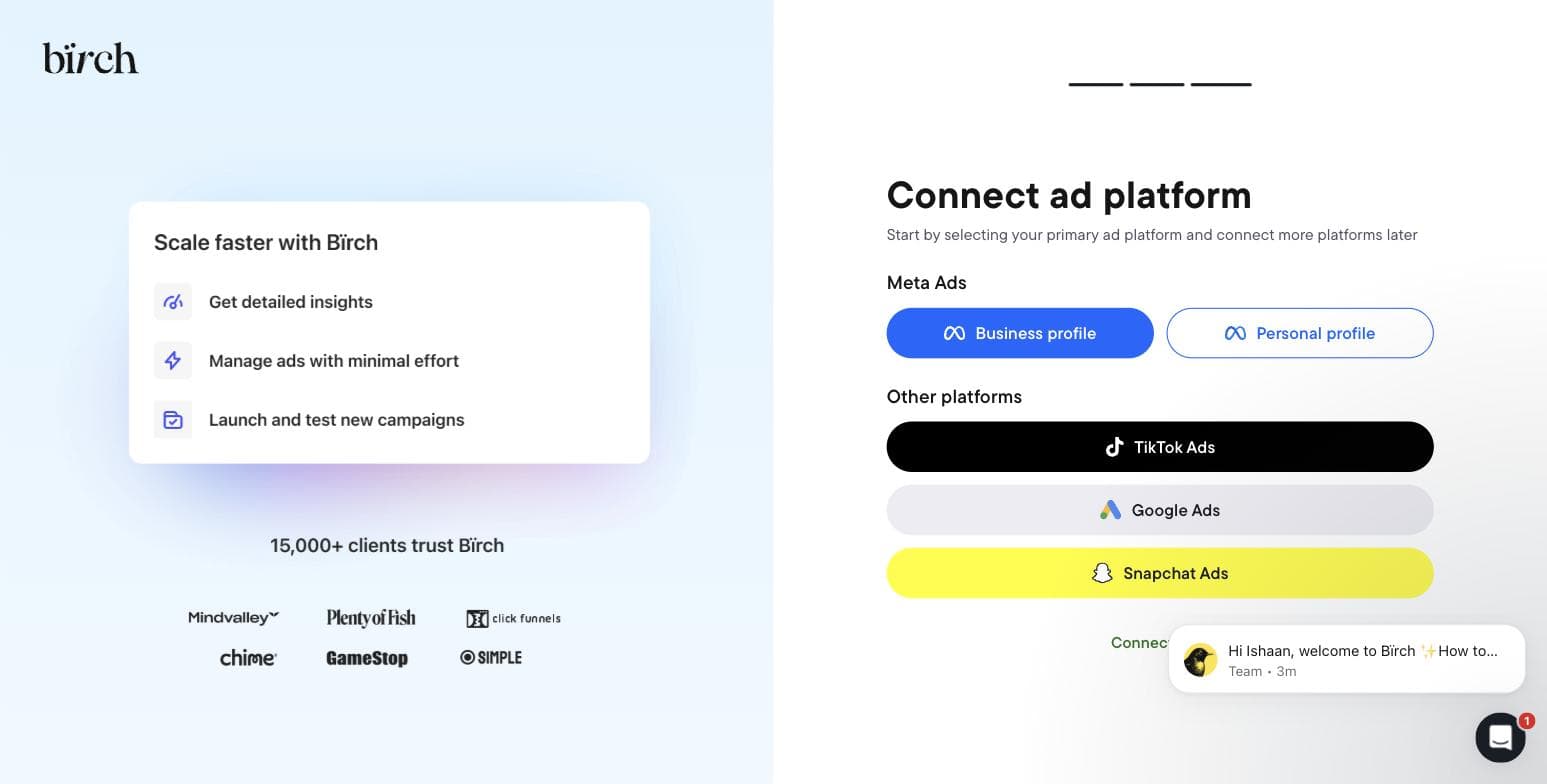
Birch's final onboarding step. Captured 30 July 2026. - 04
Open the Rules engine — the feature it is famous for
The automation screen is the reason most people arrive at Birch. Without a connected account it is a single button reading Connect ad account, over an illustration of the three action types it offers — increase bid, duplicate, notify. That is the entire surface available to an unconnected trial. There is no sandbox and no demo dataset, so you cannot evaluate the rule builder against sample data before handing over access to real campaigns.
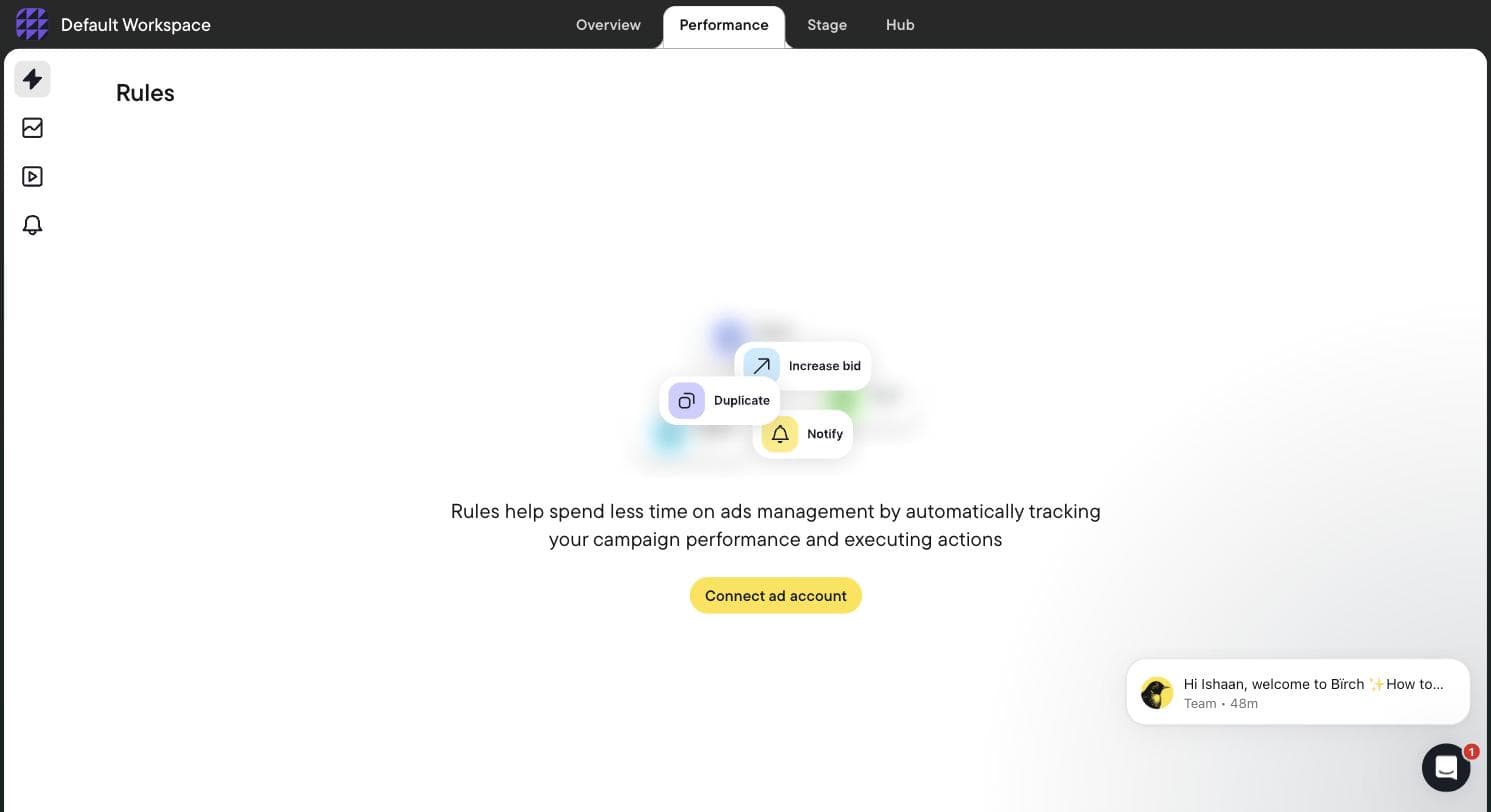
Birch's Rules screen with no ad account connected — the rule builder is entirely gated. Captured 30 July 2026. - 05
Find Stage, the product nobody has reviewed
Stage is a bulk creative launcher: you connect a planning Google Sheet and your Drive folders, and it builds the ads from there — launching creative tests from the sheet, mirroring your Drive folder structure into ad structure, duplicating winning setups with new creative swapped in, and working across multiple Drives and platforms at once. It targets Meta, TikTok and Snapchat. Birch states plainly that its Drive access is read-only and it cannot edit or delete anything. We could not find a single published roundup that mentions this exists.
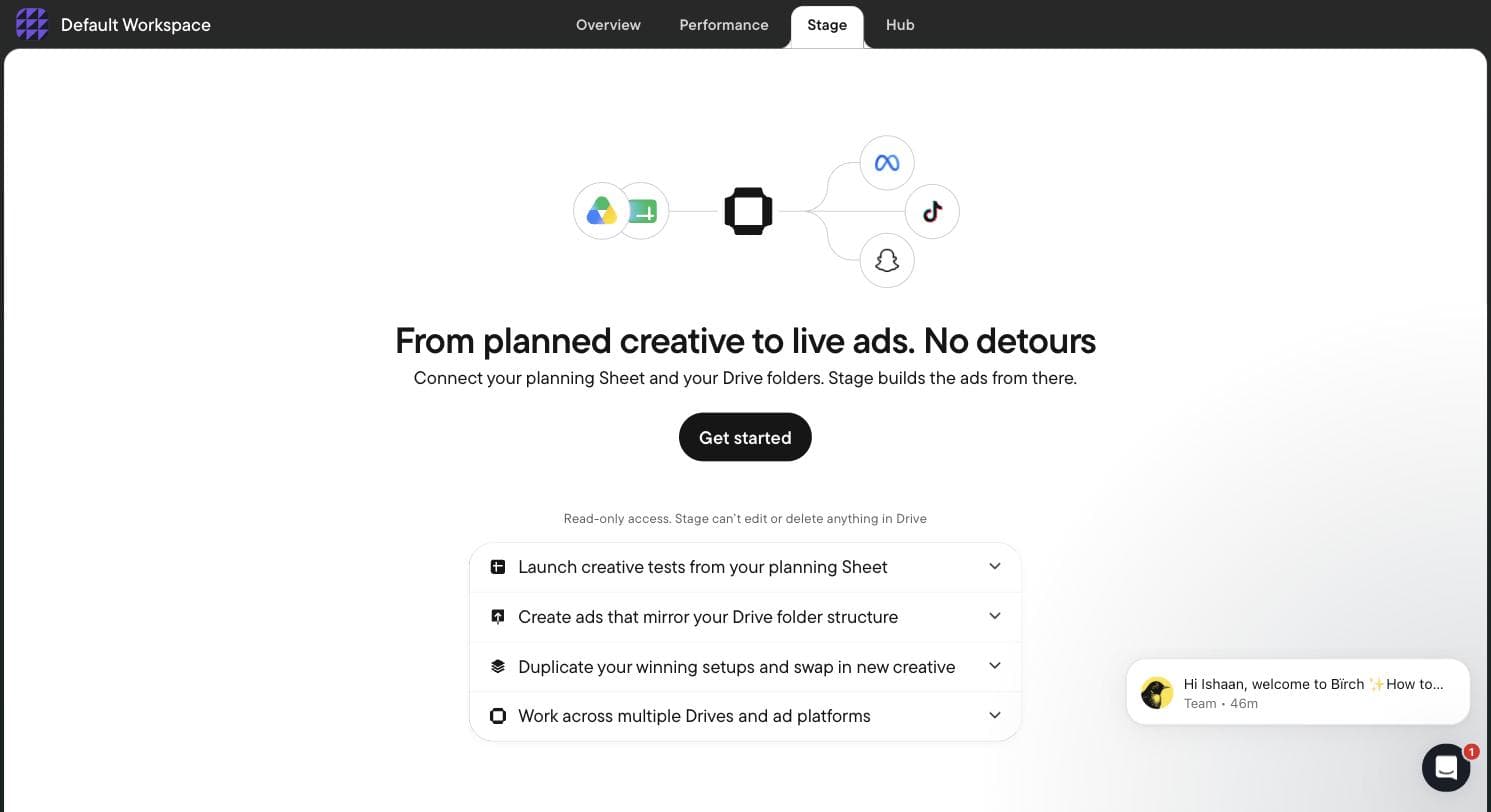
Birch Stage — a Sheet-and-Drive bulk ad launcher absent from every Revealbot-era review. Captured 30 July 2026. - 06
Find Hub, which is not an ads tool at all
Hub is server-side tracking infrastructure. You create a Signals Gateway, pick a hosting region, point it at your primary website, and it collects first-party data and forwards it to the ad platforms — the category occupied by conversions-API and server-side GTM setups. A company that used to sell Facebook rule automation now also sells you the tracking layer underneath it. That is a strategic move worth understanding before you compare Birch to anything on price alone.
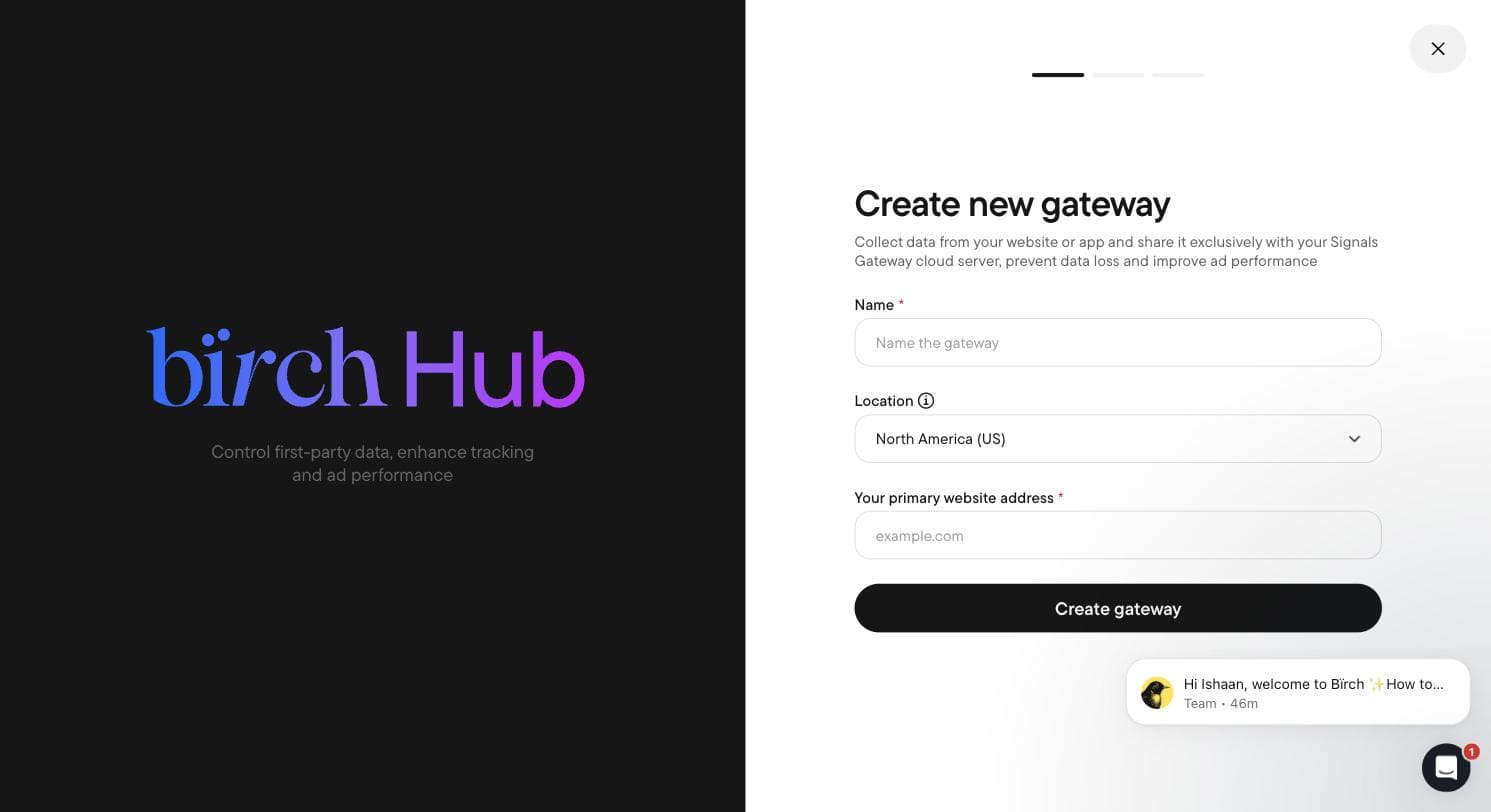
Birch Hub's Signals Gateway — server-side first-party data collection. Captured 30 July 2026. - 07
Read the integration list
Birch connects twelve services: Meta Ads, Google Ads & Google Drive, Snapchat Ads, TikTok Ads, YouTube, Google Analytics, Google Sheets, Slack, and — telling for who it is built for — the attribution stack of AppsFlyer, Adjust (in beta), Hyros and Wicked Reports. There is no Microsoft Ads, no Amazon and no LinkedIn. Set that against Optmyzr's Amazon, Microsoft, LinkedIn and Search Ads 360 and the two products stop looking like competitors at all: Optmyzr is built for search, Birch is built for paid social and direct-to-consumer attribution.
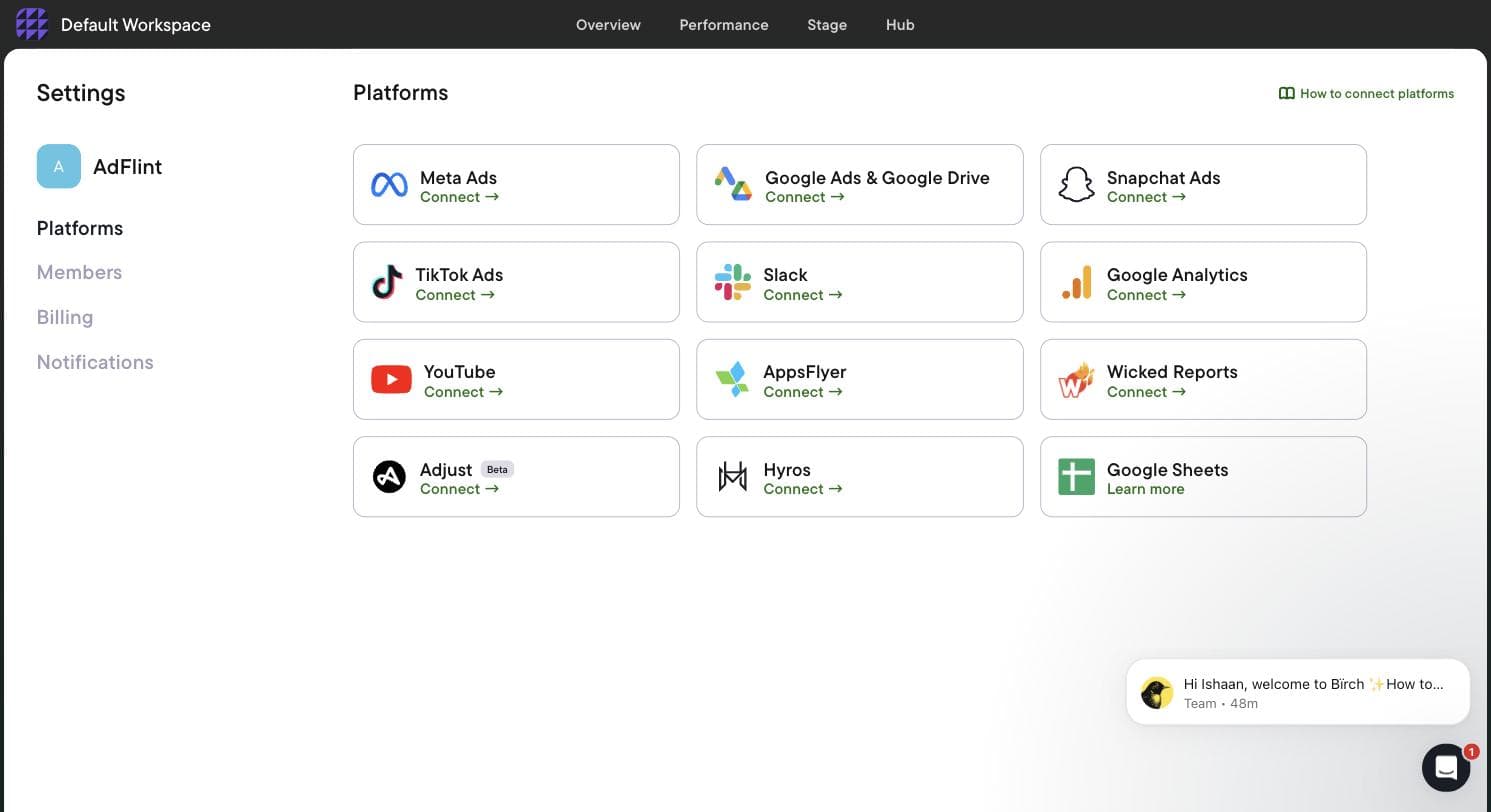
Birch's twelve integrations, heavy on paid social and attribution. Captured 30 July 2026. - 08
Read the real price off the billing screen
Birch does not have a flat price. The billing screen tracks cumulative spend across your connected accounts and charges you against it, with a slider that recalculates every plan as you move up the spend ladder. We walked the whole slider and wrote down every number. Two things matter more than the prices themselves: automated rules — the feature Revealbot was known for — are not in the entry plan at all, and above roughly $150K in monthly spend the entry plan stops being offered.
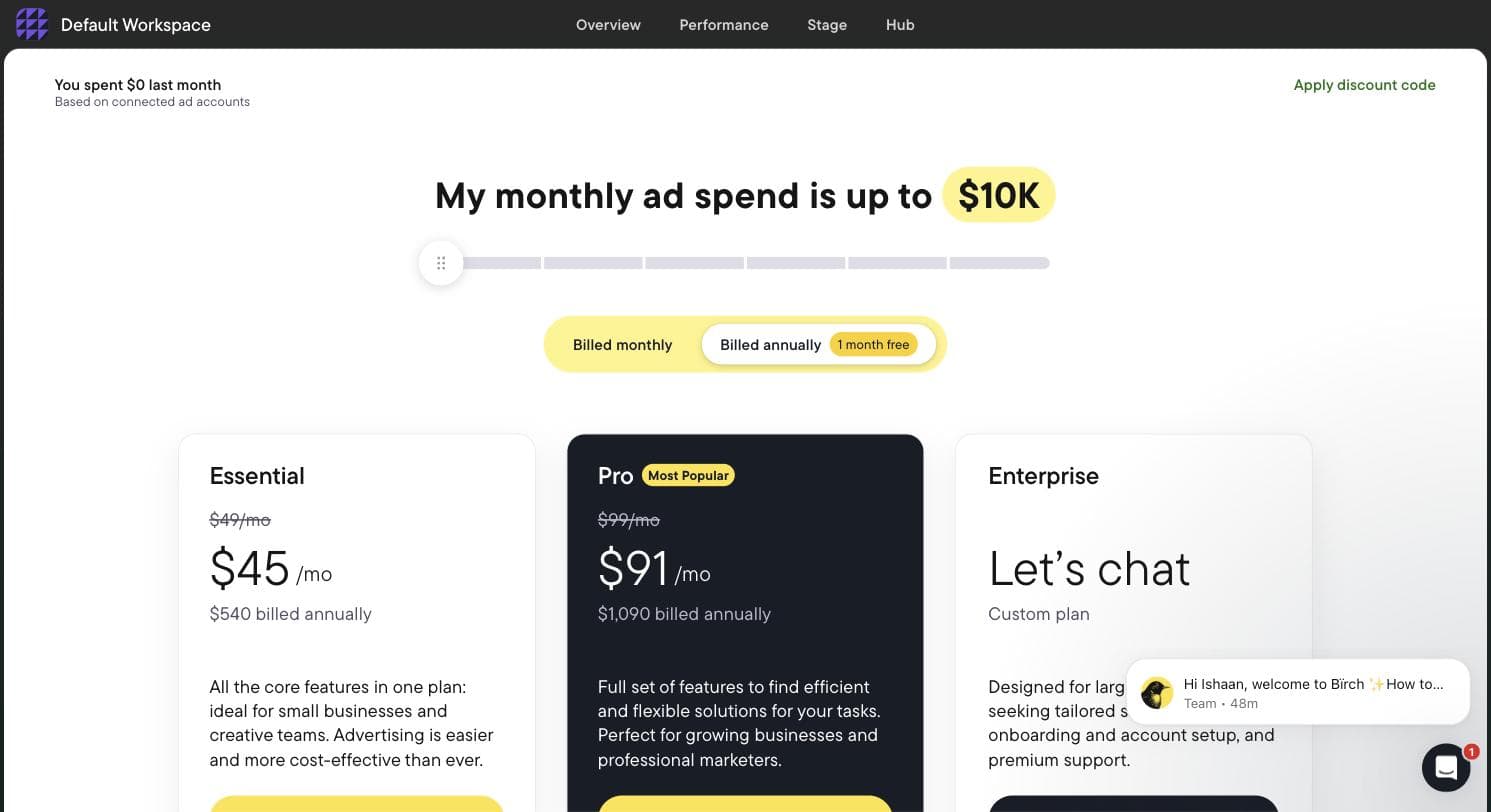
Birch's in-app pricing at the lowest spend tier. The slider above recalculates every plan. Captured 30 July 2026.
What the signup told us
- — Genuinely fast: account creation to the connect screen took under two minutes, with no phone number and no credit card.
- — The rebrand is badly signposted. Arriving from an older article pointing at revealbot.com or bir.ch/signup gets you a 404 before you find the app.
- — No sandbox and no demo data. The rule builder — the main reason to evaluate Birch — is completely inaccessible until you grant access to a live ad account.
- — Pricing is tied to your ad spend, not to seats or usage of the tool, so your bill grows as your campaigns do even if your use of Birch never changes.
- — The entry plan excludes automation entirely, which makes the widely quoted 'from $49' figure misleading for anyone arriving for the rules engine.
- — Meta is the default and most prominent option; Google Ads is present but visually secondary. Treat this as a Meta-first tool that also does Google.
- — One URL we tried inside the app hung on a loading spinner indefinitely rather than resolving or erroring.
Pricing, read off the in-app billing screen
Every figure below was read directly off Birch's own in-app billing slider on 30 July 2026, at each spend tier in turn. Monthly prices are the headline rate; annual prices are the discounted equivalent, billed once a year.
| Your monthly ad spend | Essential | Pro | Annual (Essential / Pro) |
|---|---|---|---|
| Up to $10K | $49/mo | $99/mo | $540 / $1,090 |
| Up to $30K | $149/mo | $249/mo | $1,640 / $2,740 |
| Up to $75K | $299/mo | $499/mo | $3,290 / $5,490 |
| Up to $150K | $499/mo | $799/mo | $5,490 / $8,790 |
| Up to $300K | Not offered | $1,299/mo | — / $14,290 |
| $500K+ | Not offered | Not offered | Enterprise, custom quote |
- — Essential does not include automated rules. This is the single most important line on the page: the feature Revealbot built its reputation on sits behind the Pro tier. Essential buys you workspaces, post boosting, reports, an activity page, Slack and email support — and nothing that automates a campaign.
- — Pro adds automated rules and strategies, Explorer, top audiences, Launcher, Stage, custom metrics and timeframes, the custom and lookalike audience builder, the Sheets/AppsFlyer/Hyros integrations, and live chat support.
- — Price is set by total monthly ad budget across every ad account you connect. If your spend rises past your tier, Birch states you are charged an overage fee through Stripe and notified by email; your features keep working.
- — Annual billing is described as twelve months for the price of eleven.
- — The trial is 14 days with full feature access. When it expires, your rules and reports are disabled rather than deleted, and come back when you pick a plan.
Where this stops: We did not connect a live Meta or Google account, so we have not watched a Birch rule evaluate or fire against real campaigns, and we have not seen Explorer, Stage or Hub populated with real data. Everything above is what the product does and costs, verified in-app; how well its automation actually performs on live spend is not something this walkthrough can tell you.
Madgicx
Best like-for-like replacement for Meta-first teamsMadgicx is the closest functional substitute for what most people used Revealbot for: automation on Meta ads, plus audience targeting, analytics and ad management in one workspace. Its homepage pitches it as, in its own words, "The secret AI Ads Manager top ad agencies use to run all accounts," and carries a Meta Business Partner badge. The scope is narrower than Birch's, though: the site's own page title describes it as an agentic Meta ads management platform, and its pricing page groups the product into four capability areas - Automation, Targeting, Analytics and Ad Management - all pointed at Meta.
Pricing works differently from Birch's two-plan model. Madgicx sells one plan, Madgicx Pro Complete with AI, priced by a monthly ad spend bracket you pick on the pricing page. On monthly billing in July 2026 that reads: $45 under $1,000 of spend, $99 for $1,000-$2,500, $119 for $2,500-$5,000, $129 for $5,000-$10,000, $229 for $10,000-$20,000 and $329 for $20,000-$30,000. Only the top bracket, $30,000 and above, replaces the number with "See price inside the app." Quarterly and annual billing are offered at a discount, the trial is seven days ("Try 100% free for 7 days. Cancel Anytime"), and a Tracking Pro add-on for server-side tracking and attribution on each connected account costs $49 per month.
The public review picture is genuinely mixed. On its Shopify App Store listing, Madgicx holds 4.0 stars across 13 reviews - nine five-star, one four-star and three one-star. If your spend is concentrated on Meta and you want to keep working the way Birch trained you to, this is the first tool to trial. Just check the price at your own spend bracket before you commit, because the ladder is steep.

Pros
- + Closest feature overlap with Birch for Meta-focused teams: automation, audience targeting, analytics and ad management in one tool
- + Publishes a real self-serve price for every spend bracket up to $30,000 per month, starting at $45
- + Meta Business Partner badge on its own homepage
- + 7-day free trial to test against your own account
Cons
- − The price ladder is steep: $45 per month under $1,000 of ad spend becomes $329 in the $20,000-$30,000 bracket, so like Birch the bill scales with your budget
- − The $30,000-plus bracket is the one price the page will not show - you have to sign up to see it
- − Public reviews are polarized: 4.0 stars across 13 reviews on its Shopify App Store listing, with three of the thirteen at one star
- − Meta-first by design - nothing on its pricing page promises the Google, TikTok or Snapchat rule coverage Birch gives you
Ideal for
- Meta-first media buyers replacing Birch rules like-for-like
- Agencies managing multiple Meta ad accounts
- Shopify stores whose paid growth runs on Meta
Pricing: One plan (Madgicx Pro Complete with AI), priced by monthly ad spend bracket. Monthly billing, July 2026: $45 under $1K of spend, $99 for $1K-$2.5K, $119 for $2.5K-$5K, $129 for $5K-$10K, $229 for $10K-$20K, $329 for $20K-$30K; $30K+ shows "See price inside the app". Quarterly and annual billing discounted. 7-day free trial. Tracking Pro add-on $49 per month. Pricing checked July 2026.
Visit Madgicx“I have been using Madgicx for a year now, and it's an amazing platform.”
— Jet Italian Deli, Shopify App Store review, November 2023
Meta Ads Manager automated rules
Best free optionBefore paying for any third-party tool, it is worth knowing what Meta gives away. Ads Manager includes automated rules at no extra cost. Meta's own help center describes them plainly: rules automatically check your campaigns, ad sets and ads, then update them or notify you when your conditions are met, automating actions such as turning ads off or adjusting an ad set's budget. For a single-account advertiser whose Birch usage boiled down to a handful of stop-loss and budget rules, that covers a surprising share of the workload for free.
Meta's broader automation push is Advantage+, which its business site describes this way: "Automate your entire campaign creation, or any of the core steps in the Meta Ads Manager campaign creation: Audience, Budget/Bidding, Placement, Creative and more." Between native rules for guardrails and Advantage+ for delivery optimization, Meta has absorbed a real chunk of what third-party automation tools originally sold.
The limits are structural. Rules live inside one platform - there is nothing for Google, TikTok or Snapchat, and no cross-platform reporting. Managing rules across many ad accounts is clumsy compared with a dedicated tool, and the condition and action options are narrower than what Birch or Madgicx offer. But if cost is why you are leaving Birch, this is the zero-dollar baseline to test before you pay anyone.
Pros
- + Free - included with any Meta ad account, you pay only for ad spend
- + Rules check campaigns, ad sets and ads on a schedule, then turn them off, adjust budgets or notify you
- + No third-party access to your ad account and no extra vendor to vet
- + Advantage+ layers on campaign-level automation for audience, budget, placement and creative
Cons
- − Meta only - useless for the Google, TikTok or Snapchat side of a Birch setup
- − Condition and action options are narrower than dedicated tools, and multi-account management is clumsy
- − No cross-platform reporting or bulk workflows
Ideal for
- Single-account advertisers whose Birch usage was mostly stop-loss and budget rules
- Anyone who wants to verify a paid tool is worth it by first exhausting the free tier
- Meta-only businesses with simple guardrail needs
Pricing: Free. Automated rules and Advantage+ are included with any Meta ad account; you pay only your ad spend. Checked July 2026.
Visit Meta Ads Manager automated rulesAdFlint
Best for small businesses that want the automation done for themOur product — disclosureAdFlint answers the Revealbot question differently: instead of giving you a rule builder, it does the work a rule builder exists to support. The AI plans campaigns, writes the ads, launches them inside your own Google and Meta ad accounts, and then optimizes budgets and performance on an ongoing basis. Two guardrails define the product: a human approves every ad before it runs, and hard monthly spend caps mean the system cannot outspend the budget you set. You keep ownership of your ad accounts and their history - AdFlint works inside them rather than running spend through a house account.
Pricing is a flat software fee rather than a percentage of spend. Launch is $40 per month for up to $1,000 per month in ad spend, and Growth is $89 per month for up to $2,500. Above that, a custom-priced Managed tier provides end-to-end campaign management with autonomous optimization and approval-by-exception. Every self-serve plan starts with a 7-day free trial (card required; billing starts on day 8), and AdFlint takes no percentage of self-serve ad spend.
Full disclosure: AdFlint is our product, which is why it sits behind both the closest like-for-like replacement and the free option, carries a visible tag, and gets the same blunt cons list as everyone else. An ex-Birch power user who enjoys writing multi-condition rules will find AdFlint constraining by design - there is no custom rule builder to tinker with. It covers Google and Meta only, so TikTok and Snapchat rules have no home here. And it is a younger product without the decade-long public track record some tools on this page have.
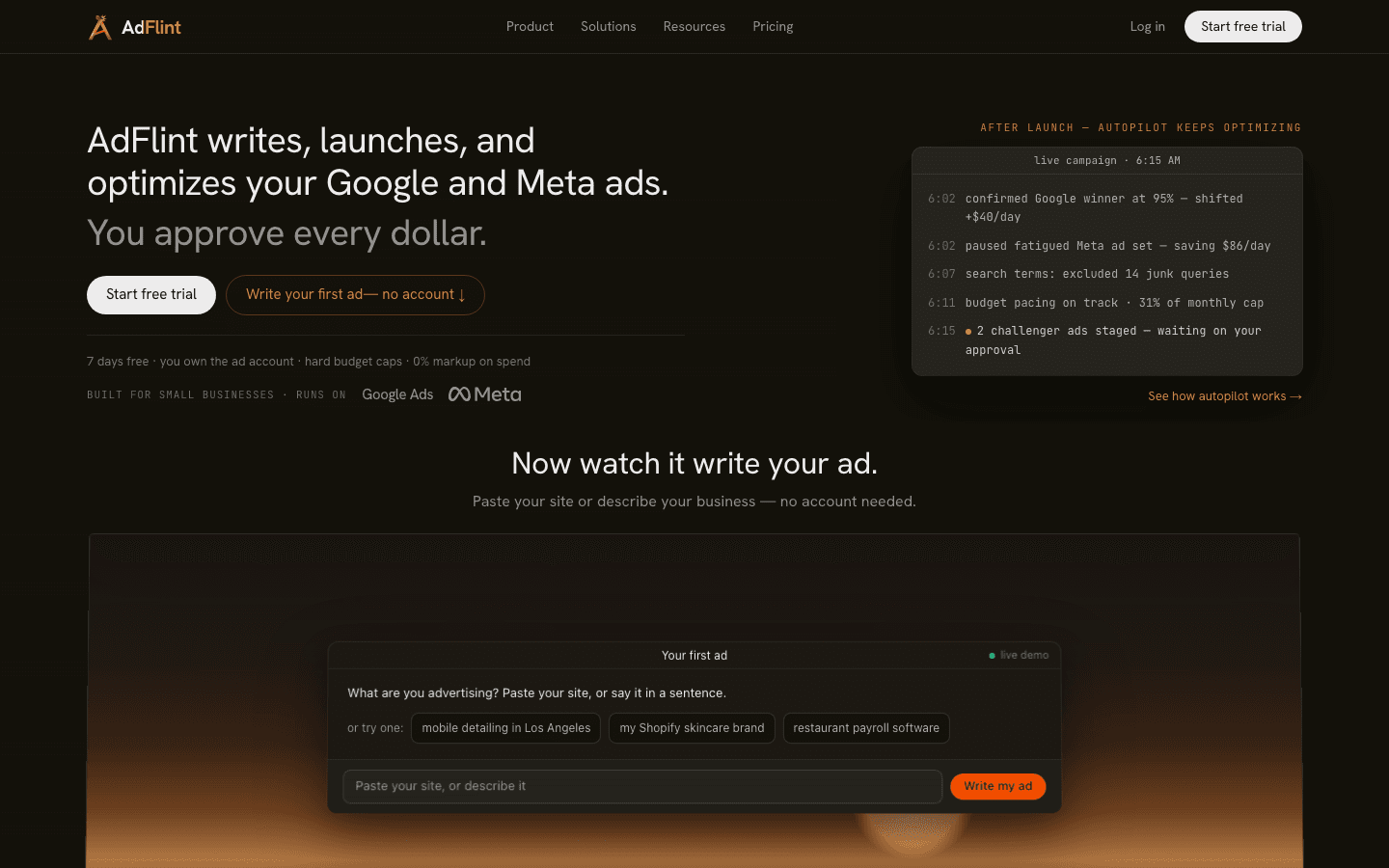
Pros
- + Flat monthly fee from $40, with no percentage of self-serve ad spend - the software bill does not grow with your budget
- + AI writes, launches and optimizes campaigns in your own ad account; you are not renting access to someone else's
- + Human approval on every ad plus hard budget caps, so automation cannot run away with your spend
- + No rules to write or maintain - built for owners without a media buyer on staff
Cons
- − Google and Meta only - no TikTok or Snapchat, both of which Birch supports
- − No custom rule builder; power users who want granular multi-condition rule logic will find it limiting
- − Self-serve plans cap at $2,500 per month in ad spend; above that you need the custom-priced Managed tier
- − Newer product with a shorter public review track record than the established tools on this list
Ideal for
- Small businesses on Google and Meta without a dedicated media buyer
- Owners who want oversight (approve each ad) without doing the daily optimization work
- Budget-conscious advertisers spending under $2,500 per month
Pricing: Launch $40 per month (up to $1,000 per month in ad spend), Growth $89 per month (up to $2,500), Managed tier custom-priced. Flat fee with no percentage of self-serve ad spend. 7-day free trial, card required, billing starts day 8. Pricing checked July 2026.
Try AdFlint freeOptmyzr
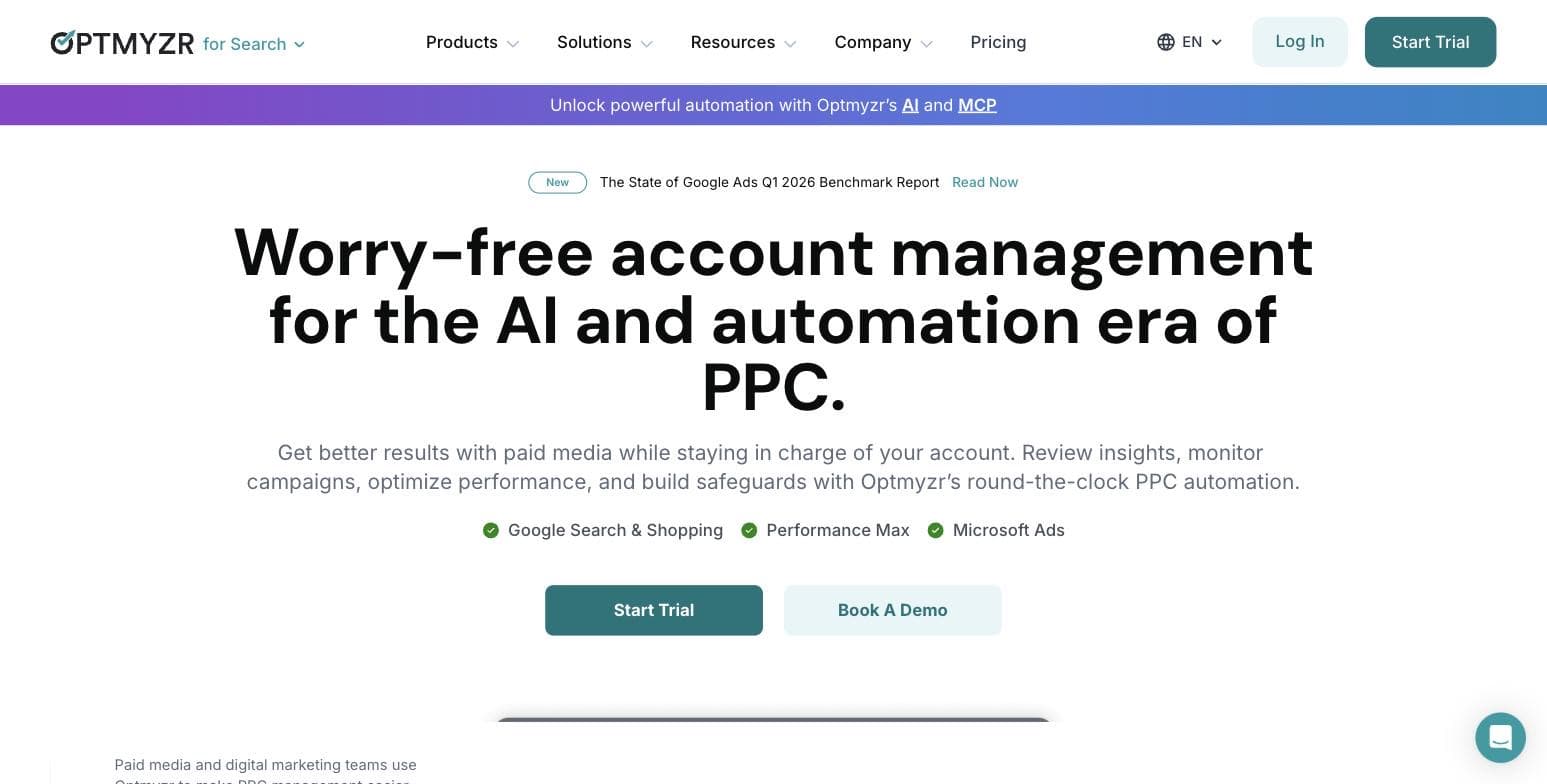
Best for Google Ads-first PPC teamsOptmyzr comes from the opposite side of the aisle. Where Birch grew up on Meta, Optmyzr is a search-first PPC suite. Its pricing FAQ states the coverage plainly: "Optmyzr supports Google Ads, Microsoft Ads, Amazon Ads, Meta Ads, LinkedIn Ads, and Yahoo! Japan Ads." Meta and LinkedIn tools are included in every plan at no separate subscription, with Essentials limited to single-account social tools and Premium and Enterprise getting portfolio-level access.
Plans come in three tiers - Essentials, Premium and Enterprise - and, like Birch, pricing steps up with monthly ad spend through published brackets that run from $25K to $500K-plus. At the entry $25K bracket in July 2026, Essentials is $299 per month billed monthly or $209 per month billed annually, and Premium is $389 or $272; Enterprise is custom. The annual discount is advertised as "SAVE 30%", the trial is 14 days with no credit card, there is a 30-day money-back guarantee, and onboarding scales by tier from one Q&A session on Essentials to three one-hour sessions on Enterprise.
The honest framing: this is the right move only if your center of gravity is search. Optmyzr does have a social rule engine, but the feature grid limits it to a single Meta account, so a Meta-first Birch refugee will not find parity. At $299 per month on monthly billing the entry price is roughly three times Birch Pro's $99 - though Optmyzr's entry bracket also covers $25K of spend against Birch's $10K. For an agency or in-house team managing serious Google and Microsoft accounts, it is the specialist option on this list.
Pros
- + Purpose-built for search: Google, Microsoft, Amazon and Yahoo! Japan Ads under one roof
- + Meta and LinkedIn tools included in every plan with no separate subscription
- + 14-day free trial with no credit card, plus a 30-day money-back guarantee
- + Structured onboarding included, scaling from one Q&A session to three one-hour sessions
Cons
- − Entry price of $299 per month billed monthly ($209 billed annually) is about three times Birch Pro's $99
- − Pricing steps up with monthly ad spend through published brackets from $25K to $500K+, and exceeding your limit triggers overage fees
- − Search-first heritage means social is the sidecar: the social rule engine is limited to a single Meta account
- − Headline add-ons cost extra on top - Campaign Automator starts at $249 per month beyond the single account included with Premium
Ideal for
- Agencies and in-house teams whose spend is concentrated in Google and Microsoft Ads
- PPC managers who want audits and optimization workflows, not just rules
- Teams also running Amazon Ads
Pricing: Three tiers stepping up by monthly ad spend through published brackets from $25K to $500K+. At the entry $25K bracket: Essentials $299 per month billed monthly or $209 billed annually (up to 25 accounts); Premium $389 or $272 (unlimited accounts); Enterprise custom. Annual discount advertised as SAVE 30%. 14-day free trial, no card required; 30-day money-back guarantee. Add-ons priced separately (Campaign Automator from $249 per month, Optmyzr for Amazon Ads from $66 per month). Pricing checked July 2026.
Visit OptmyzrSmartly.io
Best for enterprise brand and agency teamsSmartly.io is what the top end of this market looks like. It combines creative production, media buying and campaign intelligence in one AI-powered platform, promising to "Build smarter cross channel ads in one-third the time." Coverage goes well past Birch's lane: social platforms, connected TV (the site advertises AI-optimized CTV ads across 200-plus streaming services), video and the open web. Its customer roster - Samsung, Spotify, Uber, Ralph Lauren, Tripadvisor, KLM - tells you exactly who this is built for.
This is the direction to look if your problem has outgrown rules entirely: creative variations at scale, cross-channel budget orchestration, and separate workflows for brand, performance, creative and agency teams. It is not a tool one media buyer configures on a Tuesday; it is a platform a marketing organization adopts.
The trade-off is equally clear. There is no public pricing anywhere on the site - every call to action routes to a demo with sales - and the product's breadth is wasted on a single-brand account spending a few thousand a month. If you came to this page because Birch's $49-to-$99-plus pricing felt heavy, Smartly is the wrong direction; if you came because Birch feels small next to your channel mix, it is the shortlist.
Pros
- + Creative production, media buying and intelligence in one platform, beyond what rule-based tools attempt
- + Channel coverage that includes social, video, connected TV across 200+ streaming services, and the open web
- + Built for enterprise team structures: brand, performance, creative and agency workflows
- + Named global brands on its own customer wall, including Samsung, Spotify, Uber and Ralph Lauren
Cons
- − No public pricing at all - every path leads to a sales demo
- − Enterprise-scale onboarding and complexity; overkill below serious multi-channel spend
- − The opposite of a quick self-serve migration from Birch
Ideal for
- Enterprise brand teams running social plus CTV and open-web campaigns
- Large agencies standardizing creative and media workflows across clients
- Organizations whose bottleneck is creative volume, not rule execution
Pricing: Custom pricing only; there is no public pricing page and all calls to action route to a sales demo. Checked July 2026.
Visit Smartly.ioAdEspresso
Best for basic Meta split testing on a budgetAdEspresso is the best-known legacy name in this category, and its store is still open: the pricing page sells a Starter plan at $49 per month with ad spend capped at $1,000 per month, Plus at $99 per month with unlimited ad spend, and Enterprise from $259 per month, each with a 14-day free trial. The product focuses on creating, managing and analyzing Facebook and Instagram campaigns - Google Ads, which AdEspresso once managed, no longer appears in the pricing tiers.
The status question is why it sits last on this list. When we checked in July 2026, the homepage was live and accepting signups, but the blog - once the most-cited education engine in Facebook advertising - had not published since January 2, 2023. More than three years of content dormancy at a company whose reputation was built on teaching is a real signal about investment in the product, and it is why we would not move a serious account here without a careful trial.
Where it can still make sense: a small advertiser who wants simple, structured A/B testing of Meta creative at a known flat price, and who stays under the Starter plan's $1,000 monthly spend cap. Use the 14-day trial, confirm the features you need actually work against the current Meta API, and keep your expectations set by the update history rather than the brand's old reputation.
Pros
- + Simple, published flat pricing from $49 per month with a 14-day free trial
- + Approachable split-testing workflow for Facebook and Instagram campaigns
- + Long-established product with a well-known onboarding path
Cons
- − Blog and education content dormant since January 2, 2023, a three-plus-year gap we verified in July 2026
- − Facebook and Instagram only; Google Ads management no longer appears in the pricing tiers
- − Starter plan caps ad spend at $1,000 per month, so growing accounts are pushed to Plus quickly
Ideal for
- Small advertisers who want simple Meta A/B testing at a known flat price
- Accounts spending under $1,000 per month on the Starter plan
- Anyone willing to trial-first and judge the product by its current state, not its reputation
Pricing: Starter $49 per month (ad spend capped at $1,000 per month), Plus $99 per month (unlimited ad spend), Enterprise from $259 per month. 14-day free trial on all plans. Pricing checked July 2026.
Visit AdEspressoSide by side.
| Tool | Best for | Starting price | Platforms covered | Standout limitation |
|---|---|---|---|---|
| Madgicx | Meta-first teams replacing Birch rules like-for-like | From $45/mo, rising to $329/mo by spend bracket; 7-day trial | Meta only | Meta-only focus; the $30K+ price is shown only in-app |
| Meta automated rules | Basic guardrail rules at zero software cost | Free with any Meta ad account | Meta only | No cross-platform or multi-account workflows |
| AdFlint | Small businesses that want automation done for them | $40-$89/mo flat, 7-day trial | Google + Meta | No rule builder; self-serve caps at $2,500/mo ad spend |
| Optmyzr | Google Ads-first PPC teams | $299/mo billed monthly ($209 billed annually), 14-day trial | Google, Microsoft, Amazon, Yahoo! Japan; Meta/LinkedIn tools included | Search-first; social rule engine is single-account Meta |
| Smartly.io | Enterprise brand and agency teams | Custom - sales demo only | Social, video, CTV (200+ streaming services), open web | No public pricing; enterprise-scale complexity |
| AdEspresso | Basic Meta split testing on a budget | $49-$259/mo, 14-day trial | Facebook + Instagram | Blog dormant since January 2023; $1,000/mo spend cap on Starter |
How we chose.
This is a researched comparison, not a hands-on test. We have not run paid campaigns through Birch, Madgicx, Optmyzr, Smartly.io or AdEspresso, and nothing on this page should be read as first-hand product experience with those tools. Where experience matters, it comes from named, attributed reviewers on public platforms, quoted verbatim with a link.
What we actually did, in July 2026: loaded each vendor's live pricing page and recorded plan names, prices, spend tiers and trial terms exactly as displayed, including working the spend selectors and billing toggles so the numbers reflect real configurations rather than a single default view; read official product pages and help documentation for platform coverage and feature claims; captured screenshots of public marketing sites (every caption says so - none show an in-app session); and pulled short verbatim quotes from public review listings. Where we could not reach and confirm a genuine, attributable review, we left the quote out rather than paraphrase one.
Disclosure: AdFlint is our product. It appears on this list because it genuinely serves one slice of this audience - small businesses on Google and Meta who want the automation done for them - and it is ranked for that niche, behind both the closest like-for-like replacement and the free option. Its cons are listed with the same bluntness as everyone else's. Pricing everywhere on this page was checked in July 2026 and can change; confirm on the vendor's site before buying.
- — Category relevance: every entry automates or manages paid campaigns the way Birch does. No social schedulers, ad networks or reporting-only dashboards padding the list.
- — Live pricing: every figure was read from the vendor's own pricing page in July 2026, not from cached review-site data.
- — Real total cost: we looked past the headline price at spend-based tiers, overage clauses, add-on fees and spend caps, because that is where these tools get expensive.
- — Platform coverage measured against Birch's own set - Meta, Google, TikTok and Snapchat - so you know exactly what you give up by moving.
- — Signs of life: docs, changelogs and content freshness. One well-known name on this list has not published to its blog since January 2023, and we say so.
- — Fit by buyer type: a solo advertiser, an agency and an enterprise brand team should each leave this page pointed at a different tool.
Common questions.
Is Revealbot still available?
Yes, under a new name. Revealbot rebranded to Birch and now lives at bir.ch. The product is the same rule-based ad automation platform covering Meta, Google, Snapchat and TikTok. Pricing is tiered by the total monthly ad spend across your connected accounts: at the entry $10K tier, Essential is $49 per month and Pro is $99 per month; at the $150K tier Essential is $499 per month. Automated rules sit on Pro, not Essential. There is a 14-day free trial with no credit card required, and annual billing is discounted - the pricing table labels it one month free and shows Essential at $45 per month, $540 billed annually. Checked July 2026.
Why do people switch away from Birch (Revealbot)?
Three reasons come up most. First, cost structure: pricing is tiered by ad spend, so the bill climbs as your budget grows, and going over your tier means an overage charge. Second, what you get for the entry price: automated rules are a Pro feature, so the $49 Essential plan does not include the thing most people signed up for. Third, workload and fit: Birch automates execution, but you still design, test and maintain every rule yourself, which is why Google-first teams often prefer search-native tools and small businesses without a media buyer often want a service that manages campaigns instead of a rule builder.
What is the cheapest Revealbot alternative?
Free, if your needs are simple: Meta's native automated rules can check your campaigns on a schedule, turn ads off, adjust budgets and send notifications at no software cost, though only inside Meta. Among paid options as of July 2026, AdFlint (our product - disclosure) starts at $40 per month flat for up to $1,000 in monthly ad spend on Google and Meta; Madgicx is $45 per month if your monthly ad spend is under $1,000; and AdEspresso's Starter plan is $49 per month with ad spend capped at $1,000 per month.
Does Birch have a free plan?
No. As of July 2026 there is no free tier for the core automation product - plans start at $49 per month for Essential at the lowest spend tier, and automated rules require the $99 Pro plan. What Birch does offer is a 14-day free trial with full feature access and no credit card required, so you can test your rules before paying.
Which alternatives support TikTok and Snapchat like Revealbot does?
This is Birch's quiet advantage: none of the six options here replicates its Meta plus Google plus Snapchat plus TikTok rule coverage. Madgicx is a Meta-first platform, AdFlint covers Google and Meta only, AdEspresso is Facebook and Instagram only, Optmyzr is built around search platforms (Google, Microsoft, Amazon and Yahoo! Japan) with Meta and LinkedIn tools attached, and Meta's native rules are Meta-only. Smartly.io covers social channels broadly at enterprise scale and is the only entry that plausibly spans that many paid channels, but it is sold through sales, not self-serve. If automated rules on Snapchat specifically are core to your operation, staying on Birch may be the pragmatic answer.
Is AdEspresso still maintained?
It is still operating: when we checked in July 2026 the site was live and selling plans at $49 to $259 per month with 14-day trials for Facebook and Instagram campaign management. But its blog - historically the company's biggest asset - had not published since January 2, 2023, and Google Ads no longer appears in its pricing tiers. We would treat any move there as trial-first and judge the product by its current state rather than its reputation.
Keep reading
- AI Ad Tool Pricing in 2026: What It Really Costs
- AI Ad Automation: What to Let It Change, and Not
- How Long to Get a First Ad Live, Tool by Tool
- Can ChatGPT or Claude Manage Your Ad Accounts?
- Guide: Meta Ads Objectives and Bidding: The Complete Guide
- Guide: Google Ads Bidding Strategies: The Complete Guide
- Guide: Ad Budgets, Pacing, and What Ad Management Costs
- AI Ad Management Software vs Done-For-You Ad Management
- AI Ad Management Software vs DIY Ad Management
- Done-For-You Ad Management vs a PPC Agency
- CBO vs ABO: Who Should Control Your Meta Budget?
- Cost Cap vs Bid Cap: Which Meta Control to Use
- Free tool: Meta Lifetime Budget Pacing Calculator
- Free tool: Ad Budget Calculator
- Free tool: ROAS Calculator
- Free tool: CPC, CPM & CTR Calculator