DIY vs Agency vs AI: What Ad Management Costs
Here is the answer before the tables. At $1,000/mo in ad spend, an agency almost mathematically cannot pay for itself. At $20,000/mo, it very plausibly can. And DIY is only the cheapest option if you value your own time at somewhere under $14 an hour.
Almost every page ranking for this question is published by someone selling one of the paths, and most of them frame the choice as two. Agencies write “DIY vs agency” posts that conclude you should hire an agency; people selling a course write the same post with the opposite conclusion.
We sell the third path, so read this with that in mind. To compensate we publish the arithmetic, publish every assumption behind it, and use our own real price ladder so at least one column is checkable against a public page. Where we have no sourceable number — agency retainers — we have not invented one. The agency column is a break-even you fill in with a real quote instead.
The assumptions, stated up front
Every cost comparison in this category hides its assumptions. Ours are here, and you should change them if they do not match you.
- Your hourly value: $75. Not a market rate, just a placeholder. If you are a solo owner whose next best hour would have gone to billable client work at $150, double every DIY number. If ad work displaces nothing, the DIY column drops toward zero.
- DIY hours per month: 6 at $1,000/mo spend, 12 at $5,000, 25 at $20,000. These are our estimates of ongoing steady-state work — weekly performance review, search term and placement cleanup, budget pacing, creative refresh, disapproval fixes. They are not measurements. We have no product analytics on how long anyone spends, and we will not pretend otherwise.
- Software-path hours: 2, 4 and 8 per month at the same three spend levels. Also estimates, not measurements. Software takes over the pacing and the bid babysitting. It does not remove your offer, your landing page, your creative judgment or your approvals.
- First month is worse than every month after it. Budget 10–20 extra hours of learning on the DIY path regardless of spend level. That is excluded from the monthly tables below.
Every figure in the tables that follows is arithmetic on those assumptions, or a published price we cite. Nothing in this post is a performance result.
The three paths, costed at three spend levels
The self-serve AdFlint prices below come off our own pricing page: Launch $40/mo covers up to $1,000/mo in ad spend, Scale $109/mo covers up to $5,000, Performance $219/mo covers up to $20,000. Those self-serve plans are flat monthly fees with 0% markup on ad spend — your card pays Google and Meta directly, and the plan fee does not move when your spend does inside the tier. (Our done-for-you Managed tier is priced differently; that is spelled out further down, because conflating the two would make this page wrong.)
| Monthly ad spend | DIY: your hours | DIY: cost of those hours | Software: hours + plan fee | Agency |
|---|---|---|---|---|
| $1,000 | 6 hrs | $450 | 2 hrs ($150) + $40 = $190 | Your quote + oversight hours |
| $5,000 | 12 hrs | $900 | 4 hrs ($300) + $109 = $409 | Your quote + oversight hours |
| $20,000 | 25 hrs | $1,875 | 8 hrs ($600) + $219 = $819 | Your quote + oversight hours |
Arithmetic on the stated assumptions, at $75/hr. AdFlint plan fees are published prices from our own pricing page. The agency column is deliberately blank — see below.
Why the agency column has no number in it
Because we could not source a retainer range to a named, checkable publisher, and inventing a plausible-sounding one would make this whole page worthless. Agencies price in three shapes, and the shapes we can describe accurately without numbers:
- Flat retainer. A fixed monthly fee regardless of spend. Predictable. Gets expensive as a share of a small budget and cheap as a share of a large one.
- Percentage of ad spend. A fixed percent of what you spend, so the fee scales with the budget. Worth understanding the incentive: the fee rises when spend rises, whether or not results do. See percentage of ad spend.
- Hybrid: floor plus percentage. A minimum monthly fee with a spend share above it. This is also the shape our own done-for-you tier uses.
Get three real quotes, in writing, with the fee shape, the setup fee and the minimum term named. Then use the next table.
The break-even: what an agency has to beat
This is the number nobody publishes. An agency does not have to be better than software. It has to be better by more than the fee gap. Below, the left column is a quote you supply — it is an input, not a market rate we are claiming. Every agency row also assumes you still spend 2 hrs/mo on calls, approvals and creative input ($150).
| Your agency quote | Efficiency edge needed at $1,000/mo spend | at $5,000/mo | at $20,000/mo |
|---|---|---|---|
| $500/mo | 46% | 4.8% | Agency is already cheaper |
| $1,000/mo | 96% | 14.8% | 1.7% |
| $2,000/mo | 196% | 34.8% | 6.7% |
| $4,000/mo | 396% | 74.8% | 16.7% |
Arithmetic. Formula: (agency fee + $150 oversight − software path total) ÷ monthly ad spend. Software path totals are $190, $409 and $819 from the first table. The large percentages are arithmetically real and practically unreachable — that is the finding, not a rendering error.
Read the diagonal. At $1,000/mo of spend, a $1,000 retainer has to make your ads roughly twice as efficient before you are level. That is not a realistic ask of anyone, which is why the honest advice at small budgets is DIY or software, and why running ads without an agency is the default recommendation under about $3,000/mo.
Now read the right column. At $20,000/mo, a $2,000 retainer needs a 6.7% edge. Our judgment — a judgment, not a measurement, and we have no client data behind it — is that a good operator restructuring a wasteful account, killing bad placements, fixing conversion tracking and rewriting the offer can plausibly clear 6.7%. At high spend, we are not the obvious answer. The break-even shrinks as spend grows for a boring reason: the same fee is a smaller share of a bigger budget. That arithmetic cuts against us, and we would rather print it than hide it.
The DIY break-even nobody calculates
Run the DIY column against the software column and solve for the hourly rate at which DIY becomes genuinely cheaper:
- At $1,000/mo spend: 6r < 2r + $40, so DIY wins below $10.00/hr.
- At $5,000/mo: 12r < 4r + $109, so DIY wins below $13.63/hr.
- At $20,000/mo: 25r < 8r + $219, so DIY wins below $12.88/hr.
The consistency is the point. Across a 20x spend range, the crossover sits between $10 and $14 an hour. If your time is worth more than that, DIY is not a cost saving, it is a cost transfer onto a line item you never invoice yourself for.
The whole result rests on one load-bearing assumption: that software actually removes roughly two-thirds of the hours. If it removes none for you, the DIY column wins outright. That is the assumption to attack, and it is the one we cannot prove with data — AdFlint has not run sustained live ad spend, so we have no performance figures, no ROAS numbers and no client results to point at. AdFlint vs DIY lays out what the software does and does not take off your plate.
A fourth cost shape three-way comparisons miss
Not all software is flat-fee. A large part of this category is spend-tiered, meaning the software bill climbs with your ad budget even though the software does not change. On 30–31 July 2026 we signed up for Birch (formerly Revealbot) and read its complete ladder off its own in-app billing slider at every tier:
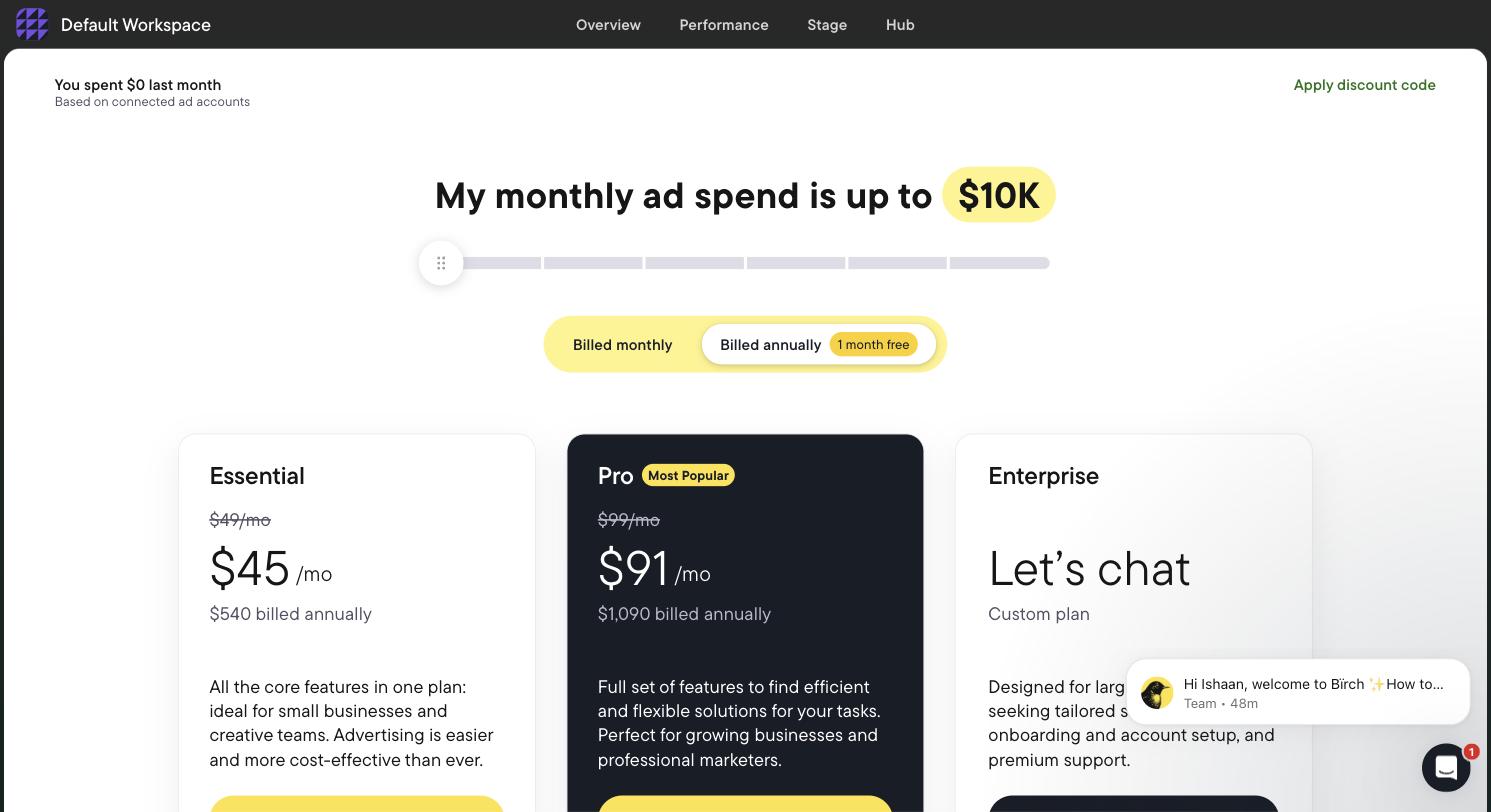
Birch’s in-app billing slider at its lowest spend tier, captured 30 July 2026.
| Monthly ad spend | Birch Essential | Birch Pro |
|---|---|---|
| up to $10,000 | $49/mo | $99/mo |
| up to $30,000 | $149/mo | $249/mo |
| up to $75,000 | $299/mo | $499/mo |
| up to $150,000 | $499/mo | $799/mo |
| up to $300,000 | Not offered | $1,299/mo |
| $500,000+ | Enterprise only | |
Measured. Read directly off Birch’s in-app billing slider at every tier, 30 July 2026. Annual billing is 12 months for 11. Automated rules are Pro-only; the $49 Essential plan does not include them. Overages are billed through Stripe.
Two things to notice. Rules — the actual automation — start at Pro, not at the $49 headline. And the Pro plan runs $99 to $1,299 across the ladder: the same product costs about 13x more at $300,000 of spend than at $10,000. That is a real cost shape, not a criticism; it just means “the tool costs $49” is not a sentence that survives growth. We break the whole category down in what AI ad tools really cost.
Put the two ladders side by side at our three spend levels and the shape difference shows up immediately. This is a price comparison only — we never connected a live ad account to Birch, so we have not seen its rules run and cannot compare what the two products actually do.
| Monthly ad spend | AdFlint self-serve plan | Birch Pro (rules included) |
|---|---|---|
| $1,000 | Launch $40/mo | $99/mo (up-to-$10K tier) |
| $5,000 | Scale $109/mo | $99/mo (up-to-$10K tier) |
| $20,000 | Performance $219/mo | $249/mo (up-to-$30K tier) |
Published AdFlint prices and Birch prices measured off its billing slider, 30 July 2026; tier assignment is arithmetic on the published brackets. At $5,000/mo of spend Birch Pro is the cheaper line item, which is the kind of row most vendor comparison tables quietly omit.
A fifth shape: no published price at all. Optmyzr made us answer five mandatory qualification questions and pass a phone-plus-SMS verification wall before the product opened, and its spend brackets start at “Under $10,000/mo” and run to “$500,000+”. Budget the sales cycle as a cost too.
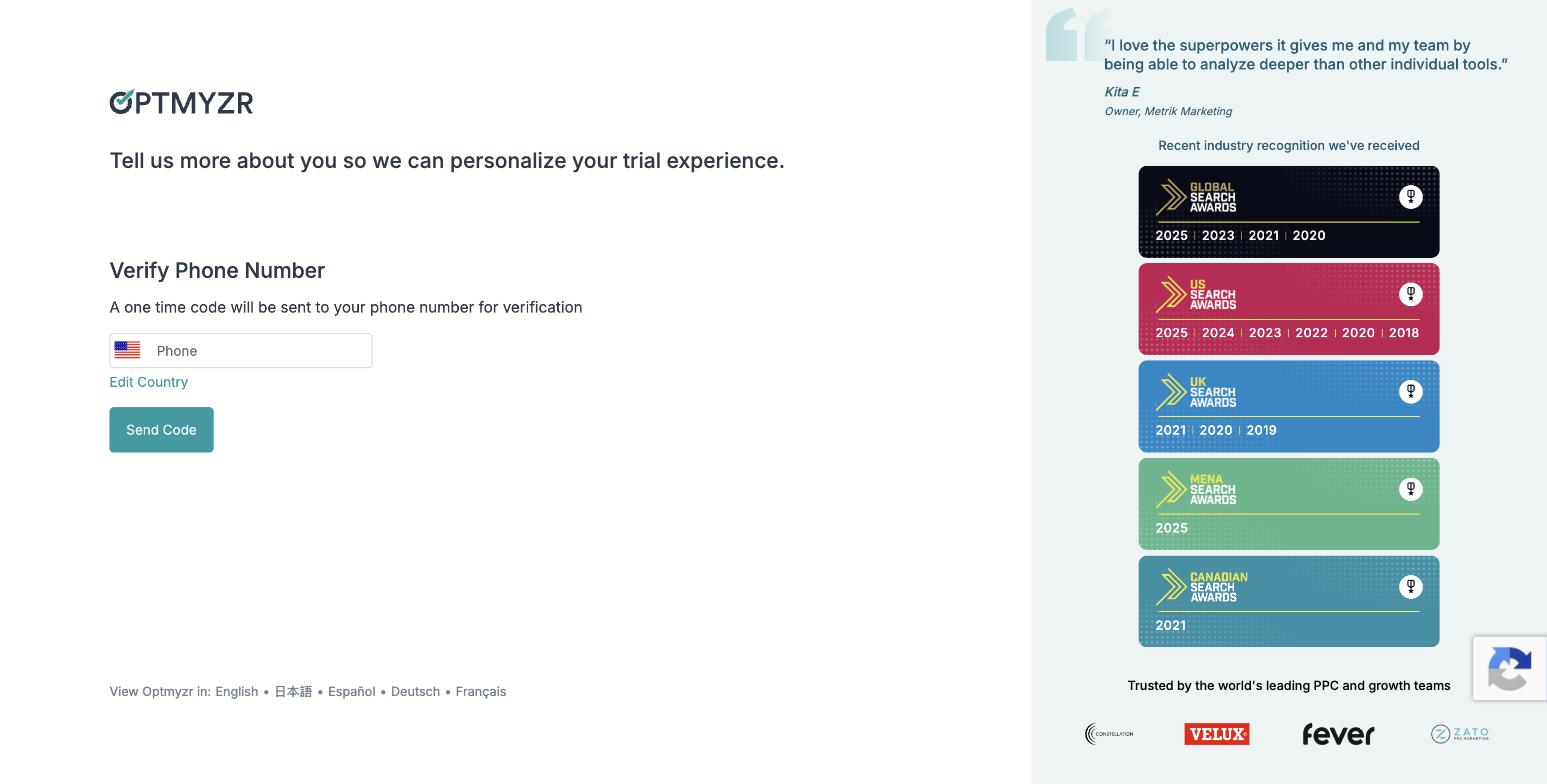
Optmyzr’s phone and SMS verification wall during signup, 31 July 2026. We did not connect a live ad account to Optmyzr or Birch, so we have not seen either product’s optimization quality.
Our own pricing, stated precisely
Two different structures, and conflating them would make this page wrong:
- Self-serve plans are flat-fee with 0% markup on ad spend. Launch $40 (up to $1,000/mo spend), Growth $89 (up to $2,500), Scale $109 (up to $5,000), Accelerate $119 (up to $10,000), Performance $219 (up to $20,000), Premium $319 (up to $30,000), custom above that. Your card pays the platforms directly. The front door is a 7-day free trial.
- Managed, our done-for-you tier, is not flat-fee. It is $249/mo plus a share of the ad spend it manages. It is metered, operator-provisioned and never self-serve selectable. Structurally it behaves like the floor-plus-percentage agency model above, so cost it that way, not as a subscription.
So “AdFlint takes 0% of your ad spend” is true of the self-serve ladder and not true of Managed. We would rather write that sentence here than let you find it out on an invoice.
Cost lines that never appear on a pricing page
- Markup on ad spend. Some managed providers run your budget through their own account and bill you a marked-up figure. Ask directly whether your card pays the platform or pays them.
- Who owns the account. If the campaigns, history and conversion data live in a provider’s account, leaving costs you the learning period, not just a notice period. AdFlint connects to accounts you own via OAuth and does not pool customers into a provider-owned account. Read who owns your ad account before signing anything.
- Minimum terms and setup fees. A three-month minimum on a $2,000 retainer is a $6,000 decision, not a $2,000 one.
- Annual lock on software. Birch’s annual plans are 12 months for 11 — a genuine discount, and also a year of commitment before you know whether the rules engine fits.
- Overage behaviour. On spend-tiered software, going over your bracket moves you up a rung; Birch bills overages through Stripe. On our flat plans, the spend cap is the ceiling rather than a meter.
- Wasted spend during the learning phase. Usually larger than any of the fees above, on every path. See why Google Ads wastes money for beginners.
How to actually decide, in order
- Write down your realistic monthly ad spend for the next six months.
- Write down your true hourly value — what the displaced hour would otherwise earn. If nothing is displaced, write $0 and expect DIY to win.
- Estimate your monthly hours on each path. Use ours as a starting point and adjust for how many platforms and offers you run.
- Price the software path at your actual spend, not the headline tier — and check whether the features you need sit above the entry plan.
- Get three written agency quotes with fee shape, setup fee and minimum term.
- Run the break-even formula: (fee + oversight − software path total) ÷ monthly spend.
- Ask whether that efficiency edge is plausible for your account. A clean, small, single-service account has little slack to recover. A neglected $20,000/mo account has a lot.
- Check account ownership and exit terms before price. A cheap deal you cannot leave is not cheap.
- Sanity-check the budget itself with the ad budget calculator and the ROAS calculator, then the CAC:LTV calculator to see whether the spend level is worth paying anyone to manage.
- Re-run the whole thing when your spend doubles. Every fee shape in this post behaves differently at 2x, which is the entire reason the answer changes.
What we would tell a friend
Under about $3,000/mo of spend, an agency retainer is very hard to justify arithmetically — the fee is too large a share of the budget for any realistic efficiency gain to recover. DIY or flat-fee software, and skip the agency.
Between roughly $3,000 and $10,000, it is genuinely close and depends on how messy your account is and how much you hate doing this. Read AdFlint vs agencies for the capability comparison rather than the cost one.
Above $20,000/mo with a complicated account, get real quotes and take the strategist seriously. The break-even is small enough at that spend that a good one can earn their fee. If you want the middle path — flat fee, hard budget caps, autopilot that keeps optimizing after launch, and an ad account that stays yours — that is what we built, and how it works is on one page. If you are leaning the other way, hiring someone to run Google Ads and agency vs AI ad manager cover that side properly.
Related guides
Ad Agency vs AI Ad Manager: How to Choose
They solve different problems. An agency sells judgment and creative direction; an AI ad manager sells execution. How spend, complexity, and ownership decide.
Who Owns Your Ad Account, Pixel, and Audiences?
Whoever the platform bills owns the account. Connected versus pooled models, what you lose on exit under each, 12 questions to ask, and a 15-step audit.
AI Ad Optimization: What It Can and Cannot Do
AI handles budget pacing, channel mix, copy variants, and delivery alerts well. It should never touch your offer or claims unattended. The guardrails to set.
Skip the learning curve
AdFlint writes, launches, and optimizes Google and Meta campaigns inside the ad account you own — you approve every ad, and hard budget caps protect your spend. 7-day free trial.
Free tools: ad copy generator, ROAS calculator, budget calculator · ads by industry