Hiring Someone to Run Your Google Ads: Freelancer, Agency, or Software (2026)
By the AdFlint research team · Compiled from official documentation, current pricing pages, and verified user reviews (methodology below) · Published July 28, 2026 · Updated July 28, 2026
TL;DR
- Most businesses spending $1,000-$5,000 a month are best served by a vetted freelance PPC specialist. Professional management typically runs 10-20% of ad spend or $1,000-$3,000 a month (WebFX's published benchmark, checked July 2026), and a good independent usually lands at the low end.
- Spending under about $2,500 a month? A human retainer can cost as much as your media. AdFlint - our product, disclosure tag applies - writes, launches, and optimizes Google and Meta ads inside your own ad account for a flat $40-$89 a month with no percentage of spend.
- Spending $5,000+ a month, or running search plus social plus shopping at once? A boutique PPC agency is where the fee starts earning itself back through process and team redundancy.
- Whatever you pick, take Google's free 1-to-1 onboarding call within your first 30 days on the platform. It costs nothing and gets the plumbing right - just remember the advice comes from the company selling the clicks.
Search for this phrase and the results are almost entirely marketplaces selling you their own freelancers. Upwork ranks its directory, Toptal ranks its network, and the agency blogs that fill the remaining slots conclude, reliably, that you should hire an agency. Nobody maps the actual decision, which is not 'which freelancer' but 'which kind of help' - and the honest answer depends almost entirely on how much you spend on ads each month.
The math that matters is the ratio of management fee to media budget. If you spend $10,000 a month, a $1,500 management fee is 15% overhead and probably pays for itself in avoided waste. If you spend $1,500 a month, that same fee doubles your cost per click before a single ad improves. That is why this page is organized by spend tier rather than by a single winner: the right answer at $800 a month is genuinely different from the right answer at $8,000.
This guide covers the six realistic routes: a freelance specialist hired through a marketplace or vetted network, a boutique PPC agency, LocaliQ's managed service (the company behind WordStream), AI ad-management software (including AdFlint, which we build - it carries a disclosure tag below), Google's own free onboarding support, and a full in-house hire. For every route with a named vendor we fetched the live pricing and product pages in July 2026; for the two that have no single vendor - the boutique agency and the in-house hire - we used published benchmark and salary data instead, and said so. Review quotes are verbatim from public review pages that allowed access.
Freelance PPC specialist (Upwork, Toptal, Mayple)
Best for most businesses spending $1K-$5K/monthFor the majority of businesses asking this question, the right hire is one experienced human who runs your account part-time. The market splits into two lanes. Open marketplaces like Upwork give you the largest pool and the widest price range, but vetting is entirely on you: the platform verifies almost nothing about ad skill, and its client-side reviews reflect that. Vetted networks trade selection for a higher floor: Toptal states that 'typically fewer than 3%' of applicants pass its five-step screening and starts every engagement with a trial period of up to two weeks where you only pay if satisfied; Mayple publishes actual figures - paid media management from $1,800 a month on media budgets of $5,000-$10,000; MarketerHire quotes each engagement individually but publishes the band, stating its pricing is 'typically ranging from $5,000 to $20,000+ per month based on the marketer's specialization and your project scope,' with a fully refundable two-week trial and month-to-month terms.
The economics are the draw. WebFX's published benchmark for professional PPC management is 10-20% of ad spend or $1,000-$3,000 a month, and an independent specialist without agency overhead usually sits at or below the bottom of that band. You also get something agencies rarely deliver at small-account scale: the person you interviewed is the person in your account.
The risk is variance. A great freelancer is the best value on this page; a bad one costs you months of budget before you notice. Insist on running everything inside your own Google Ads account with the freelancer added as a manager, ask for a read-only audit before any contract, and treat marketplace escrow as a payment tool, not a quality guarantee - the dispute-resolution complaints in Upwork's public reviews are consistent on that point.
Pros
- + Lowest realistic cost for genuine human management
- + Direct line to the actual person running your account
- + Vetted networks (Toptal, MarketerHire) offer paid-only-if-satisfied trial periods
- + Easy to scope month-to-month; no long agency contract
- + Works inside your own ad account if you set it up correctly
Cons
- − Quality variance is extreme and the vetting burden is entirely yours
- − Upwork's client-side platform reviews average 2.3/5 across 2,130 reviews on SmartCustomer (formerly Sitejabber), with dispute resolution the recurring complaint
- − One person means vacation gaps, capacity limits, and a single point of failure
- − The vetted networks are not the cheap route: Mayple starts at $1,800/month and MarketerHire states $5,000-$20,000+, so the $1K-$5K tier usually means hiring an independent directly
- − Upwork does not publish verifiable rate data we could fetch; expect to calibrate rates yourself during interviews
Ideal for
- Businesses spending $1,000-$5,000 a month on Google Ads
- Owners who want one accountable human without an agency retainer
- Anyone willing to spend a few hours vetting before hiring
Pricing: Set per freelancer; no reliable public rate card (Upwork's own rate pages blocked verification this pass). Published figures from vetted networks, checked July 2026: Mayple paid media management from $1,800/month on $5K-$10K media budgets, plus a $1,000 one-time audit option; Toptal publishes no rates at all and prices per engagement, with an up-to-two-week trial billed only if you are satisfied; MarketerHire quotes per engagement on a call but states its pricing 'typically rang[es] from $5,000 to $20,000+ per month,' with a fully refundable two-week trial and month-to-month terms at 30 days' notice. For calibration, WebFX pegs typical professional management at 10-20% of spend or $1,000-$3,000/month.
Visit Freelance PPC specialist (Upwork, Toptal, Mayple)“I got scammed of the money. Stay away from using Upwork. Just look for a good freelancer on your own...”
— Dario D., 1-star Upwork review on SmartCustomer (formerly Sitejabber), December 18, 2024
Boutique PPC agency
Best for $5K+/month spend and multi-channel accountsOnce your media budget clears roughly $5,000 a month, or you are coordinating search, shopping, and paid social at once, an agency's overhead starts buying real things: a team instead of a person, documented process, coverage when someone leaves, and pattern recognition from dozens of accounts in your vertical. Boutique here means a focused PPC shop of a few people to a few dozen - not a holding-company agency where small accounts get parked with the newest hire.
Pricing is more standardized than agencies like to admit. WebFX, one of the few large shops that publishes numbers, states that management fees 'typically range from 10% to 20% of your ad spend' or $1,000-$3,000 monthly for most agencies, with percentages usually decreasing as spend rises; WebFX's own plans start at $750 a month. Two structural questions matter more than the logo wall: who exactly touches your account each week, and whether the fee is flat or a percentage of spend - percentage pricing quietly rewards the agency for recommending bigger budgets.
Below about $2,500 a month in media, the math stops working. A $1,000 fee on $2,000 of spend is 50% overhead, which is why every honest agency has a minimum and why the next entry on this list exists.
Pros
- + Team redundancy - no single point of failure
- + Cross-account and cross-vertical pattern knowledge
- + Handles strategy, creative, and reporting as a package
- + Scales with you across channels beyond Google
Cons
- − Fees typically start around $750-$1,000/month, which exceeds many small media budgets
- − Percentage-of-spend pricing creates an incentive to grow your budget
- − The senior person who pitched you is rarely the person doing weekly work
- − No single vendor to review; quality varies shop to shop and you must reference-check each one
Ideal for
- Businesses spending $5,000+ a month on paid media
- Teams running Google plus Meta plus shopping simultaneously
- Owners who want strategy and reporting handled, not just execution
Pricing: No single vendor, but the published benchmark (WebFX PPC pricing guide, checked July 2026): management fees of 10-20% of ad spend or $1,000-$3,000/month for most agencies, decreasing as spend rises; WebFX's own PPC plans start at $750/month. Expect stated or unstated minimum ad budgets around $1,000-$3,000/month.
AdFlint
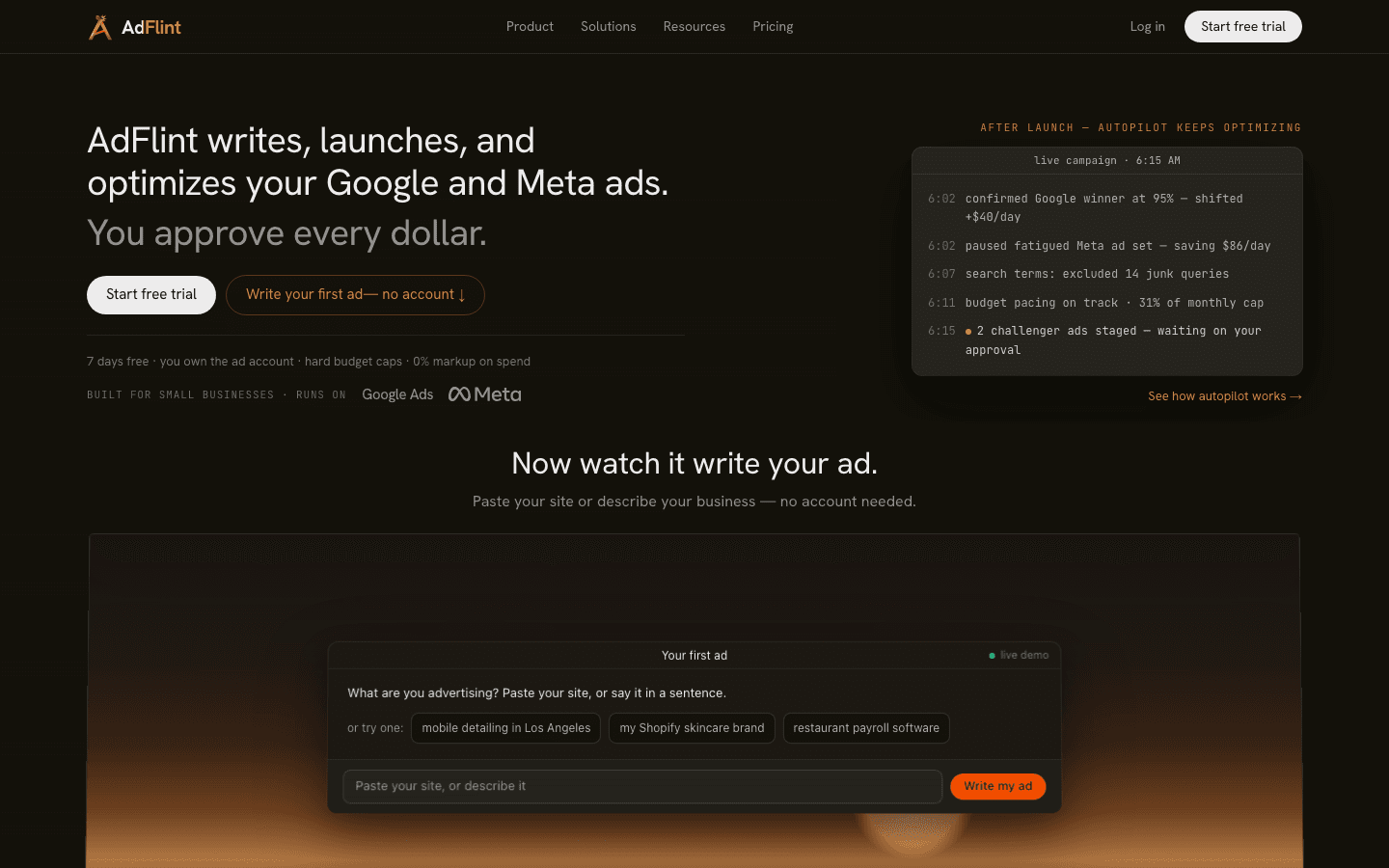
Best under $2,500/month in spend - software instead of a hireOur product — disclosureDisclosure first: AdFlint is our product, so read this as a first-party description, not an independent review. It exists for the exact gap the two entries above leave open - the business spending a few hundred to a few thousand dollars a month, where every human option costs as much as the media itself. The AI writes the ads, launches the campaigns, and runs ongoing optimization on Google and Meta, inside your own ad account rather than a house account you can lose access to.
Two design choices matter for anyone burned by 'set and forget' tools. Every ad requires human approval before it goes live - the AI drafts, you approve. And budgets are enforced with hard caps tied to your plan tier, so a runaway campaign cannot outspend the ceiling you set. Self-serve pricing is a flat software fee: the pricing page states plainly that 'AdFlint never takes a percentage of your spend.' At the plan ceilings that works out to about 4% of spend on Launch and 3.6% on Growth, against the 10-20% agency benchmark - or far worse than that benchmark in practice, since a $1,000 minimum retainer on a $2,000 budget is 50%. The one exception is the optional Managed tier, which is quoted on a call as a monthly floor plus a share of managed spend.
The honest limits: it covers Google and Meta only, self-serve plans do not include a human strategist, and as a young product it does not yet have a public review base on G2 or Capterra you could check us against - which is exactly the standard we applied to everyone else on this page. If you want a person to call, hire the freelancer at rank 1 or ask about the Managed tier, where AdFlint runs Google and Meta end-to-end with approval-by-exception.
Pros
- + Flat $40-$89/month - an order of magnitude cheaper than any human option
- + Runs inside your own Google and Meta ad accounts; you keep everything if you leave
- + Human approval required on every ad before it spends
- + Hard budget caps, and no percentage of ad spend taken on any self-serve plan
- + 7-day free trial on every self-serve plan
Cons
- − Google and Meta only - no TikTok, Microsoft, or programmatic
- − No human strategist on self-serve plans; you still approve and read the summaries
- − No public third-party review base yet, so you cannot check our claims against G2 or Capterra the way you can for older vendors
Ideal for
- Businesses spending under $2,500 a month, where retainers do not pencil
- Owners who want to approve every ad but not write or manage them
- Google + Meta advertisers who want enforced budget ceilings
Pricing: Fetched from adflint.com/pricing, July 2026: Launch $40/month (up to $1,000/month spend; Google and Meta setup, AI ad copy, budget pacing and conversion tracking), Growth $89/month (up to $2,500/month spend; adds priority optimization checks and weekly summaries), Managed custom-priced on a call (AdFlint runs Google + Meta end-to-end with approval-by-exception). Each self-serve plan starts with a 7-day free trial, card required, and takes no percentage of ad spend; the Managed tier is billed as a flat monthly floor plus a share of managed spend, quoted on the call.
Try AdFlint freeWordStream / LocaliQ managed services
Best for local businesses that want one vendor across search, social, and listingsWordStream's software era is over: the brand now operates as part of LocaliQ, the Gannett/USA TODAY marketing arm, and what is actually for sale is LocaliQ's managed advertising. The free WordStream tools survive - the Google Ads Performance Grader remains a genuinely useful first diagnostic before you pay anyone. The paid product is a done-for-you service: LocaliQ states it places ads across 'the 98% of search environments consumers use,' pairs 'certified experts in Google Ads, Microsoft Ads, Yelp, and other key platforms' with AI that adjusts bids, budgets, placements, and ad copy, and typically launches campaigns 'within 3-5 business days.'
The pitch is breadth plus data: keyword plans built on insights from a claimed 3.4M+ campaigns, and one vendor for search ads, social, and local listings - genuinely convenient for a service business with no marketing staff. But two things kept it out of the top three. First, there is no published pricing anywhere; every path on the site ends at a demo call, which makes comparison shopping impossible and negotiating blind. Second, the public review record is rough: 1.5/5 across 8 reviews on Clutch, and 2.6/5 across 52 reviews on Sitejabber for the ReachLocal-era service, with 'negative ROI' appearing verbatim in the complaints - alongside genuinely happy long-term customers.
If you evaluate them, ask in writing what happens to your campaigns, history, and lead data if you cancel, and get the total of media plus management fee itemized before signing anything.
Pros
- + Real human management plus established optimization tech from one vendor
- + Covers Google, Bing, Yelp, display, and social in a single relationship
- + Fast claimed launch (3-5 business days)
- + Free WordStream grader tools are useful regardless of whether you buy
Cons
- − No published pricing at all - every path leads to a sales call
- − Public review aggregates are poor: 1.5/5 on Clutch (8 reviews) and 2.6/5 on Sitejabber for the ReachLocal era (52 reviews)
- − Built around LocaliQ's own platform, so clarify data and campaign portability before you sign
- − Sales-led model makes it hard to comparison-shop against the transparent options above
Ideal for
- Local service businesses with no in-house marketing at all
- Owners who value one throat to choke across many channels
- Businesses already using LocaliQ listings or website products
Pricing: Not published. LocaliQ's site (checked July 2026) shows no pricing tiers, minimum budgets, or management-fee structure for Search Ads or any managed product; all paths route to a demo/sales call. Budget for media cost plus a management fee, and get both itemized in writing before signing.
Visit WordStream / LocaliQ managed services“We were extremely happy with all aspects of every marketing campaign we had with LocaliQ.”
— President, Town Square Furniture - 5.0-star review on Clutch, April 26, 2023
Google Ads free onboarding support
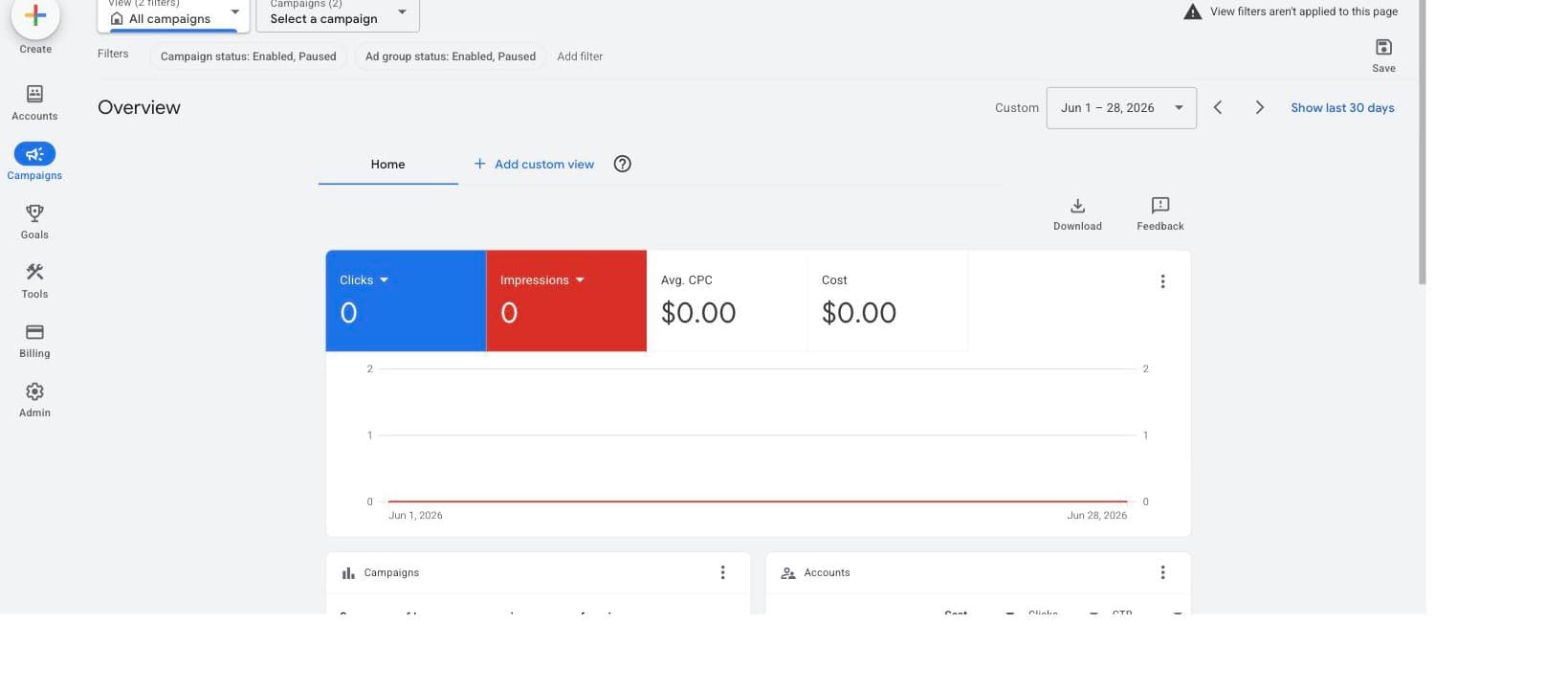
Best free starting point before you pay anyoneBefore you hire anybody, use the help Google gives away. New advertisers can schedule a 1-to-1 call or chat with a Google Ads specialist within the first 30 days of signing up, and the published scope is real work, not a sales script: hands-on guidance to launch your campaign, help to 'design a media plan, select the right keywords, and optimize your budget,' and a walkthrough of current platform features. Phone support runs Monday to Friday, 9am-9pm ET, and Google publishes no spend requirement for any of it.
The platform economics also favor starting here: Google publishes no minimum spend for Google Ads, and its Help Center confirms 'You can edit your average daily budget at any time,' so you keep your hand on the meter from day one. For a first campaign, thirty minutes with an onboarding specialist plus a conservative daily budget will get the account structure, conversion tracking, and billing set up correctly - which is most of what a bad freelancer would have charged you to do badly.
Understand what this is not. It is onboarding, not management: nobody at Google watches your account week to week, and the 1-to-1 window is the first 30 days. And the incentive structure is worth naming plainly - this is free advice from the company that sells the clicks, so expect recommendations to lean toward Google's automated defaults and broader targeting. Take the setup help; make the budget decisions yourself.
Pros
- + Completely free, with no published spend requirement
- + 1-to-1 setup help directly from the platform: media plan, keywords, budget
- + Phone and chat support beyond the onboarding window
- + No minimum spend; budgets are adjustable any time
Cons
- − The 1-to-1 onboarding window is only the first 30 days of a new account
- − It is setup help, not ongoing management - nobody optimizes your account for you afterward
- − The advice comes from the seller of the ad inventory; recommendations skew toward Google's automated defaults and bigger reach
Ideal for
- Brand-new advertisers in their first 30 days
- Anyone about to hire help, who wants the account plumbing correct first
- Bootstrapped businesses not ready to pay for management at all
Pricing: Free. Google publishes no minimum spend for Google Ads, and its Help Center states 'You can edit your average daily budget at any time.' The 1-to-1 onboarding call, phone line (Mon-Fri 9am-9pm ET), and chat support carry no fee, and Google attaches no published spend requirement to them (checked July 2026).
Visit Google Ads free onboarding supportIn-house PPC hire
Best when paid ads are a core, full-time functionThe most expensive option on this page, and for a narrow slice of businesses, the correct one. Indeed's aggregated posting data (updated July 15, 2026) puts the average US PPC specialist at $66,584 a year, with a range of $41,431 to $107,009 - before benefits, payroll taxes, and tools. Against the WebFX benchmark of 10-20% of spend for outsourced management, a full-time salary starts beating an agency fee somewhere around $30,000-$50,000 a month in media spend, or earlier if the role also owns landing pages, analytics, and creative.
What you buy is attention and context that no retainer matches: someone who knows your margins, sits in your product meetings, and can react to inventory or seasonality the same morning. What you risk is concentration - one person is your entire paid-media capability, and if nobody else in the building can evaluate PPC work, you will not know whether the hire is good until the spend data tells you.
The pragmatic path most companies actually take: start with the rank-1 freelancer, and when the account has grown to the point where their invoice approaches a salary, convert the function in-house - often by hiring the freelancer.
Pros
- + Full-time attention and same-day reaction speed
- + Deep institutional knowledge: margins, seasonality, product roadmap
- + Can own the whole funnel - landing pages, tracking, creative - not just bids
- + No management fee scaling with your ad spend
Cons
- − Highest fixed cost: $66,584 average salary before benefits and tools (Indeed, July 2026)
- − Hard to vet if nobody internally can judge PPC skill
- − Single point of failure for the entire channel
- − Only pencils out at spend levels most small businesses never reach
Ideal for
- Businesses spending roughly $30K+/month where agency percentages exceed a salary
- Companies where paid acquisition is the primary growth channel
- Teams ready to build marketing as a permanent function
Pricing: US average salary of $66,584/year for a PPC specialist, range $41,431-$107,009, per Indeed's aggregate of 131 posted salaries (updated July 15, 2026). Add roughly 20-30% for benefits and employer taxes, plus tooling, to estimate the true annual cost.
Side by side.
| Option | Best for | Starting price | Platforms covered | Standout limitation |
|---|---|---|---|---|
| Freelance PPC specialist | $1K-$5K/mo spend, one accountable human | Varies; vetted networks from $1,800/mo (Mayple) | Google Ads, plus whatever the specialist covers | Quality variance; vetting is entirely on you |
| Boutique PPC agency | $5K+/mo spend, multi-channel | About $750-$3,000/mo or 10-20% of spend | Google, Meta, shopping, and beyond | Fees exceed most small media budgets |
| AdFlint (our product) | Under $2,500/mo spend, software route | $40-$89/mo flat self-serve, 0% of spend | Google + Meta | No human strategist on self-serve plans |
| WordStream / LocaliQ | Local businesses wanting one vendor for everything | Not published; sales call required | Google, Bing, Yelp, display, social | Opaque pricing and rough public review scores |
| Google's free support | New advertisers in their first 30 days | Free | Google Ads only | Onboarding help, not ongoing management |
| In-house hire | Ads as a core full-time function | $66,584/yr average salary (Indeed) | Whatever you hire for | Highest fixed cost; single point of failure |
How we chose.
This is a researched comparison, not a hands-on test. We have not hired each provider on this page and run campaigns through them, and nothing below claims otherwise. What we did do: fetch every vendor's official pricing and product pages in July 2026 (AdFlint, Mayple, Toptal, MarketerHire, LocaliQ, WordStream, and Google's own support and budget documentation), pull published market-rate benchmarks from WebFX's PPC pricing guide and salary data from Indeed, and quote real reviewers verbatim from public review pages, with the source and URL attached to each quote.
Where a vendor publishes no rate card - LocaliQ and Toptal both route every pricing question to a sales call - we say so plainly rather than guessing. MarketerHire also quotes per engagement, but it does publish a typical range on its site, so we cite that figure rather than calling its pricing hidden. Some sources blocked automated access during this research pass: Upwork's own rate pages, G2, Capterra, Trustpilot, TrustRadius, and ZipRecruiter all returned errors, so no figures or quotes on this page come from them. Where we could not verify a number, it does not appear.
AdFlint is our product. Its entry carries a visible disclosure tag, and you should read it as a first-party description held to the same factual standard as the rest of the page, not an independent review. We ranked it where the fee-to-spend math actually puts it - third, for a specific budget tier - rather than at the top.
- — Verifiable cost: pricing had to come from a live fetch of the vendor's own pricing page in July 2026, or be explicitly flagged as unpublished.
- — Fee-to-spend ratio: we judged every option against a realistic small-business media budget, not an enterprise one, and ranked by tier of monthly spend.
- — Account ownership: whether the campaigns, history, and conversion data live in an ad account you control if you leave.
- — Accountability structure: trials, month-to-month terms, and cancellation friction, as published by the vendor.
- — Independent review signal: where a public review page could actually be fetched, we read it and quoted it verbatim - including when the aggregate scores were ugly.
- — Honest scope: what the option genuinely covers (platforms, hours, strategy depth) rather than what its marketing implies.
Common questions.
How much does it cost to hire someone to run Google Ads?
The published market benchmark (WebFX, checked July 2026) is 10-20% of your ad spend or $1,000-$3,000 a month for professional management. Vetted freelancer networks that publish numbers run from about $1,800 a month (Mayple, on $5K-$10K media budgets) up to MarketerHire's stated $5,000-$20,000+ a month; independent freelancers hired directly often charge less, and software like AdFlint runs $40-$89 a month flat on its self-serve plans. Whatever you are quoted, ask whether it is a flat fee or a percentage of spend - the incentive difference matters.
Is it worth paying someone to manage Google Ads?
It depends on the ratio of fee to media budget. At $5,000+ a month in spend, a competent manager typically recovers their fee in avoided waste. Under about $2,500 a month, a $1,000 retainer can cost more than the mistakes it prevents - at that level, use Google's free onboarding to set up correctly and consider software before a retainer.
How do I vet a Google Ads freelancer before hiring?
Ask for a read-only audit of your account before any contract, require that campaigns run in an ad account you own with the freelancer added as a manager, and ask for a 90-day plan with specific metrics rather than promises of ROAS. Prefer networks with paid-only-if-satisfied trials (Toptal offers up to two weeks), and treat marketplace escrow as payment protection, not quality assurance - the recurring complaint in Upwork's public reviews is weak dispute resolution after bad work.
Will Google run my ads for me if I ask?
Google offers real free help - a 1-to-1 call or chat within your first 30 days that covers media planning, keyword selection, and budget setup, plus ongoing phone support Monday to Friday. But it is onboarding, not management: nobody at Google monitors or optimizes your account week to week, and the advice naturally leans toward Google's automated defaults, since Google sells the clicks.
Should my ads run in my account or the agency's account?
Yours, almost without exception. If campaigns run in a provider's account, your history, learning data, and conversion tracking can vanish when you leave, and rebuilding from zero resets performance. Any freelancer, agency, or software worth hiring can work inside an account you own - if a provider insists otherwise, ask exactly what you keep when you cancel, in writing.
What does AI ad management software do that a freelancer does not?
Software handles the mechanical layer - writing ad variants, launching campaigns, watching budgets daily, and applying optimizations - at a flat monthly price far below human rates, which is why it fits budgets where retainers do not. What it does not do is strategy: positioning, offer design, and judgment calls about your business. Above a few thousand dollars a month in spend, the strongest setups pair a human strategist with automated execution rather than choosing one.
Keep reading
- DIY vs Agency vs AI: What Ad Management Costs
- What a PPC Retainer Actually Buys You Each Month
- How to Fire Your Ad Agency Without Losing Data
- Ad Account OAuth Scopes: What a Tool Really Gets
- Google Ads Advertiser Verification Deadline
- Guide: Google Ads Bidding Strategies: The Complete Guide
- Guide: Ad Budgets, Pacing, and What Ad Management Costs
- AI Ad Management Software vs a Freelance PPC Specialist
- Done-For-You Ad Management vs a PPC Agency
- Freelance PPC Specialist vs Hiring In-House
- Marketing Consultant vs PPC Agency: Advice or Execution
- Monthly Retainer vs Performance-Based Pricing
- Flat Fee vs Percentage of Ad Spend
- Free tool: Google Ads Budget Calculator
- Free tool: ROAS Calculator
- Free tool: Cost Per Acquisition Calculator
- Free tool: Google Search Ad Preview & Headline Checker