Google or Meta Ads First? Decide by Budget
If you have one budget and cannot split it, the default is Google first below about $5,000 a month, and at $5,000 and above you can afford both if you sequence them rather than split on day one. The reason is arithmetic, not preference. Meta needs a minimum number of conversion events per week before its delivery system stops guessing. Google does not. Below roughly $5,000 a month most advertisers cannot buy enough events to clear that bar at a real purchase or lead, so a Meta-first budget spends its whole life in the learning phase. Google will take $16 a day and put your ad in front of the handful of people who typed your product into a search box today.
That default flips for specific, checkable reasons. This is a sequencing guide: which platform to start on at your budget, why, and the five diagnostics that override the default. If what you want is the conceptual difference between the channels — intent versus interruption, targeting, creative, attribution — read Facebook Ads vs Google Ads instead. This page assumes you know the difference and only need to know which one gets the money first.
The one mechanic that decides everything: Meta’s learning phase
Meta’s own Business Help Center documentation says an ad set stays in the learning phase until it gets roughly 50 optimization events in a 7-day window. Optimization event means whatever you told the ad set to optimize for. If you optimize for purchases, you need about 50 purchases a week per ad set. Not per account. Per ad set.
Now do the multiplication. Your cost per acquisition times 50 is the weekly budget that exits learning. That single sum is the honest answer to “can I start on Meta?”
| Your CPA on the event | Weekly spend for 50 events | Monthly equivalent | Meta-first realistic? |
|---|---|---|---|
| $5 (cheap upper-funnel event) | $250 | ~$1,080 | Yes, but you are optimizing for a signal, not a customer |
| $20 (lead form) | $1,000 | ~$4,330 | Only at the top of a $1,500–5,000 budget, with the whole budget in one ad set |
| $40 (qualified lead or low-ticket purchase) | $2,000 | ~$8,670 | Not at $5,000. Needs roughly $8,700 a month pointed at Meta alone |
| $80 (considered purchase) | $4,000 | ~$17,330 | No, unless you optimize a cheaper upstream event |
Provenance: the 50-events-per-7-days figure is published by Meta and linked above. Every number in this table is our arithmetic on that figure (CPA × 50, then × 52/12). The CPA values in the left column are illustrative brackets, not measured results and not AdFlint customer data.
Google has no equivalent published event floor for a manual-CPC or maximize-clicks search campaign. Its automated bidding does have a data appetite — Google’s help documentation for Target CPA bidding recommends conversion history before the strategy has enough to work with — but a small campaign on manual or maximize-clicks bidding still puts your ad in front of people with active intent from day one. That is the structural asymmetry. Google can run usefully small. Meta mostly cannot.
The budget tiers
| Monthly ad budget | Start with | Why | What this budget cannot prove |
|---|---|---|---|
| Under $500 | Google, narrowly | ~$16/day buys real intent clicks; $115 a week on Meta clears 50 events only if your CPA is under about $2.30 | Statistical confidence in anything. You are buying a yes/no, not a benchmark |
| $500–1,500 | Enough clicks to find which search terms convert; still far under Meta’s 50-event weekly bar at a real CPA | Whether Meta would have worked. You are deferring that question, not answering it | |
| $1,500–5,000 | Google, unless a diagnostic below flips it | First tier where Meta-first is arithmetically defensible — at the top of the band, with a cheap event and one consolidated ad set | Both at once. Splitting here usually starves both |
| $5,000+ | Both, sequenced — not split on day one | Budget stops being the binding constraint once CPA × 50 fits inside the share you can hand to Meta while search keeps running | Little that is structural — though at the bottom of this band a $25+ CPA still will not clear learning on the Meta half |
Provenance: arithmetic and judgement built on the published Meta learning-phase threshold. The spend-band context comes from our Google Ads cost guide and Facebook ads cost guide. We have no product analytics on what AdFlint customers choose and are not implying any.
Under $500 a month: Google, and keep it deliberately small
$500 a month is about $16 a day. Work it with your own inputs, not ours: at a $4 cost per click that is four clicks a day, roughly 120 a month, and at a 5% landing page conversion rate about six leads. Thin, but each click is a person who typed your service into a search box. On Meta the same $16 a day at a $20 lead cost is five or six events a week — a tenth of what the ad set needs to stop exploring. You would pay for exploration for months and never reach steady-state delivery.
The setup that makes $500 work: one campaign, one ad group, three to eight exact-match keywords that describe the purchase and not the research, a tight geo radius, and a phone number above the fold. Do not enable broad match at this budget — that is exactly the failure mode we wrote up in why Google Ads wastes money for beginners.
There is one condition where under-$500 Google also fails: verticals with double-digit cost per click, of which legal, insurance, restoration and B2B software are the usual examples. Do not take a benchmark’s word for it — pull your own phrases in Keyword Planner and read the top-of-page bid range. If $16 a day buys one click, that is a rounding error, not a test. The answer then is neither platform yet: raise the budget, or use Local Services Ads where they exist for your trade, which are priced per lead rather than per click. Run your own numbers in the ad budget calculator before you commit.
$500–1,500 a month: still Google, now with room to prune
$16–50 a day is the first budget that produces enough search terms to make decisions with. The value here is not volume, it is the search terms report: after three to four weeks you can see the exact phrases people used, add negatives, and push the winners. That feedback loop does not exist on Meta, where there are no keywords to prune.
Meta at this tier is still out of reach for a purchase or qualified-lead objective. At $1,500 a month you have about $350 a week; 50 events needs a CPA under $7. If your CPA genuinely is under $7 — a newsletter signup, an app install, a low-friction quiz — Meta-first is legitimate here. Be honest about whether that event is worth money or is just a number that makes the dashboard look busy.
$1,500–5,000 a month: the first genuine fork
$50–165 a day. This is where the default stops being automatic. At the top of the band, $5,000 a month is about $1,150 a week, which clears 50 events at a $23 CPA. That is the first point where a Meta-first strategy can reach steady-state delivery on a real lead, provided you concentrate the entire budget in one ad set rather than spreading it across five. Every extra ad set divides your event count and pushes each one back into learning.
Choose Meta at this tier if the diagnostics below point that way. Otherwise the sequence that wastes least is Google for six to eight weeks until CPA is stable, then Meta on top-up budget rather than by cutting search. The one thing not to do here is split 50/50 on day one: $2,500 each puts Google in a fine position and Meta permanently in learning. This is the first band where a small business advertiser gets a real choice rather than a forced one, which is why it deserves the diagnostics below rather than a default.
$5,000+ a month: run both, but sequence the launch
Above $5,000 the constraint is execution, not arithmetic. The launch order that wastes least, step by step:
- 1. Install both pixels first. Google tag and Meta pixel firing correctly before a dollar moves, even though only one platform gets funded this month.
- 2. Define one primary conversion. The same event on both platforms, so the CPA numbers are comparable later.
- 3. Launch search only. One campaign, tight keyword set, manual or maximize-clicks bidding until conversions accumulate.
- 4. Let it run two to three weeks. Prune search terms weekly. Do not touch bids daily.
- 5. Compute the Meta minimum before you launch it. Your observed CPA from search × 50 is the weekly budget the Meta ad set needs on its own.
- 6. Fund Meta at that number, not with leftovers. If what is left is smaller than the minimum, delay Meta rather than underfund it.
- 7. Launch one Meta ad set, not five. Broad targeting, three to five creatives inside the single ad set.
- 8. Segment branded and non-branded search before you compare. Branded search volume often rises once Meta launches, which flatters your blended Google CPA.
Five diagnostics that override the budget default
Run all five. Any one of them can beat the tier table.
| Question | How to check it in 20 minutes | If the answer is no |
|---|---|---|
| Does anyone search for what you sell? | Google Keyword Planner on your three core purchase phrases, filtered to your metro | Meta first regardless of budget. You cannot capture intent that does not exist |
| Is the product visual? | Can a still image or 10-second video make someone want it who was not looking? | Google first. Meta with weak creative is an expensive way to be ignored |
| Is it an emergency purchase? | Burst pipe, lockout, towing, urgent care, same-day repair | Not decisive on its own. But if yes, Google first at every budget — nobody scrolls a feed with a flooded kitchen |
| Is your lifetime value high enough to absorb a long learning period? | CAC to LTV calculator. If lifetime value is under about 3× your target CAC, you have no slack | Google first. Meta’s learning period is paid for out of margin you do not have |
| Can you track the conversion at all? | Pixel or tag firing, and a landing page that works — ad-readiness checklist | Neither yet. Both platforms optimize on the events you send them; no events means no optimization on either |
Provenance: judgement and arithmetic, plus the linked Google Keyword Planner documentation. Not measured outcomes.
The strongest override is the first one. If Keyword Planner shows single or double-digit monthly volume for your purchase phrases in your area, the budget table is irrelevant — you sell something nobody knows to look for, and Meta is the only channel that can create the demand. Accept that under $1,500 a month you are buying awareness and a very slow learning curve, and set expectations accordingly.
How to tell you picked wrong, and when to switch
- Google, week 4, no conversions and under 100 clicks. The budget is too small to have learned anything. Do not switch platforms; narrow the keywords or raise the budget.
- Google, week 4, 300+ clicks and no conversions. The problem is the landing page or the offer, not the platform. Switching to Meta will reproduce it more expensively.
- Meta, week 3, ad set still shows learning. Consolidate ad sets, or move the optimization event one step earlier in the funnel, or accept that your budget is below the floor and move to search.
- Either platform, CPA is 3× your target and stable. Stable and wrong is a unit-economics answer, not a testing answer. Fix price, offer, or close rate before you spend more.
Give any first test three to four weeks. Both platforms spend the first week or two calibrating, and a decision made on day five is a decision made on noise. Our Facebook ads cost guide and Google Ads cost guide both break down what each spend band can and cannot prove; read whichever matches the platform you picked.
What management costs on top, at each tier
Whatever you decide, the management layer has to be small enough not to distort the maths — a percentage-of-spend agency at $500 a month is usually a minimum retainer that dwarfs the ad budget. Here is our own ladder, stated plainly so you can compare it against anything else.
| Ad spend covered | AdFlint plan | Flat monthly fee | Fee as % of max covered spend |
|---|---|---|---|
| Up to $100/mo | Starter | $10 | 10% |
| Up to $1,000/mo | Launch | $40 | 4% |
| Up to $2,500/mo | Growth | $89 | 3.6% |
| Up to $5,000/mo | Scale | $109 | 2.2% |
| Up to $10,000/mo | Accelerate | $119 | 1.2% |
| Up to $20,000/mo | Performance | $219 | 1.1% |
| Up to $30,000/mo | Premium | $319 | 1.1% |
Provenance: fees read from our own plan configuration on 31 July 2026; the percentage column is our arithmetic against the top of each spend band, so your real percentage is higher if you spend below the cap. Above $30,000 is quoted. Full detail on pricing.
The scoping that matters, because it is the sentence most tools get wrong about themselves: these self-serve plans are a flat monthly fee with 0% markup on ad spend — your card pays Google and Meta directly, and you keep ownership of the ad accounts, because we connect to accounts you own rather than pooling you into ours. Our separate done-for-you Managed tier is a different model: a $249/mo floor plus a share of the ad spend it manages, operator-provisioned rather than self-serve. So “0% of spend” is true of the self-serve ladder and not of Managed. If a tool tells you it takes zero percent, ask which of its tiers that applies to.
Starting on one platform without building two of everything
The friction in sequencing is that the platform you defer still needs an account, a pixel, and creative when its turn comes. Set up tracking for both on day one even if you fund one — a Meta pixel collecting data for eight weeks before you spend anything is free warm-up for the learning phase you are eventually going to pay for.
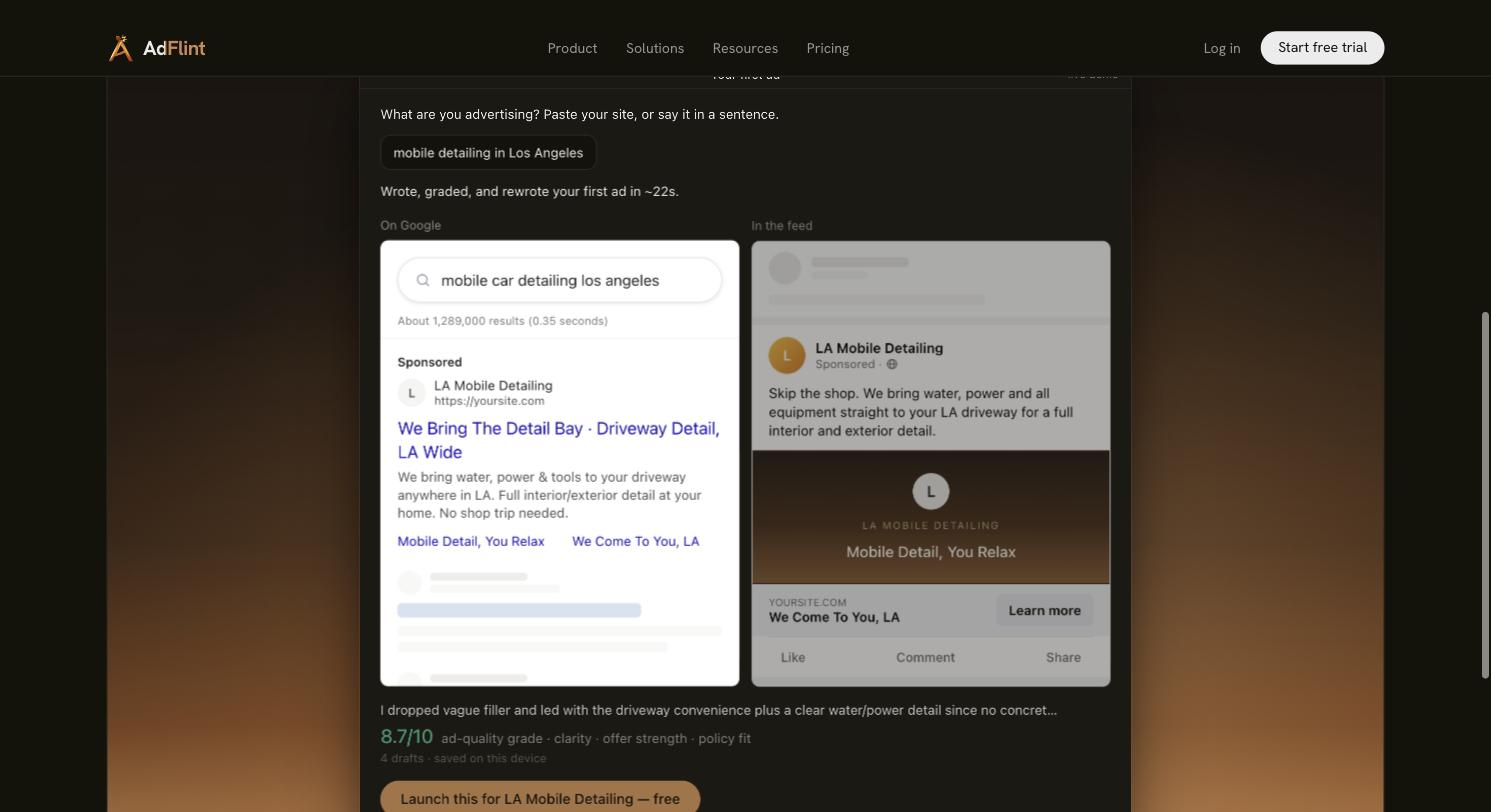
Our own live demo, run by us on AdFlint: the prompt “mobile detailing in Los Angeles” produced a Google search ad and a Meta feed preview in about 22 seconds, four drafts, self-graded 8.7/10. A self-grade is a quality check on the copy, not a performance result — it says nothing about CTR or CPA.
That is the shape of what we built AdFlint to do for small business advertisers: generate for both platforms, launch on the one your budget supports, enforce hard budget caps so a misconfigured campaign cannot outrun you, and keep optimizing after launch rather than at a monthly review. There is a 7-day free trial, and how it works walks the setup end to end. To understand the automation logic first, AI ad optimization for small business covers what should and should not be automated at these budgets.
What we do not know
Stated plainly, because the internet is full of pages that would fake it: we have not run sustained live ad spend of our own, so there are no ROAS figures, no case studies, and no client results on this page. We have no product analytics telling us which platform AdFlint customers pick first or at what budget, so we have not implied a trend. Every number above is either arithmetic you can redo yourself, a fee read off our own plan configuration, or a published figure with a link to its source.
The decision is simpler than the industry makes it sound. Multiply your conversion cost by 50. If that weekly number is bigger than your weekly budget, Meta cannot learn on your money yet, and Google gets the spend. When you are ready, start with AdFlint for small business, or read the platform-specific setup guides for Google Ads and Facebook Ads. And if you land above $5,000 a month and want both running together, Google and Meta in one place is the configuration that stops you managing two dashboards by hand.
Related guides
DIY vs Agency vs AI: What Ad Management Costs
At $1,000 a month in spend an agency can barely pay for itself; at $20,000 it can. DIY is cheapest only if your hour is worth under $14. Assumptions shown.
How Much Do Google Ads Cost for a Small Business?
Budget $500 to $2,000 for a first test, then judge it on CPC, conversion rate, and cost per conversion. How to size a test that teaches you something real.
AI Ad Optimization: What It Can and Cannot Do
AI handles budget pacing, channel mix, copy variants, and delivery alerts well. It should never touch your offer or claims unattended. The guardrails to set.
Skip the learning curve
AdFlint writes, launches, and optimizes Google and Meta campaigns inside the ad account you own — you approve every ad, and hard budget caps protect your spend. 7-day free trial.
Free tools: ad copy generator, ROAS calculator, budget calculator · ads by industry