Best Facebook Ads Tools for Restaurants (2026)
By the AdFlint research team · We run live campaigns on these platforms; every screenshot is from our own sessions · Published August 3, 2026 · Updated August 3, 2026
TL;DR
- One location spending under about $300 a month: use Meta Ads Manager itself, free, with a radius audience and an Order Now or Book Now button. Every paid tool on this page would eat 15-30% of a budget that size before a single ad ran.
- Independent restaurants with 1-3 locations and $300-$2,500 a month: AdFlint (our product - disclosure) writes, launches and watches Google and Meta campaigns for a flat $40-$89 a month with 0% of ad spend on self-serve plans, hard budget caps and your approval before anything goes live. It has no Toast, OpenTable or Square integration and no restaurant track record - both spelled out below.
- Restaurant groups rotating weekly specials across locations: Birch (formerly Revealbot). Its Stage product turns a planning Google Sheet plus Drive folders into bulk ads across Meta, TikTok and Snapchat. Know the catch we found on its own in-app billing slider: automated rules are NOT in the $49 Essential plan - you need Pro at $99 a month at the lowest spend tier.
- Delivery-first brands with a Meta pixel on their ordering flow: Madgicx. It is the only tool here with a checkable public review from a food business - Jet Italian Deli, an Italian deli reviewing on the Shopify App Store, not a dining room - and we have not tested it. Meta-only, and the price is shown only inside the app (pricing page checked 3 August 2026).
- Franchise systems with 20+ locations: SOCi - localized pages, listings, reviews and boosted local ads from one corporate console. Quote-only pricing behind a demo form (checked 3 August 2026). We have not tested it.
- Skip AdEspresso in 2026. Its $49 Starter caps ad spend at $1,000 a month - squarely inside the typical single-location restaurant budget, so you outgrow it almost immediately - and the product has been visibly coasting since January 2023. We have not tested it.
This page is for the owner or marketing lead of an independent restaurant or small restaurant group deciding what, if anything, to put between themselves and Meta Ads Manager. Search this exact phrase and you will find that eight of the current top ten results are '7 strategies' posts written by POS and online-ordering vendors whose real pitch is their own platform, and the two tool-shaped pages filter nothing for restaurants - one claims '17 tools tested' with no evidence any tool was opened. Nobody in the results answers the question a restaurant operator is actually asking: which of these tools understands that my conversion is a table booked, an order placed, or a person walking through the door - and which of them costs more than my ad budget can justify?
Start with the arithmetic, because it decides most of this page. Meta clicks are cheap in this category and restaurant budgets are small, which is a worse combination for software fees than it sounds. Our own published Food & Beverage benchmark row - category averages compiled from published industry data, not from campaigns we ran - puts the average Meta CPC at $0.63 with a 1.2% CTR, and typical monthly spend for the category between $500 and $4,000. At $0.63 a click, a $1,000 monthly budget buys roughly 1,500 clicks. A $99-a-month software fee is 157 of those clicks - about a tenth of your traffic, bought back as overhead. A $40 fee is 63 clicks. That difference is the whole ranking argument below, and it is why a tool priced for a $50,000-a-month e-commerce advertiser is simply the wrong instrument for a taqueria.
The second restaurant-specific problem is that your conversion arrives through three different funnels and only one of them is properly measurable. Online orders are trackable if your ordering provider lets your Meta pixel onto its pages - Toast and Square Online both expose a pixel field in their own settings documentation, so confirm it in your current account before assuming. Reservations largely are not: OpenTable completes bookings on its own domain, where you cannot install your pixel, so a completed booking reaches your ad account as nothing more than an outbound click. Walk-ins are proxies only - Meta's standalone Store Traffic objective was retired in the ODAX consolidation and folded into Awareness, so the honest measurement is direction requests, calls, and whether covers moved during the flight. Third, the creative: a weekly-special or happy-hour ad is stale in seven days, so the real workload is not bid management - it is constant creative rotation, which is exactly where owner-operators quit.
Our evidence base, stated plainly: we created a real trial account and worked inside Birch on 30-31 July and 3 August 2026, reading its pricing off its own in-app billing slider at every spend tier. AdFlint is our own product, which we disclose on its entry and weigh in the ranking. Madgicx, SOCi and AdEspresso we have not tested - those entries are built from their own documentation, live pricing pages and attributed public reviews, and each says so. And one more honesty note that matters on a vertical page: we have never run ad campaigns for a restaurant. Every restaurant-specific claim here - the alcohol-targeting rule, the lifetime-budget dayparting catch, the pixel situation on ordering platforms - comes from Meta's published policies and the platforms' own documentation, not from campaigns we ran. We think that beats the alternative on today's SERP, which is advice from companies trying to sell you a POS.
AdFlint
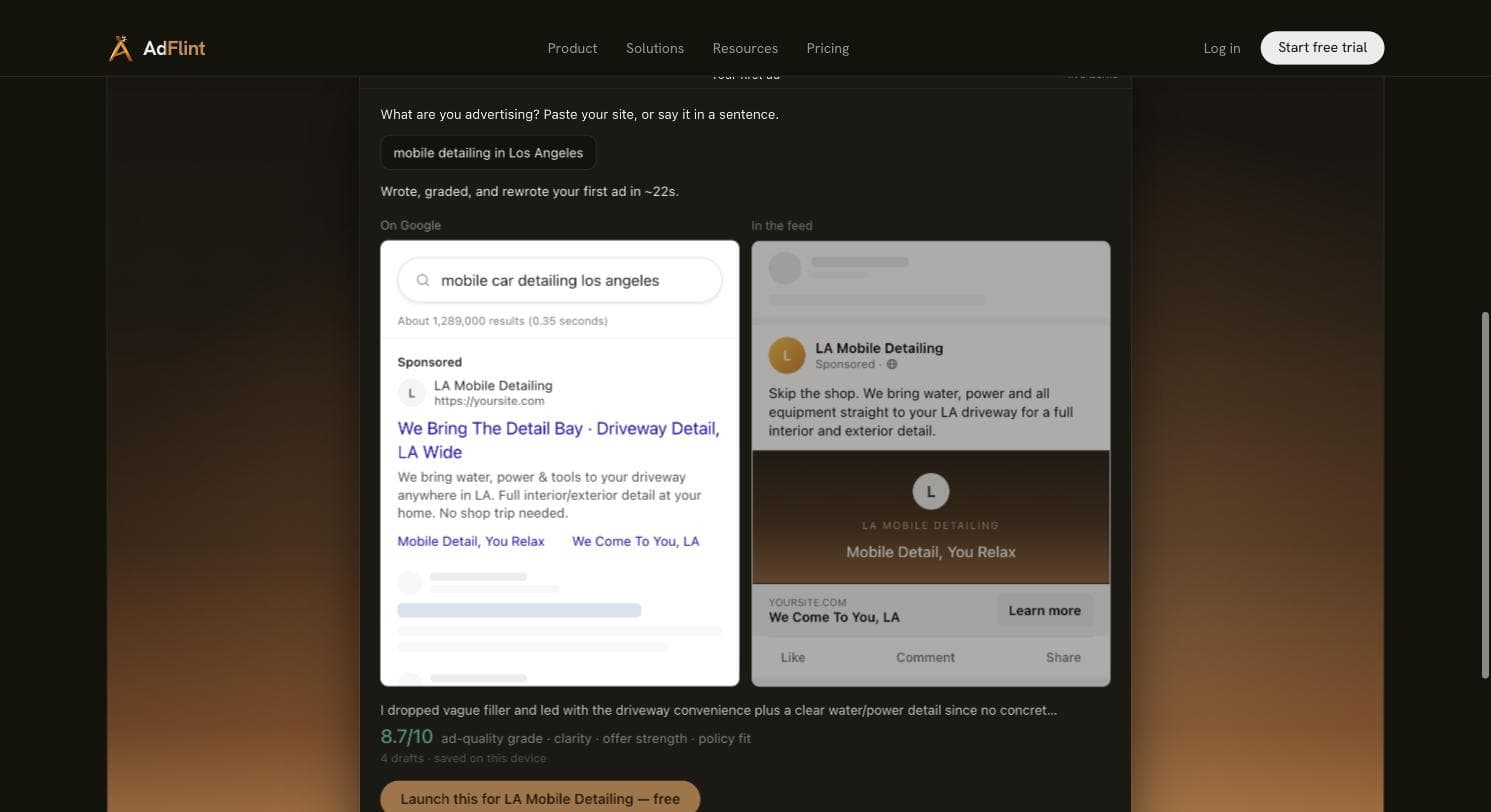
Best for independent restaurants (1-3 locations)Our product — disclosureAdFlint is our product - read this entry knowing that. It writes, launches and optimizes Google Ads and Meta campaigns on a connected-account model: you connect your own ad accounts with one-click OAuth, you own them, and your card pays Google and Meta directly. The fee is flat with 0% of ad spend on self-serve plans, there are hard budget caps the system cannot exceed, and nothing launches until you approve it. Our live public demo wrote, graded and rewrote an ad in about 22 seconds from a one-line business description, producing a Google search ad and a Meta feed preview and self-grading 8.7/10 across four drafts.
Why it leads this specific slice: the two costs that actually kill restaurant advertising are fee-to-budget ratio and creative cadence. Take the click math from the intro - at the category-average $0.63 Meta CPC, a $1,000 monthly budget is about 1,500 clicks. AdFlint's Launch tier is $40, which is 63 of those clicks, or 4% overhead. Birch's cheapest plan that includes automated rules is $99, or 157 clicks and 10%, and a typical agency retainer at this budget costs more than the media itself. On cadence: a weekly-special ad is dead in seven days, and rewriting copy every week is precisely the job owner-operators stop doing by week four. AdFlint's core loop is generating, grading and rotating that creative, which matters more for a taqueria's Tuesday special than any bid rule. Covering Google alongside Meta also matters more for restaurants than most verticals: 'open now', '[dish] near me' and '[your restaurant's name] menu' searches convert at the moment of hunger, and the Meta-only tools on this page never touch them.
Now the honest limits, because on a vertical page they are load-bearing. We have never run campaigns for a restaurant - AdFlint has no restaurant case studies, no ROAS figures to show you, and no third-party review presence on G2, Capterra or Trustpilot yet; the product is young and has not run sustained live spend at scale. It has no POS or reservation integrations: nothing native for Toast, Square, OpenTable or Resy, so conversion tracking is your Meta pixel and UTMs, which works cleanly for pixel-accessible online ordering but leaves reservation-led restaurants with click-proxies like everyone else on this page. And it is Google + Meta only - no TikTok, which is a genuine gap for restaurants, where short-form food video is the one organic-to-paid channel that reliably outperforms its budget.
One case where you should not buy us: if you are spending under about $300 a month, a $40 fee is 13% or more of your budget and the free native tool ranked third on this page is the correct answer - come back when the budget grows or a second location arrives. The way in is a 7-day free trial; self-serve tiers then run from $40 to $319 a month depending on how much ad spend they need to cover, and a managed done-for-you plan starts at $249 a month plus a share of managed spend for owners who want zero involvement. For a single location spending $500-$2,500 a month, the relevant tiers are Launch ($40, up to $1,000 of spend) and Growth ($89, up to $2,500).
Pros
- + Flat fee, 0% of ad spend on self-serve: $40/mo covers up to $1,000 of monthly spend - about 4% overhead, where rule tools with automation start at 10%
- + Writes, grades and rotates the ad creative itself - the weekly-special copy grind is the actual restaurant job, and this does it
- + You connect your own Google and Meta accounts via OAuth and keep ownership; hard budget caps and approval before anything launches
- + Covers Google search alongside Meta - 'open now' and '[dish] near me' intent that every Meta-only tool on this page ignores
- + 7-day free trial with no long-term contract
Cons
- − No restaurant track record: we have never run campaigns for a restaurant - or any other vertical - and there are no restaurant case studies or performance figures to show
- − No POS or reservation integrations - nothing native for Toast, Square, OpenTable or Resy; conversions rely on your pixel and UTMs
- − Google and Meta only: no TikTok, Snapchat, Microsoft or LinkedIn, and TikTok genuinely matters for restaurant marketing in 2026
- − Young product with no third-party review presence on G2, Capterra or Trustpilot yet, and no sustained live-spend history
- − Each self-serve tier hard-caps the ad spend it manages, so multi-location groups climb tiers quickly
Ideal for
- Single-location independents spending $300-$2,500 a month
- Owner-operators with no time to write and rotate weekly ad copy
- Restaurants that want Google search and Meta covered by one flat fee
Pricing: Self-serve, flat monthly fee, 0% of ad spend: Launch $40/mo (up to $1,000/mo ad spend), Growth $89 (up to $2,500), Scale $109 (up to $5,000), Accelerate $119 (up to $10,000), Performance $219 (up to $20,000), Premium $319 (up to $30,000), custom above that. Managed done-for-you from $249/mo plus a share of managed spend (managed only - the 0% figure applies to self-serve). 7-day free trial. From our own pricing page, August 2026.
Try AdFlint freeBirch (formerly Revealbot)
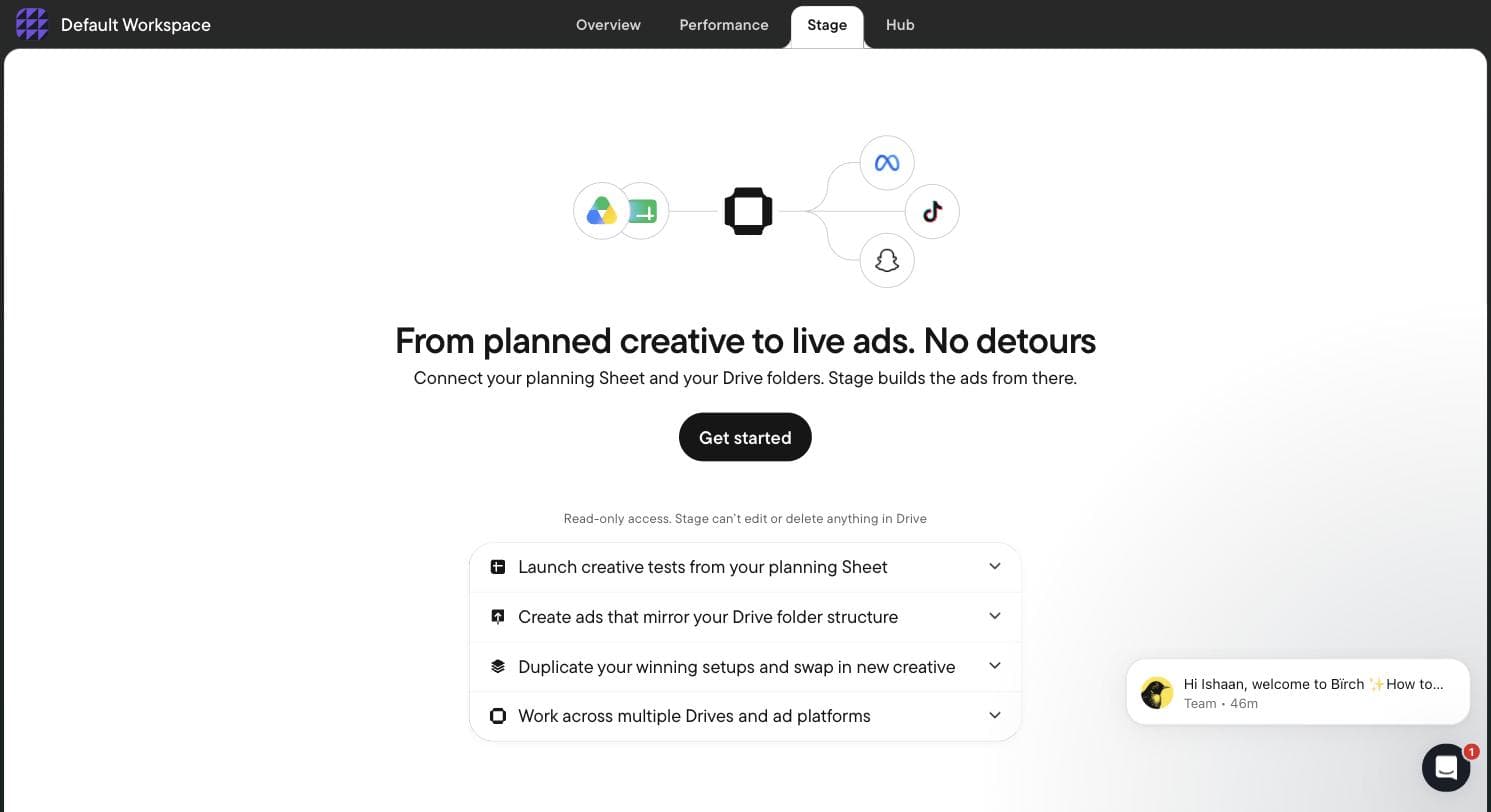
Best for weekly-special rotation across locationsWe created a real trial account and worked inside Birch on 30-31 July and 3 August 2026, so this entry is first-hand - the only third-party product on this page that is. Practical note before anything else: Revealbot rebranded to Birch, and both revealbot.com and bir.ch/signup currently 404 - the working signup is app.bir.ch/signup. Once you find it, signup is genuinely fast: under two minutes to a logged-in screen, no phone number, no credit card. Birch is now three products, not one: the rules engine everyone still reviews it for, Stage (a planning Google Sheet plus Drive folders that feed bulk ad creation for Meta, TikTok and Snapchat, with read-only Drive access), and Hub (Signals Gateway - server-side, first-party conversion tracking).
Stage is why Birch ranks this high on a restaurant page specifically. The recurring workload of restaurant-group advertising is rotation: this week's specials, next week's happy hour, per location, every week, forever. Stage's sheet-to-ads flow maps onto that almost perfectly - a marketing manager keeps one planning Google Sheet, drops creative in Drive folders, and pushes the week's ads in bulk across Meta, TikTok and Snapchat instead of hand-building ad sets per location in Ads Manager. It is the strongest weekly-creative workflow of anything we evaluated for this page. The rules engine earns its keep on the clock: per Meta's own documentation, ad scheduling is available only on lifetime budgets, so a lunch campaign on a normal daily budget cannot daypart natively - Birch's scheduled rules can start and pause campaigns by the hour, which is the practical workaround for lunch-versus-dinner delivery.
Two findings from inside the product that no pricing page will tell you. First, Birch gates hard on connecting a live ad account: there is no sandbox and no demo data, so the rule builder was entirely inaccessible on our unconnected trial - its empty state shows just three action types (increase bid, duplicate, notify). You cannot evaluate the core product without OAuth-ing a real ad account. Second, the pricing catch we read off Birch's own in-app billing slider: automated rules are not included in the $49 Essential plan. They are Pro-only, along with Explorer, Launcher, Stage, custom audiences and the Sheets, AppsFlyer and Hyros integrations - so the real entry price for everything that makes Birch worth buying is $99 a month at the lowest spend tier, and every 'Revealbot from $49' roundup you have read is quoting a plan that cannot do the thing restaurants would buy it for.
Fit notes: Birch's 12 integrations skew social and attribution - Meta, Google Ads, Google Drive, Snapchat, TikTok, YouTube, Google Analytics, Google Sheets, Slack, AppsFlyer, Adjust (beta), Hyros and Wicked Reports - with no Microsoft, Amazon or LinkedIn, which for a restaurant is irrelevant. More relevant: there is no OpenTable, Toast or Square integration either, so conversions are whatever your pixel or Hub's server-side gateway already sends. When the 14-day trial expires, rules and reports are disabled, and plan overages are billed automatically via Stripe.
Pros
- + Stage's sheet-to-ads bulk flow is the best weekly-special rotation workflow on this page: one Google Sheet drives ads across Meta, TikTok and Snapchat
- + Scheduled rules start and pause campaigns by the hour - the practical workaround for Meta allowing dayparting only on lifetime budgets
- + Hub's Signals Gateway offers a server-side, first-party tracking path as browser pixels keep degrading
- + Fast, low-friction signup: under two minutes, no phone, no card, 14-day trial
Cons
- − Automated rules are not in the $49 Essential plan - they require Pro at $99/mo at the lowest spend tier, which is 10%+ of a typical single-location restaurant budget
- − Gates entirely on connecting a live ad account: no sandbox or demo data, so the rule builder cannot even be seen until you OAuth a real account
- − No reservation or ordering integrations - nothing for OpenTable, Toast or Square; conversion data is whatever your pixel already sends
- − Post-rebrand link rot: revealbot.com and bir.ch/signup both 404; the working signup is app.bir.ch/signup
- − On trial expiry rules and reports are disabled, and overages are auto-billed via Stripe
Ideal for
- Restaurant groups with 3+ locations rotating weekly specials
- Marketing managers who already plan campaigns in Google Sheets
- Brands running TikTok and Snapchat alongside Meta
Pricing: Priced by total monthly ad spend across connected accounts, read off Birch's own in-app billing slider (July-August 2026): up to $10K/mo spend - Essential $49/mo, Pro $99/mo (annual $540 / $1,090); up to $30K - Essential $149, Pro $249 (annual $1,640 / $2,740); up to $75K - Essential $299, Pro $499 (annual $3,290 / $5,490); up to $150K - Essential $499, Pro $799 (annual $5,490 / $8,790); up to $300K - Essential not offered, Pro $1,299 (annual $14,290); $500K+ - Enterprise only. Automated rules, Stage and the key integrations are Pro-only. Annual billing is 12 months for the price of 11. Overages billed via Stripe. 14-day free trial, no card required.
Visit Birch (formerly Revealbot)“I tried Birch for about a month to support my campaign monitoring and performance analysis workflows. While the platform shows promise and has some useful features, it didn't fully meet my expectations in its current state.”
— Bhoomi Arora, Trustpilot review of Birch (formerly Revealbot), March 2026
Meta Ads Manager (native)
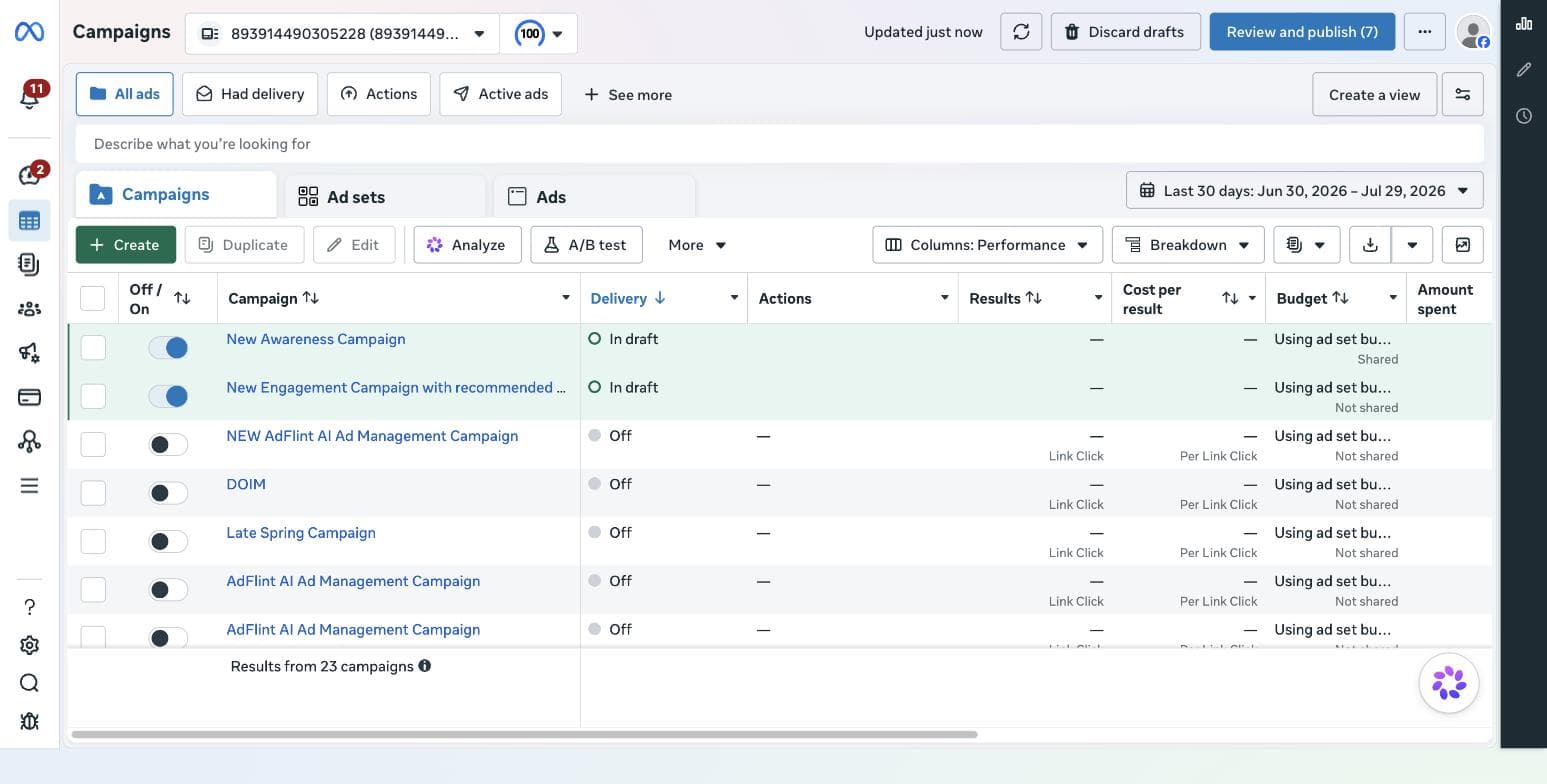
Best free baseline for every restaurantEvery tool on this page sits on top of Meta Ads Manager, and at typical restaurant budgets the native tool is not the fallback - it is the correct answer. It costs nothing beyond your ad spend, and it already has the restaurant-shaped pieces: radius targeting down to a 1-mile minimum around a pin (most urban restaurants draw from a 3-5 mile trade area, wider in the suburbs), and call-to-action buttons that map directly onto restaurant funnels - Order Now, Book Now, Get Directions, Call Now. One structural advantage restaurants should appreciate: unlike housing, employment and credit advertisers, restaurants are not a Meta special ad category, so the full targeting stack - radius plus age plus interest layers, and lookalikes - is available with no restrictions. Its free automated rules cover basic guardrails like pausing an ad set that spends past a threshold.
Three native catches are worth knowing before you blame yourself for them. First, dayparting: per Meta's documentation, ad scheduling is available only on lifetime budgets, not daily budgets - so the obvious restaurant move of running lunch ads until 1pm and dinner ads from 3pm requires either lifetime-budget campaigns, separate campaigns per daypart, or an external scheduler like Birch's rules. Second, walk-ins: Meta's standalone Store Traffic objective was retired in the ODAX objective consolidation and folded into Awareness, so there is no dedicated 'measure visits' campaign type to reach for - walk-in impact is read through proxies like direction requests, calls, and whether covers moved during the flight. Third, alcohol: happy-hour and drinks-forward creative falls under Meta's alcohol policy, which requires age-restricted targeting - 21+ in the US - and prohibits alcohol ads outright in some countries, so build drinks campaigns with the age floor set before review flags them.
Where native genuinely runs out is scale and cadence: rotating this week's specials means hand-editing creative every week, a second or third location means duplicating campaigns and ad sets per radius by hand, and there is no cross-location rollup that a group's owner can read in one screen. That boundary - not any missing feature at one location - is the honest justification for every paid tool above and below this entry.
Pros
- + Free - at sub-$300/mo budgets the only defensible choice, since any paid fee would be 15-30% overhead
- + Full targeting available because restaurants are not a special ad category: radius to 1 mile, age and interest layers, lookalikes, no restrictions
- + Restaurant-shaped CTAs built in: Order Now, Book Now, Get Directions, Call Now
- + Free native automated rules handle basic budget guardrails, and native A/B testing costs nothing
Cons
- − Ad scheduling (lunch vs dinner dayparting) works only on lifetime budgets, not daily budgets
- − The standalone Store Traffic objective is retired - walk-in impact is measured only by proxies like direction requests and calls
- − Multi-location means hand-duplicating campaigns and ad sets for every radius
- − Weekly creative rotation is entirely manual, and the interface's error messages are famously unhelpful
Ideal for
- Every restaurant's first $300 a month of paid social
- Single locations testing whether Meta ads move covers or orders at all
- Operators who would rather spend the software fee on ad spend
Pricing: Free. There is no fee for the tool itself - you pay only your ad spend. The Meta Ads Manager mobile app is also free.
Visit Meta Ads Manager (native)“Sometimes errors will pop up due to little mistakes like missing info or something, and when you're looking for the place to insert the missing info, it's nowhere to be found.”
— SpaceBearPluto, Apple App Store review of Meta Ads Manager, December 2024
Madgicx
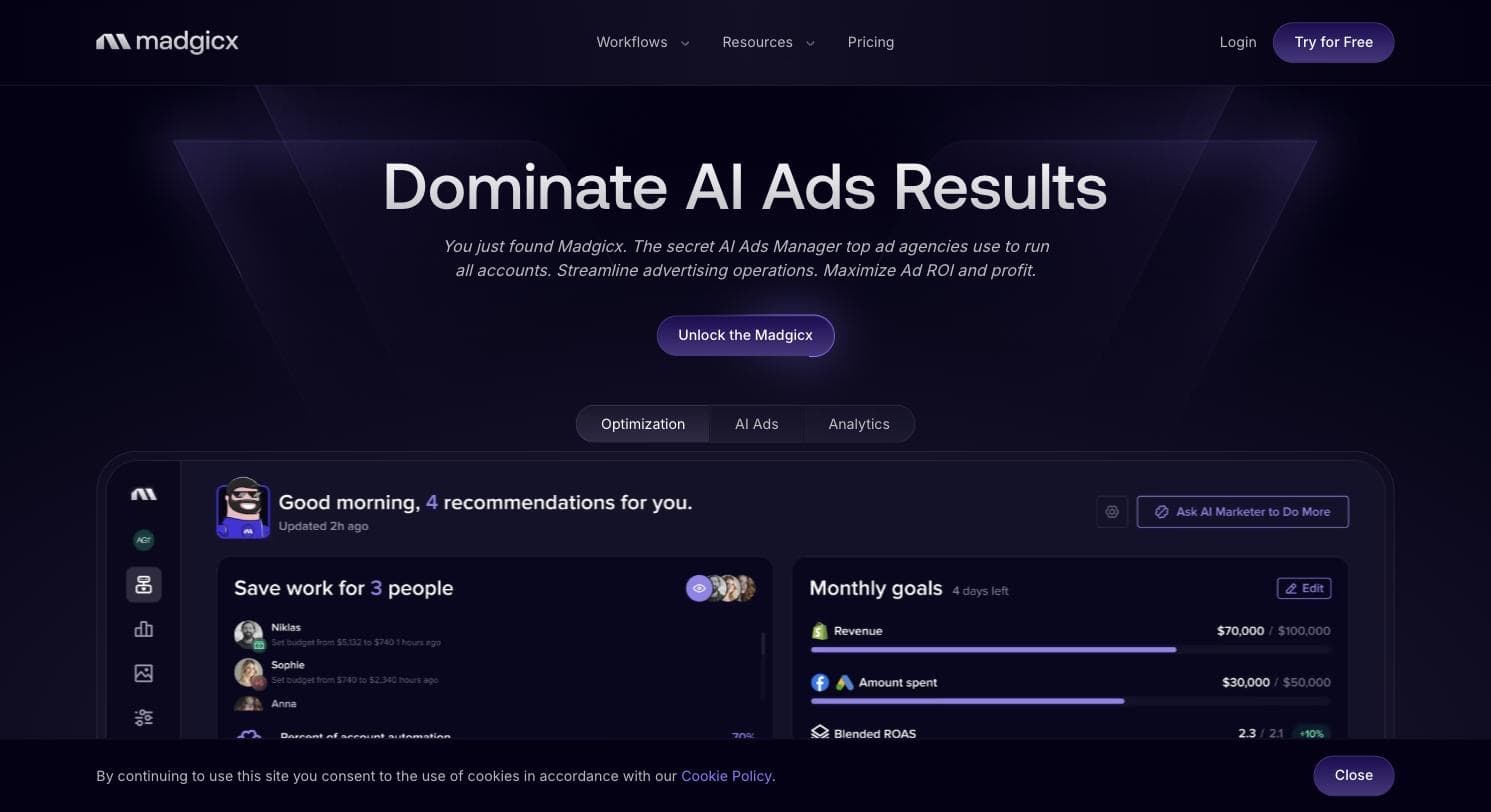
Best for delivery-first restaurants on MetaWe have not tested Madgicx - no trial account, no campaigns - so this entry is built from its own documentation, its live pricing page and attributed public reviews, and should be read that way. Madgicx is a Meta-only AI layer: automated budget shifting, audience mining, creative-fatigue insights and reporting on top of Facebook and Instagram ads. It earns its place on a restaurant list for a specific reason: it carries the only checkable public review here from a food business - Jet Italian Deli, an Italian deli reviewing on the Shopify App Store, quoted below. That is a delivery-and-online-order operation rather than a dining room, which is exactly the shape of restaurant this tool suits, but it is worth naming rather than dressing up as a restaurant case study.
The fit is narrower than its marketing suggests, and the boundary is your conversion data. Madgicx's automation is built around purchase events and ROAS math. A delivery- or pickup-first restaurant whose ordering flow carries its Meta pixel - Toast and Square Online both document a pixel field in their settings - generates exactly the purchase-event stream Madgicx is designed to optimize against, and for that operator it is a genuine contender. A reservation-led dining room is the opposite case: OpenTable completes bookings on its own domain where your pixel cannot go, so there is no purchase event to feed the AI, and a purchase-optimizing tool has little to work with. Ghost kitchens and multi-brand delivery operations sit at the strong end of this spectrum.
Three frictions to price in. Madgicx does not publish its plan price: the pricing page (checked 3 August 2026) shows spend tiers from under $1K to $30K+ and monthly, quarterly and annual billing, but the plan itself says 'See price inside the app', so you learn the cost only after signing up for the 7-day trial - and its Tracking Pro attribution product is a separate $49-a-month add-on. It is Meta-only: no Google, which for restaurants means no coverage of the '[cuisine] near me' and '[restaurant name] menu' searches that convert at the moment of decision. And its Trustpilot listing carries billing complaints - a September 2025 reviewer describes being charged after cancelling and struggling to get a refund - so read the cancellation terms before the trial ends.
Pros
- + Carries the only checkable public review on this page from a food business (an online-ordering Italian deli, not a dining room)
- + Deep Meta automation - AI budget shifts, audience mining, creative-fatigue insights - genuinely useful when your ordering flow sends purchase events
- + 7-day free trial lets you verify fit (and learn the price) before paying
Cons
- − We have not tested it - this entry is documentation and public reviews only
- − Plan price is not published: the pricing page shows spend tiers but says 'See price inside the app' (checked 3 August 2026)
- − Meta-only - no Google, so no coverage of near-me and menu search intent
- − Built around purchase ROAS: reservation-led restaurants have little event data to feed it, and attribution (Tracking Pro) is a $49/mo add-on
- − Trustpilot reviews include post-cancellation billing complaints (a September 2025 review describes being charged after cancelling)
Ideal for
- Delivery- and pickup-first restaurants with the Meta pixel on their ordering flow
- Ghost kitchens and multi-brand delivery operations
- Meta-heavy spenders who want AI budget automation and will tolerate in-app pricing
Pricing: Plan price not published. The pricing page (checked 3 August 2026) offers spend tiers from under $1K to $30K+ per month and monthly/quarterly/annual billing, but shows 'See price inside the app' instead of a dollar amount. Tracking Pro attribution add-on: $49/mo per connected account. 7-day free trial.
Visit Madgicx“I have been using Madgicx for a year now, and it's an amazing platform. It has greatly simplified the management of my Facebook ad accounts, providing me with clear insights and useful suggestions through its AI marketer tools.”
— Jet Italian Deli, verified merchant review on the Shopify App Store, November 2023
SOCi
Best for franchises with 20+ locationsWe have not tested SOCi - it sells through a demo process we did not go through - so this entry is built from its own site and documentation. SOCi is a multi-location marketing platform aimed at franchise and chain brands: local pages, listings management, review response, localized social posting and a paid product it currently calls Ads & Boost, plus a family of 'Genius' AI agents for local search, social and reputation. It is the only tool on this page built from the ground up for the org chart of a franchise restaurant group - a corporate team that controls the brand, and dozens to hundreds of locations that each need localized presence and spend without their GMs ever opening Ads Manager.
The restaurant fit is real but specifically corporate: a 60-location fast-casual brand localizing one campaign across markets, keeping every location's pages, hours, menus and reviews consistent, and putting boost-style local spend behind each location's posts from one console. That last piece matters more in restaurants than in most categories, because a chain's Google Business Profile hours and menu accuracy drive as much walk-in traffic as the paid layer does. Note what the ads product means for measurement: it is boost-centric - awareness-shaped rather than order-attribution-shaped - so it complements rather than replaces a performance stack tied to ordering conversions.
The frictions are the enterprise ones. SOCi publishes no pricing at all: its pricing page (checked 3 August 2026) is a demo-request form with no dollar amounts, plan names or contract terms, so budgeting starts with a sales call. Below roughly 20 locations the platform is wrong-sized - an independent or three-location group would be paying for franchise infrastructure it cannot use - which is why it sits here despite being the most restaurant-relevant enterprise tool in the category.
Pros
- + Purpose-built for multi-location: localized pages, listings, reviews and boosted local ads from one corporate console
- + Locations get localized spend without each GM touching Ads Manager
- + Consolidates the pages/listings/reputation tools franchise groups usually buy separately - and for restaurants, hours and menu accuracy across locations is itself a traffic driver
Cons
- − We have not tested it - this entry is documentation-based
- − No public pricing whatsoever: the pricing page is a demo-request form (checked 3 August 2026), so budgeting starts with a sales call
- − Enterprise sales motion and platform scope are wrong-sized below roughly 20 locations
- − The ads product is boost-centric - built for localized awareness, not order or reservation attribution
- − No verifiable public review we could cite, so this entry carries no quote
Ideal for
- Franchise restaurant systems with 20+ locations
- Corporate marketing teams localizing one campaign across many markets
- Groups that also need listings, pages and review management centralized
Pricing: Quote-only. SOCi publishes no pricing: the pricing page (checked 3 August 2026) contains no dollar amounts, plan names or contract terms - it is a demo-request form. Expect a sales-led, per-location commercial conversation.
Visit SOCiAdEspresso (a cautionary entry)
Not recommended in 2026AdEspresso appears in almost every aging 'Facebook ads tools for restaurants' list, which is exactly why it needs a cautionary entry rather than silence. We have not tested it - this assessment comes from its own pricing page, its public output and attributed reviews - and the documentation alone is disqualifying for this audience. The decisive number: the $49 Starter plan caps managed ad spend at $1,000 a month, which is precisely the middle of the typical restaurant range. A restaurant that buys the entry plan outgrows it the day the campaign scales, and the next stop is $99 a month - the same price as Birch Pro, which does far more.
The staleness signals are unusually concrete. The blog - once the most-cited Facebook ads resource on the internet - has been dormant since January 2023, and the product has been visibly coasting under Hootsuite's ownership. Recent Trustpilot reviews include post-cancellation billing complaints, one of which is quoted verbatim below. Nothing in the product is restaurant-specific: no local radius workflow beyond what native offers, no ordering or reservation awareness, no multi-location tooling.
If what drew you to AdEspresso is split testing, both honest alternatives are already in front of you: Meta's native A/B testing is free, and the tools ranked above cover automation and creative rotation with current, maintained products. We link AdEspresso here so you can check it yourself, not because we recommend it.
Pros
- + Historically beginner-friendly split-testing UI
- + 14-day trial and a cheap-in-absolute-terms $49 entry price
Cons
- − Starter's $1,000/mo ad spend cap sits squarely inside a typical single-location restaurant budget - you outgrow the plan almost immediately
- − Blog and product marketing dormant since January 2023 under Hootsuite ownership
- − Recent Trustpilot reviews include post-cancellation billing complaints
- − We have not tested it, and nothing in the product is restaurant-specific
Ideal for
- Honestly, nobody running restaurant ads in 2026 - the alternatives above cover every use case with maintained products
Pricing: From the live pricing page, July 2026: Starter $49/mo (capped at $1,000/mo ad spend), Plus $99/mo (unlimited spend, up to 15 seats), Enterprise from $259/mo. Facebook and Instagram only. 14-day free trial on all plans.
Visit AdEspresso (a cautionary entry)“Avoid!! Still charging us after a free trial which was cancelled a month ago.. we have had two $49 invoices come out of our account”
— Mark Brown, Trustpilot review of AdEspresso, July 2025
Side by side.
| Tool | Best for | Hands-on tested? | Cost at a $1,000/mo ad budget | Platforms | The restaurant-specific gap |
|---|---|---|---|---|---|
| AdFlint (our product) | Independent restaurants, 1-3 locations | Yes - it is our product; no restaurant campaigns ever run | $40/mo flat (Launch tier, ~4% overhead), 0% of spend on self-serve | Google + Meta | No Toast/OpenTable/Square integration; no TikTok; no restaurant track record |
| Birch (formerly Revealbot) | Groups rotating weekly specials across locations | Yes - real trial account, 30-31 Jul + 3 Aug 2026 | $99/mo (rules need Pro - the $49 Essential has no automated rules) | Meta, Google, TikTok, Snapchat, YouTube | Gates on a live ad account (no sandbox); no reservation or ordering integrations |
| Meta Ads Manager | Every restaurant's free starting point | Our own ad account (not a restaurant account) | Free | Facebook + Instagram | Dayparting requires lifetime budgets; Store Traffic objective retired, so walk-ins are proxies |
| Madgicx | Delivery-first brands with a pixeled ordering flow | No - documentation and public reviews only | Not published - 'See price inside the app' (checked 3 Aug 2026); 7-day trial | Meta only | Built around purchase events - reservation-led restaurants have little to feed it; no Google |
| SOCi | Franchise systems, 20+ locations | No - documentation only | Quote-only; demo form, no public pricing (checked 3 Aug 2026) | Facebook/Instagram boosts, plus pages, listings, reviews | Boost-centric ads product; enterprise-sized, so below ~20 locations it makes no sense |
| AdEspresso | Not recommended in 2026 | No - documentation and public reviews only | $49/mo Starter - but its spend cap is exactly $1,000/mo (checked Jul 2026) | Facebook + Instagram | Starter cap sits inside a typical restaurant budget; product dormant since January 2023 |
How we chose.
Hands-on, and when: Birch (formerly Revealbot) only. We created a real trial account and worked inside it on 30-31 July and again on 3 August 2026 - signup, onboarding, the Stage creative launcher, Hub, the rules engine's gating, and the in-app billing slider at every spend tier, which is where every Birch price on this page comes from.
Our own products and accounts: AdFlint is ours - we run it daily and disclose the conflict on its entry. Meta Ads Manager we use in our own ad account, which is where that entry's screenshot comes from; it is not a restaurant account and we have never run a restaurant campaign in it.
Not hands-on: Madgicx, SOCi and AdEspresso. We have not created accounts or run campaigns in any of them. Those entries rely on each vendor's own documentation and pricing pages plus attributed public reviews, and each entry states this in its first sentence.
We have never run ad campaigns for a restaurant - no restaurant clients, no restaurant case studies, no vertical performance data of our own. Vertical guidance on this page (alcohol targeting rules, the lifetime-budget requirement for ad scheduling, radius minimums, the retired Store Traffic objective, pixel access on Toast, Square Online and OpenTable) comes from Meta's published policies and the platforms' own documentation. The CPC and spend figures come from our published Food & Beverage benchmark row, which is compiled category data, not our results.
Every price is dated. Birch: read off its in-app billing slider, July-August 2026. Madgicx: pricing page checked 3 August 2026 - spend tiers and a $49/mo Tracking Pro add-on are shown, but the plan price says 'See price inside the app'. SOCi: pricing page checked 3 August 2026 - no dollar amounts, plan names or terms, demo-request form only. AdEspresso: pricing page checked July 2026. AdFlint: our own live pricing page, August 2026. Prices change; confirm on the vendor's site before buying.
Review quotes are verbatim, attributed, and linked to their source. Where we could not verify a genuine, checkable review - SOCi, and our own AdFlint, which has no third-party review presence yet - we left the quote out rather than paraphrase or invent one.
AdFlint is ranked first for one specific slice - independent restaurants with 1-3 locations spending $300-$2,500 a month - on price-to-budget math and creative workload, with the disclosure visible and its cons listed as bluntly as everyone else's. Below $300 a month the free native tool at #3 is the better answer and we say so on our own entry. Franchise systems and delivery-first brands are better served by other tools here, and we say that too.
- — Priced against real restaurant budgets, not enterprise ones. Our Food & Beverage benchmark row puts typical category spend between $500 and $4,000 a month, so we evaluated every fee as a percentage of that range - and as a share of the clicks it buys at a $0.63 average Meta CPC - and penalized tools whose useful plan starts at 10%+ overhead.
- — Restaurant conversions, not generic ones. We asked what each tool can do with the three funnels restaurants actually have: online orders (pixel-trackable when Toast or Square Online expose the pixel field), reservations (invisible to your ad account when they complete on OpenTable's domain), and walk-ins (proxies only, since the standalone Store Traffic objective was retired).
- — Creative cadence over bid wizardry. Weekly specials make restaurant creative stale in seven days, so we weighted workflows that generate or bulk-rotate creative - AdFlint's generation loop, Birch Stage's sheet-to-ads flow - above optimization features designed for evergreen e-commerce catalogs.
- — Hands-on where we have it, documentation where we do not, labeled per entry. Birch we worked inside on a real trial (July-August 2026); AdFlint is our own product, disclosed; Meta Ads Manager is our own ad account but never a restaurant campaign; Madgicx, SOCi and AdEspresso are researched entries and say so in their first sentence.
- — Multi-location honesty. A single-location tool and a 60-location franchise platform are different products; we ranked each tool for the operator size it actually serves rather than pretending one list order fits everyone - which is why the free native tool, not our product, is the recommendation below $300 a month.
- — Penalties for opacity and dormancy. Hidden in-app pricing (Madgicx), quote-only pricing (SOCi) and visible product dormancy (AdEspresso) all cost ranking positions, because a restaurant operator's evaluation time is dinner-service time.
Common questions.
Can Facebook ads track OpenTable reservations?
Not directly. OpenTable reservations complete on opentable.com, and you cannot install your Meta pixel on OpenTable's pages - so from your ad account's point of view, a completed booking is just an outbound click. Your practical options: treat the outbound click to your booking page as the conversion (it undercounts, but consistently, so trends still read); use Meta's Book Now-style CTAs where available; or run a crude lift check by comparing covers by day and hour against your ad flight dates. If measurable return matters most, put the measurable budget behind online ordering instead - Toast and Square Online both document a Meta pixel field in their settings, which gives you real purchase events. Confirm the pixel field in your own provider's current settings before you plan around it; these integrations change.
Are restaurant ads a Meta 'special ad category'?
No. Special ad categories cover housing, employment, credit and social issues/politics - restaurants are unaffected, so the full targeting stack (radius, age, interest layers, lookalikes) is available. The one policy that does bite restaurants is alcohol: happy-hour and drinks-forward creative must use age-restricted targeting - 21+ in the US - and alcohol ads are prohibited outright in some countries. Build drinks campaigns with the age floor set from the start rather than waiting for ad review to flag them, and keep a non-alcohol version of the creative ready for markets where the ad cannot run at all.
How do I run lunch ads at lunch and dinner ads at dinner?
Per Meta's documentation, ad scheduling (dayparting) is available only on lifetime budgets - daily-budget campaigns run all day, period. Three workable routes: give each daypart campaign a lifetime budget and a schedule; run separate lunch and dinner campaigns and accept all-day delivery with daypart-specific creative and offers; or use an external scheduler like Birch's rules, which can start and pause campaigns by the hour on top of daily budgets. One caution: aggressive on-off cycling can push ad sets back into Meta's learning phase, so prefer fewer, longer windows over hourly toggling.
How much should a single-location restaurant spend on Facebook ads?
Our Food & Beverage benchmark row puts typical category spend between $500 and $4,000 a month, and most independents that advertise meaningfully sit at the low end of that - a few hundred to $1,500 per location. The pattern that works is concentration: $10-$20 a day on one campaign, one radius, one clear offer (this week's special, happy hour, brunch) beats $5 a day scattered across five boosted posts. Below about $300 a month, skip paid tools entirely - every fee on this page would be 15-30% overhead at that level - and revisit software when the budget grows or a second location arrives.
Which conversion event should a restaurant optimize for?
Whichever one you can actually measure, in this order. If your ordering provider carries your Meta pixel (Toast and Square Online both document a pixel field), optimize for Purchase - it is the only event with a real dollar value attached, and at the category-average $13 Meta CPA in our Food & Beverage benchmark row it is also the one that makes the math legible. If you are reservation-led, optimize for the outbound click to your booking page or a Book Now action, and accept that completed bookings on OpenTable's domain are invisible. If you are walk-in-led, use calls and direction requests and treat them as proxies. The mistake to avoid is optimizing for link clicks when purchase data exists - Meta will happily find you cheap clickers who never order.
What about TikTok? Every restaurant marketing article says I need it.
Short-form food video genuinely is the outlier channel for restaurants, and the honest tool answer: Birch covers TikTok - Stage bulk-creates ads for Meta, TikTok and Snapchat from one sheet - and TikTok's own Ads Manager is free to use directly. AdFlint does not do TikTok (Google and Meta only - listed in its cons), Madgicx is Meta-only, and SOCi's paid product is Facebook-centric. If TikTok is the center of your strategy, Birch is the only paid tool on this page that follows you there.
Is AdEspresso still worth it for restaurants in 2026?
We do not recommend it, and we have not tested it - but the documentation alone decides this one. The $49 Starter plan caps ad spend at $1,000 a month, which sits squarely inside a typical single-location restaurant budget, so the entry plan is outgrown almost immediately; the blog has been dormant since January 2023; and recent Trustpilot reviews include billing complaints after cancellation. Meta's native A/B testing is free, and every maintained tool above covers the rest.
Should I just boost posts instead of using Ads Manager?
Boosting is fine for one job: cheap awareness on something time-boxed, like an event announcement or a new-menu post, aimed at your radius. Real campaigns earn their extra setup the moment you care about outcomes - Ads Manager gives you objectives, the Order Now/Book Now/Get Directions/Call Now buttons, radius plus interest stacking, exclusions, and placement control that boosts hide. A reasonable split for one location: boost occasionally for reach, run one properly built campaign for orders or bookings, and judge the two by different yardsticks. Notably, boosting at scale is essentially what SOCi's Ads & Boost product does for franchises - useful for localized awareness, but nobody should mistake it for order attribution.
Keep reading
- Radius Targeting on Google and Meta, Compared
- How Much Do Facebook Ads Cost a Small Business?
- Conversion Tracking Setup for Google and Meta
- Google or Meta Ads First? Decide by Budget
- AI Ad Tool Pricing in 2026: What It Really Costs
- Who Owns Your Ad Account, Pixel, and Audiences?
- Facebook Ads Without a Page: What Meta Allows
- Free tool: Meta Lifetime Budget Pacing Calculator
- Free tool: Meta Learning Phase Budget Calculator
- Free tool: Ad Management Cost Calculator
- Free tool: Ad Budget Calculator
- Free tool: UTM Builder for Paid Ads
- Free tool: Meta Ad Copy Preview & Character Checker