Madgicx Alternatives in 2026: For Small Budgets to Agencies
By the AdFlint research team · We built trial accounts on Birch (formerly Revealbot) and worked inside them ourselves; every screenshot below is from those sessions, and the rest is documentation and verified user reviews · Published July 28, 2026 · Updated July 30, 2026
TL;DR
- Closest like-for-like Madgicx replacement: Birch (formerly Revealbot) - rules-based automation across Meta, Google, TikTok, and Snapchat, from $49 per month.
- Smallest budgets: AdFlint (our product - disclosed below) runs Google and Meta ads for a flat $40 to $89 per month with hard spend caps and no percentage of ad spend.
- Meta-only and free: Advantage+ inside Meta Ads Manager automates audience, budget, placement, and creative at no software cost.
- Enterprise and large agencies: Smartly.io covers social, CTV, and the open web, but pricing is custom-quote only and the sales process is built for big teams.
Madgicx built its name on Meta ad automation for ecommerce brands, but its pricing is tiered by your monthly ad spend and only revealed inside the app after signup, and its advanced tracking is a separate $49 per month add-on per account. If your spend is small, your channel mix goes beyond Meta, or you simply want a price you can see before entering a card, there are real reasons to shop around.
This page compares six alternatives across the full budget range: a direct rules-based replacement (Birch, which Revealbot became after a rebrand), a flat-fee option for small budgets (AdFlint, which is our own product and is labeled as such), Meta's free native automation (Advantage+), a legacy A/B testing tool that still sells plans (AdEspresso), an enterprise platform (Smartly.io), and an attribution-first option (Cometly) for teams whose actual complaint with Madgicx is tracking, not campaign management.
What actually differentiates these options is less the AI marketing copy and more three practical things: the pricing model (flat fee versus spend-scaled versus free native), platform breadth (Meta-only versus Meta plus Google and beyond), and whether the tool automates campaigns or just reports on them. The comparison table and the cons lists below are built around those three axes.
We got inside. Here is every screen.
We created real trial accounts, cleared the verification walls, and worked through the products. Every screenshot below is from those sessions — no vendor marketing imagery, no stock dashboards.
Birch (formerly Revealbot)
Walkthrough performed July 30, 2026Revealbot rebranded to Birch and moved to bir.ch. A lot of published roundups still send readers to revealbot.com, and the old /signup path 404s — the working signup is at app.bir.ch/signup.
We created an account, completed onboarding and worked through the product. The headline finding: Birch in 2026 is three products, not one. The automation tool everyone reviews is now sitting alongside a bulk creative launcher and a server-side tracking gateway, and it is priced against your ad spend.
- 01
Create the account
Email, a password of six or more characters, and your name — or one-click signup with Google. The page states a 14-day free trial, no credit card required, cancel anytime. A newsletter checkbox is present and unticked. No card was requested at any point, and no phone number either. Account creation to the connect screen took under two minutes.
- 02
Set up the company and declare your budget
Step two asks for company name, industry, monthly ad budget, and how you heard about them. Industry options are Agency, Services, Ecommerce, Mobile App, Lead Generation, and Other. The budget brackets run Below $10K, $10K-$30K, $30K-$75K, $75K-$150K, $150K-$300K, $300K-$500K, and Over $500K. As with Optmyzr, everything under ten thousand dollars a month is one undifferentiated bucket at the bottom — and it turns out that bracket is not just a survey question, it is the pricing.
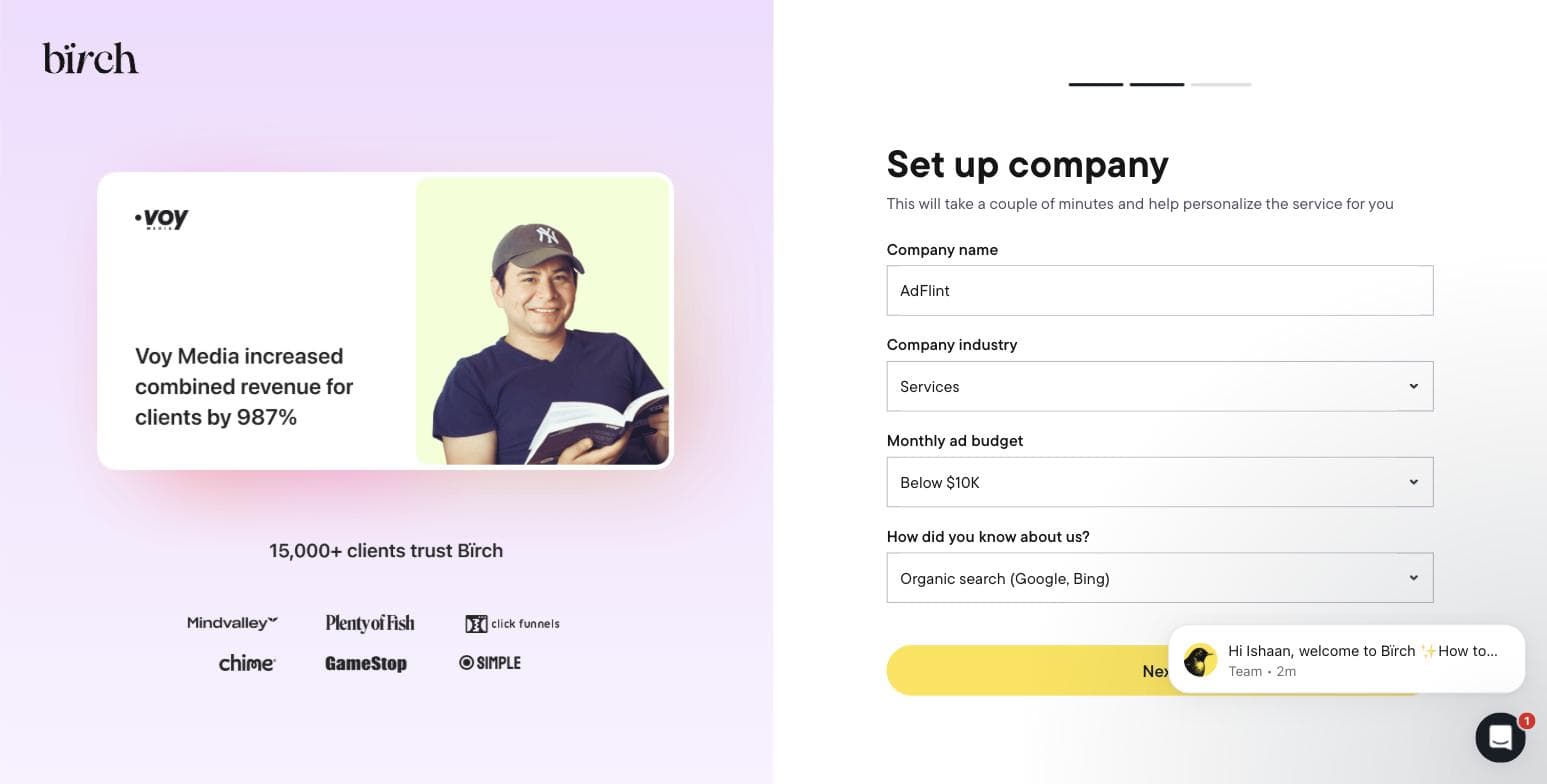
Step two of Birch's onboarding, captured during our own signup on 30 July 2026. - 03
Connect an ad platform — or don't, and see what breaks
Step three asks you to connect Meta Ads, TikTok, Google Ads, or Snapchat before you reach the product. Meta is presented first and most prominently, matching Birch's heritage. We skipped it deliberately, to find out how much of the product survives without granting a third party access to a live ad account. The answer is: the shell, but not the substance.
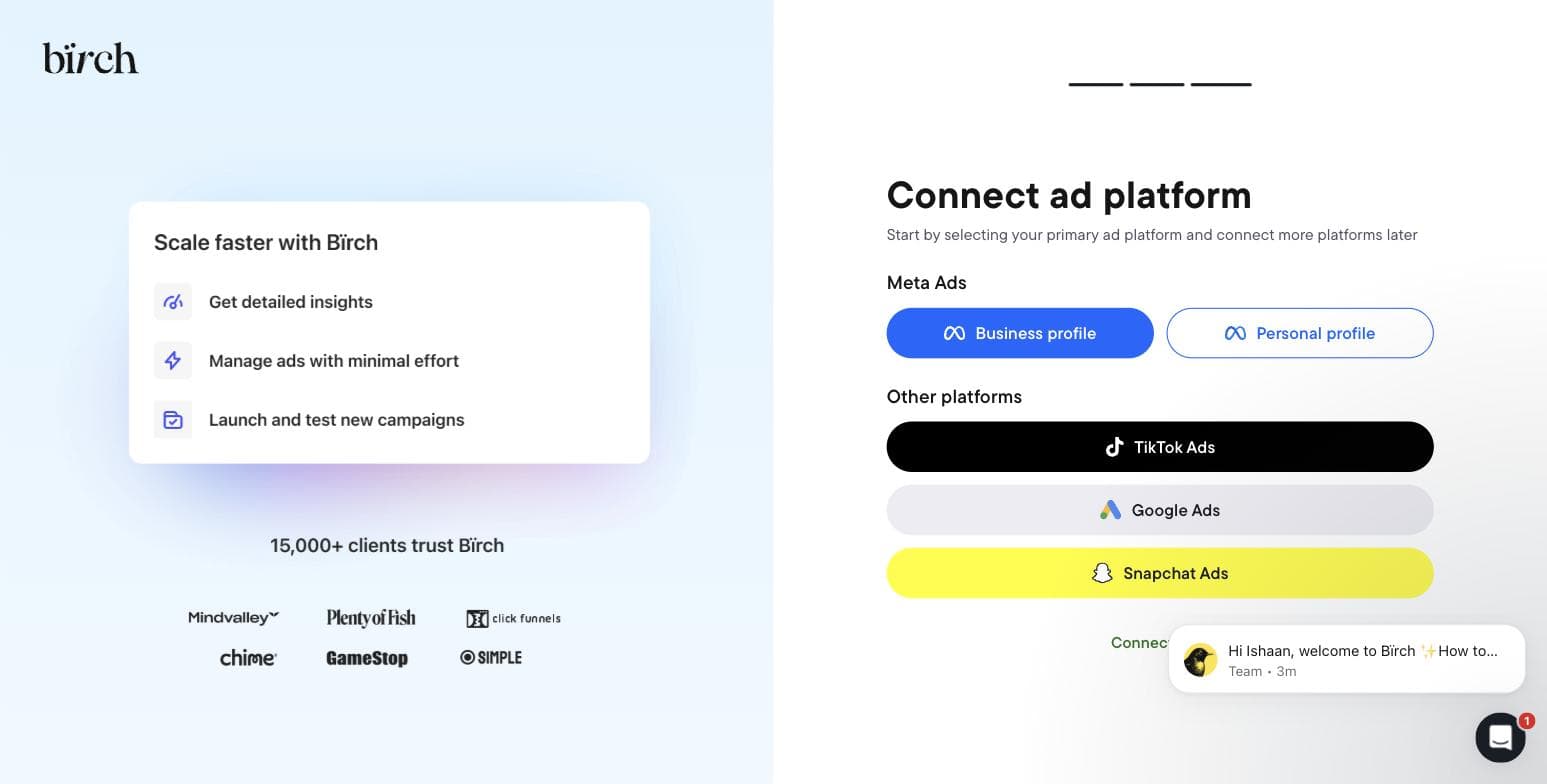
Birch's final onboarding step. Captured 30 July 2026. - 04
Open the Rules engine — the feature it is famous for
The automation screen is the reason most people arrive at Birch. Without a connected account it is a single button reading Connect ad account, over an illustration of the three action types it offers — increase bid, duplicate, notify. That is the entire surface available to an unconnected trial. There is no sandbox and no demo dataset, so you cannot evaluate the rule builder against sample data before handing over access to real campaigns.
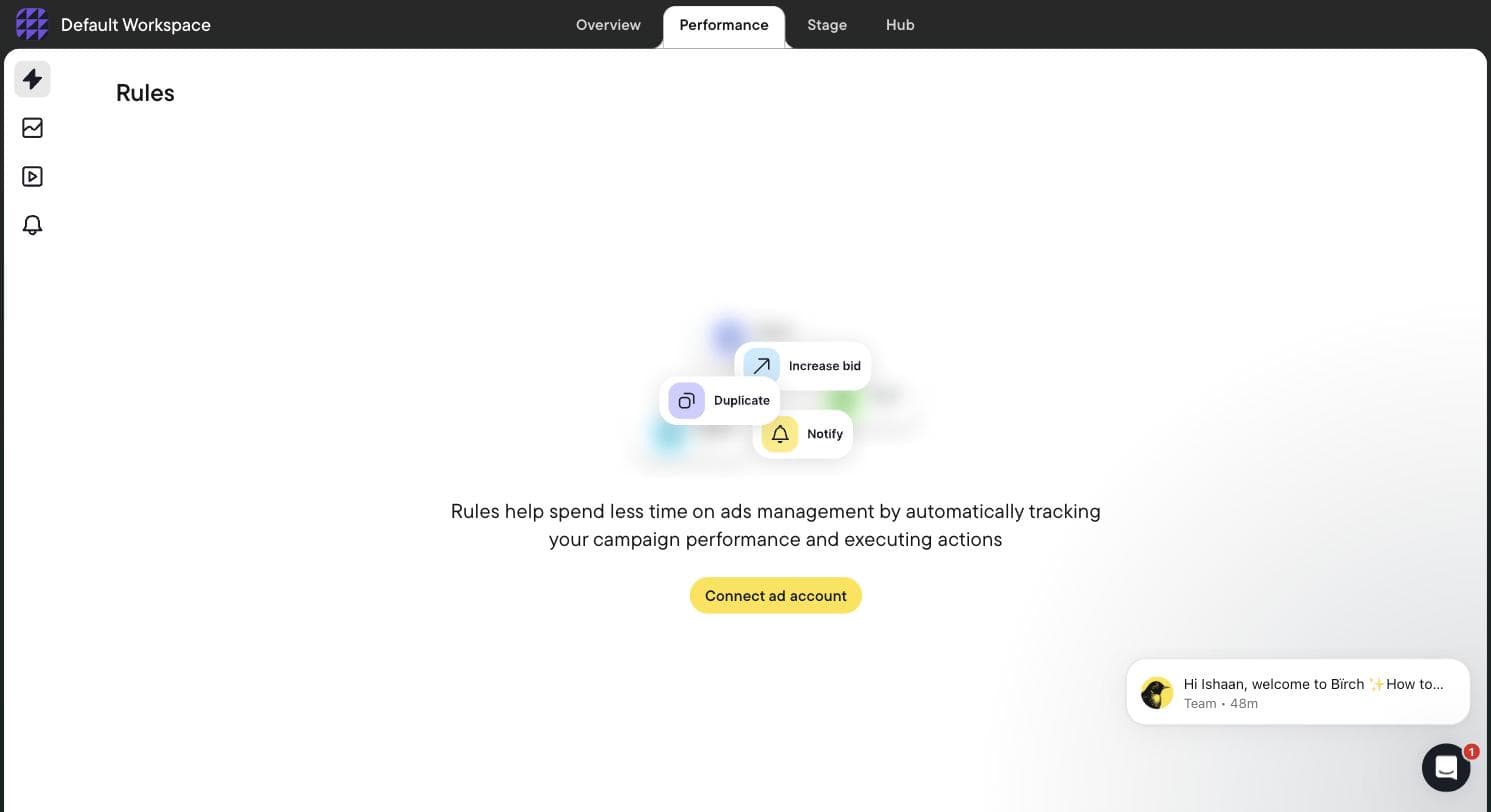
Birch's Rules screen with no ad account connected — the rule builder is entirely gated. Captured 30 July 2026. - 05
Find Stage, the product nobody has reviewed
Stage is a bulk creative launcher: you connect a planning Google Sheet and your Drive folders, and it builds the ads from there — launching creative tests from the sheet, mirroring your Drive folder structure into ad structure, duplicating winning setups with new creative swapped in, and working across multiple Drives and platforms at once. It targets Meta, TikTok and Snapchat. Birch states plainly that its Drive access is read-only and it cannot edit or delete anything. We could not find a single published roundup that mentions this exists.
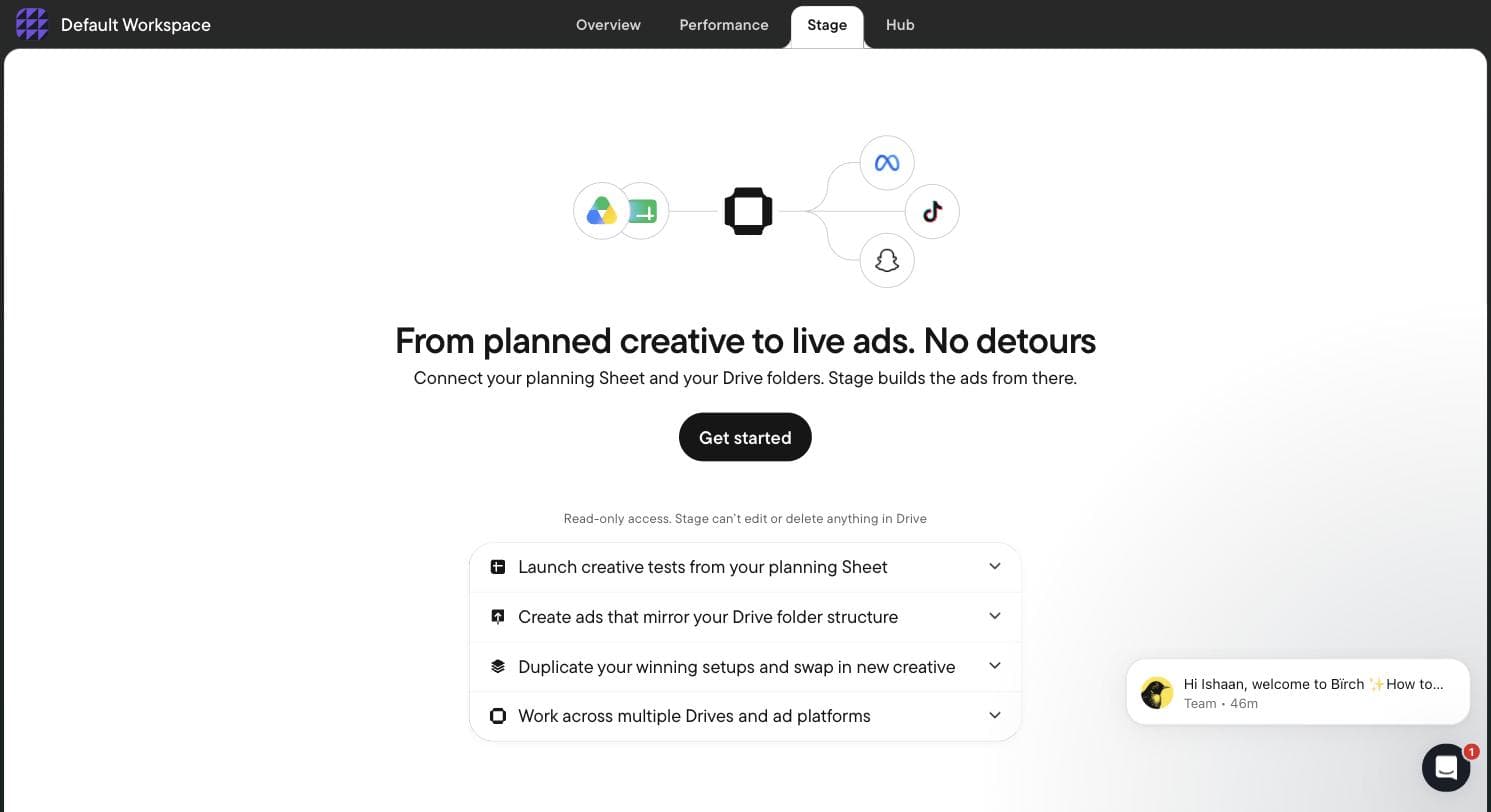
Birch Stage — a Sheet-and-Drive bulk ad launcher absent from every Revealbot-era review. Captured 30 July 2026. - 06
Find Hub, which is not an ads tool at all
Hub is server-side tracking infrastructure. You create a Signals Gateway, pick a hosting region, point it at your primary website, and it collects first-party data and forwards it to the ad platforms — the category occupied by conversions-API and server-side GTM setups. A company that used to sell Facebook rule automation now also sells you the tracking layer underneath it. That is a strategic move worth understanding before you compare Birch to anything on price alone.
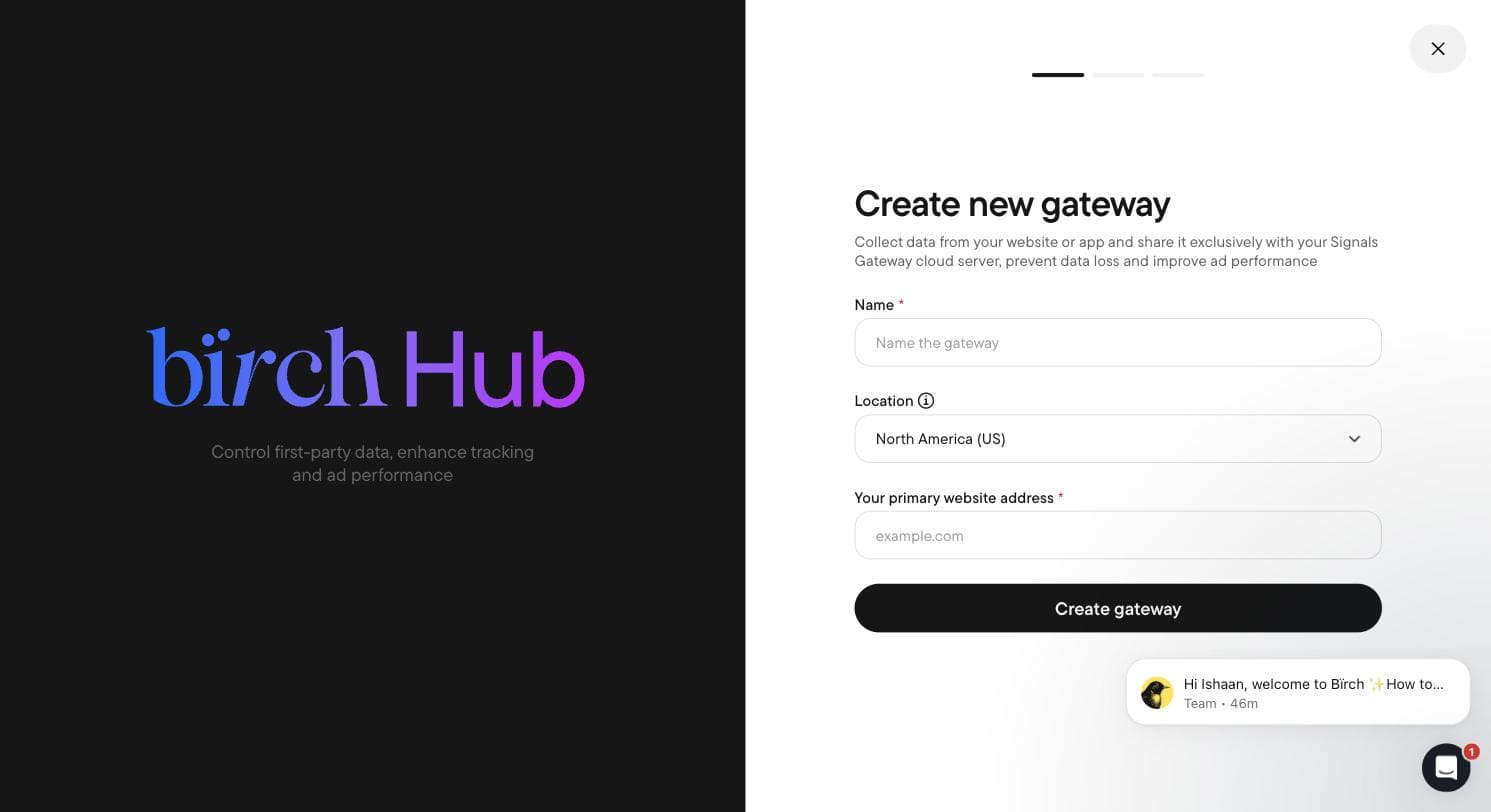
Birch Hub's Signals Gateway — server-side first-party data collection. Captured 30 July 2026. - 07
Read the integration list
Birch connects twelve services: Meta Ads, Google Ads & Google Drive, Snapchat Ads, TikTok Ads, YouTube, Google Analytics, Google Sheets, Slack, and — telling for who it is built for — the attribution stack of AppsFlyer, Adjust (in beta), Hyros and Wicked Reports. There is no Microsoft Ads, no Amazon and no LinkedIn. Set that against Optmyzr's Amazon, Microsoft, LinkedIn and Search Ads 360 and the two products stop looking like competitors at all: Optmyzr is built for search, Birch is built for paid social and direct-to-consumer attribution.
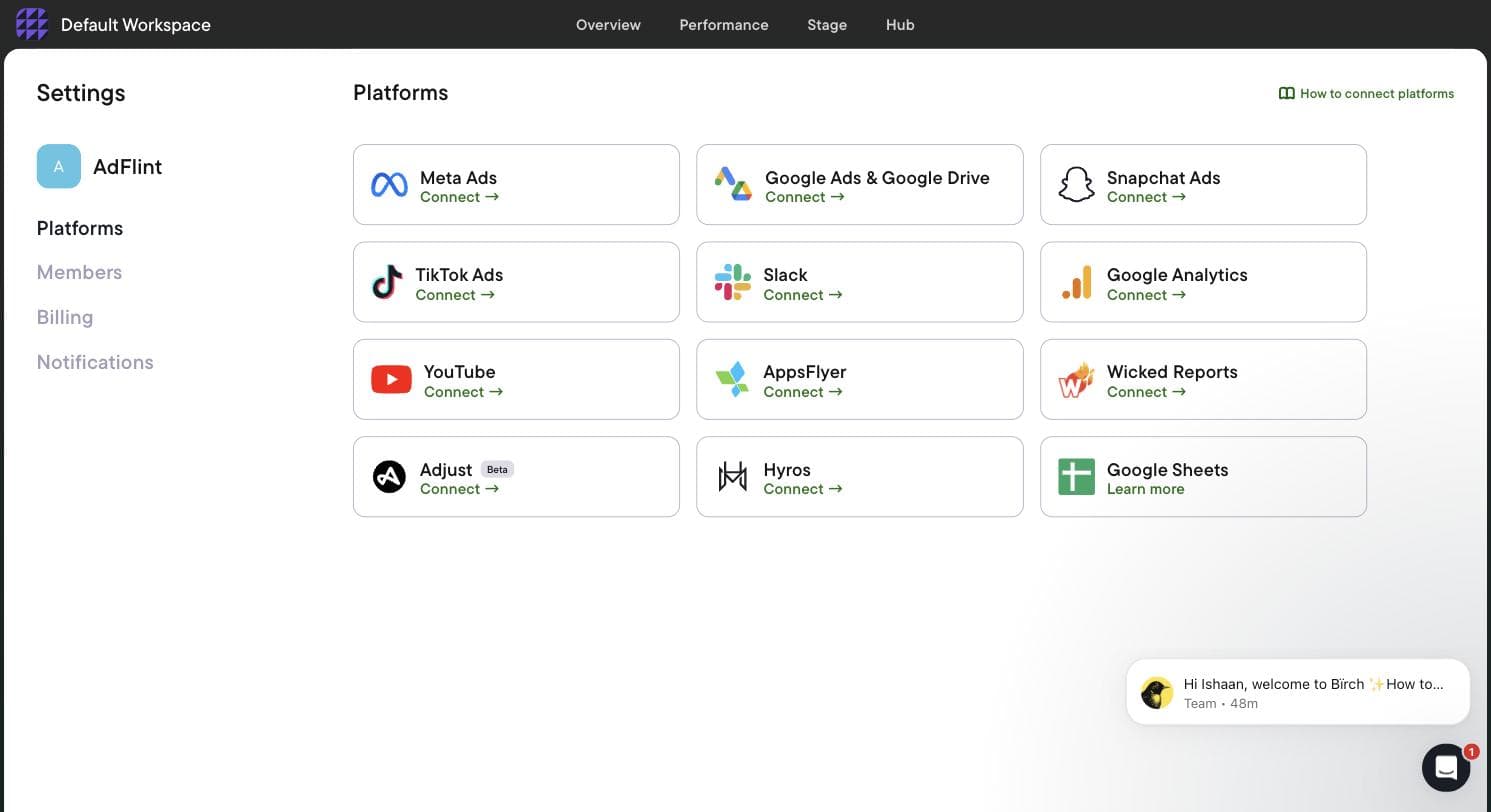
Birch's twelve integrations, heavy on paid social and attribution. Captured 30 July 2026. - 08
Read the real price off the billing screen
Birch does not have a flat price. The billing screen tracks cumulative spend across your connected accounts and charges you against it, with a slider that recalculates every plan as you move up the spend ladder. We walked the whole slider and wrote down every number. Two things matter more than the prices themselves: automated rules — the feature Revealbot was known for — are not in the entry plan at all, and above roughly $150K in monthly spend the entry plan stops being offered.
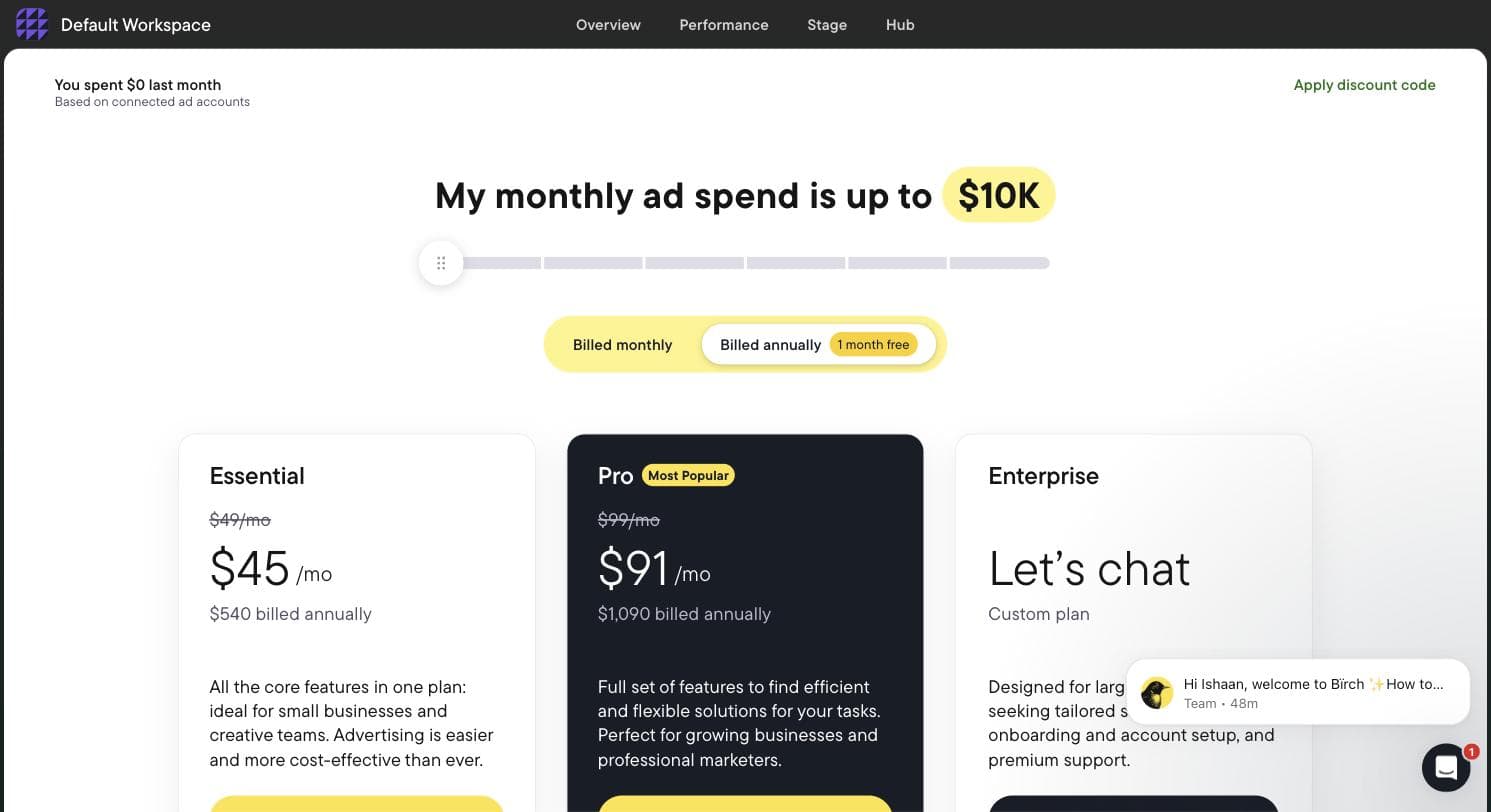
Birch's in-app pricing at the lowest spend tier. The slider above recalculates every plan. Captured 30 July 2026.
What the signup told us
- — Genuinely fast: account creation to the connect screen took under two minutes, with no phone number and no credit card.
- — The rebrand is badly signposted. Arriving from an older article pointing at revealbot.com or bir.ch/signup gets you a 404 before you find the app.
- — No sandbox and no demo data. The rule builder — the main reason to evaluate Birch — is completely inaccessible until you grant access to a live ad account.
- — Pricing is tied to your ad spend, not to seats or usage of the tool, so your bill grows as your campaigns do even if your use of Birch never changes.
- — The entry plan excludes automation entirely, which makes the widely quoted 'from $49' figure misleading for anyone arriving for the rules engine.
- — Meta is the default and most prominent option; Google Ads is present but visually secondary. Treat this as a Meta-first tool that also does Google.
- — One URL we tried inside the app hung on a loading spinner indefinitely rather than resolving or erroring.
Pricing, read off the in-app billing screen
Every figure below was read directly off Birch's own in-app billing slider on 30 July 2026, at each spend tier in turn. Monthly prices are the headline rate; annual prices are the discounted equivalent, billed once a year.
| Your monthly ad spend | Essential | Pro | Annual (Essential / Pro) |
|---|---|---|---|
| Up to $10K | $49/mo | $99/mo | $540 / $1,090 |
| Up to $30K | $149/mo | $249/mo | $1,640 / $2,740 |
| Up to $75K | $299/mo | $499/mo | $3,290 / $5,490 |
| Up to $150K | $499/mo | $799/mo | $5,490 / $8,790 |
| Up to $300K | Not offered | $1,299/mo | — / $14,290 |
| $500K+ | Not offered | Not offered | Enterprise, custom quote |
- — Essential does not include automated rules. This is the single most important line on the page: the feature Revealbot built its reputation on sits behind the Pro tier. Essential buys you workspaces, post boosting, reports, an activity page, Slack and email support — and nothing that automates a campaign.
- — Pro adds automated rules and strategies, Explorer, top audiences, Launcher, Stage, custom metrics and timeframes, the custom and lookalike audience builder, the Sheets/AppsFlyer/Hyros integrations, and live chat support.
- — Price is set by total monthly ad budget across every ad account you connect. If your spend rises past your tier, Birch states you are charged an overage fee through Stripe and notified by email; your features keep working.
- — Annual billing is described as twelve months for the price of eleven.
- — The trial is 14 days with full feature access. When it expires, your rules and reports are disabled rather than deleted, and come back when you pick a plan.
Where this stops: We did not connect a live Meta or Google account, so we have not watched a Birch rule evaluate or fire against real campaigns, and we have not seen Explorer, Stage or Hub populated with real data. Everything above is what the product does and costs, verified in-app; how well its automation actually performs on live spend is not something this walkthrough can tell you.
Birch (formerly Revealbot)
Best like-for-like Madgicx replacementBirch is the product Revealbot became - revealbot.com now 301-redirects to bir.ch, and its Product Hunt listing names it Birch (ex. Revealbot), stylized on its own site with a diaeresis. It is the closest thing on this list to a direct Madgicx substitute: rules-based automation that starts, stops, and adjusts campaigns on triggers you define, plus reporting, audience builders, and launch tooling. Its pricing FAQ states support for ad accounts across Meta, Google, Snapchat, and TikTok, which immediately gives it broader campaign coverage than Madgicx's Meta-first core.
Pricing is public, which is itself a differentiator against Madgicx's price-revealed-in-app model. The Essential plan starts at $49 per month with workspaces, boosting, reports, and email support; the Pro plan starts at $99 per month and adds the parts most Madgicx switchers actually want - automated rules, audience builders, and the Explorer, Launcher, and Stage tools. Every plan starts with a 14-day free trial that does not ask for a card, and like Madgicx the final price is determined by your monthly ad spend across connected accounts - the $49 and $99 headline figures are the up-to-$10K-per-month tier.
The trade-offs are real. Rules-based automation means you are writing the playbook yourself: Birch executes your logic but does not decide strategy for you, so it rewards teams that already know what a good rule looks like. There is no free plan, price climbs with spend, and the rebrand has left its public review footprint scattered - the most substantive review we could retrieve dates to the Revealbot era.
Pros
- + Closest functional overlap with Madgicx: trigger-based automation, reporting, and launch tools in one place
- + Covers Meta, Google, Snapchat, and TikTok ad accounts - broader campaign coverage than Madgicx's Meta-first core
- + Public, published pricing with a 14-day free trial on all plans and no card required to start
- + Automated rules are fully user-defined, so nothing changes in your account that you did not specify
Cons
- − Price scales with your monthly ad spend - $49 and $99 only hold up to $10,000/month in spend, and overages are charged above your tier
- − Automated rules on the Pro tier are where the real value sits, effectively making $99 per month the practical starting price
- − You have to design the automation logic yourself - there is no done-for-you strategy layer
- − Post-rebrand, its review footprint on fetchable public platforms is thin and dated
Ideal for
- Media buyers who liked Madgicx's automation but want multi-platform rules
- Agencies managing several ad accounts with defined optimization playbooks
- Teams that want published pricing before connecting an ad account
Pricing: Essential from $49/month and Pro from $99/month at the up-to-$10K/month ad spend tier (price is determined by monthly ad spend across connected accounts, with overages above your tier; annual billing saves 20 percent); Enterprise custom; 14-day free trial, no credit card required. Pricing fetched from bir.ch July 2026.
Visit Birch (formerly Revealbot)“Easy to use and set up custom reports for ad accounts and other details that's important to constantly monitor.”
— Chet N., owner, on SourceForge (posted April 13, 2020, when the product was still called Revealbot)
AdFlint
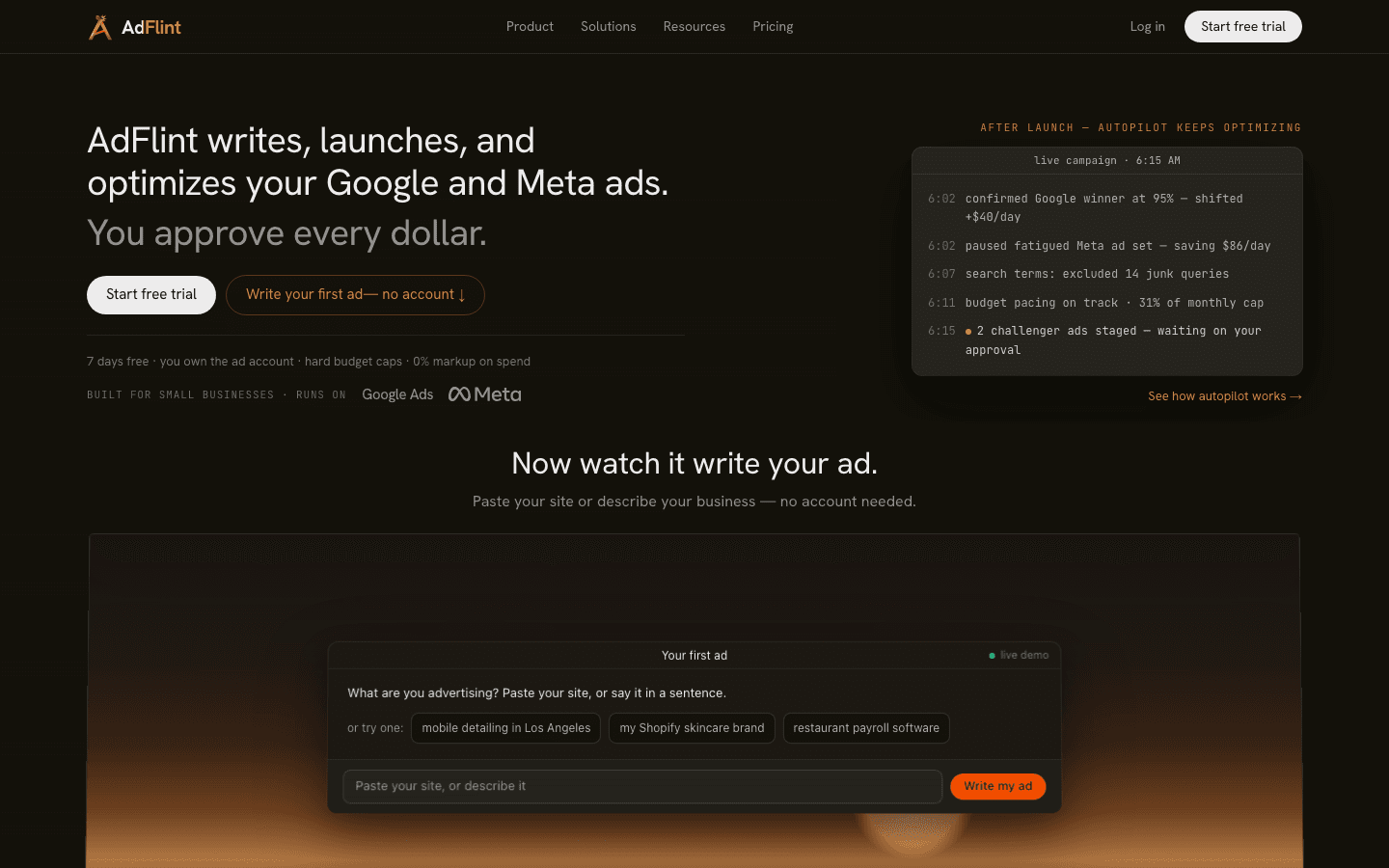
Best for small budgets on Google and MetaOur product — disclosureAdFlint is our product, so read this entry with that in mind - the ranking and the cons below are meant to survive that bias. It occupies a slot none of the other tools on this page do: flat-fee AI ad management for small budgets. Plans start at $40 per month for up to $1,000 per month in ad spend, and the top self-serve tier is $89 per month for up to $2,500 in spend. Madgicx's spend brackets start at 'less than $1K' and climb to '$30K+'; AdFlint is built for the bottom of that range and below it, where a spend-scaled tool fee is hardest to justify.
The working model is different from Madgicx and Birch in two ways. First, the AI writes, launches, and optimizes campaigns inside your own Google and Meta ad accounts rather than handing you dashboards and rule builders - closer to a done-for-you service than a power tool. Second, every ad the AI produces goes through human approval before it runs, and each plan carries a hard ad spend cap, so the system cannot quietly outspend your budget. AdFlint charges a flat monthly fee and takes no percentage of self-serve ad spend; you pay Google and Meta directly.
The honest limits: it covers Google and Meta only, so TikTok- or Snapchat-heavy accounts need Birch or a native tool instead. The self-serve spend caps that protect small budgets make it the wrong tool for scaling ecommerce brands spending five figures a month - that is what the custom-priced Managed tier or a different product entirely is for. And as a young product it has no meaningful third-party review footprint yet, which is why there is no review quote on this entry.
Pros
- + Flat monthly fee from $40/month with no percentage of ad spend - you pay Google and Meta directly
- + AI writes, launches, and optimizes campaigns inside your own ad accounts, not a separate walled garden
- + Human approval required on every ad plus hard budget caps per plan
- + Published pricing and a 7-day free trial, no talk-to-sales step for self-serve plans
Cons
- − Google and Meta only - no TikTok, Snapchat, or LinkedIn campaign support
- − Self-serve plans cap ad spend ($100 to $2,500 per month), so scaling brands outgrow them quickly
- − Young product with no meaningful third-party review footprint yet
- − Approval-first workflow adds a human step that pure automation tools skip
Ideal for
- Small businesses spending under $2,500 per month on ads
- Owners who want ads handled but insist on approving what runs
- Advertisers priced out of spend-scaled tools like Madgicx and Birch
Pricing: Launch $40/month (up to $1,000/month ad spend), Growth $89/month (up to $2,500), Managed custom; 7-day free trial with card required, billing starts day 8; flat fee, no percentage of self-serve ad spend. Pricing fetched from adflint.com July 2026.
Try AdFlint freeMeta Advantage+
Best free option for Meta-only advertisersBefore paying any third party to automate Meta ads, it is worth being clear about what Meta now gives away. Advantage+ is Meta's native automation suite inside Ads Manager: Advantage+ shopping campaigns ('automated sales campaigns that leverage machine learning to serve your ads to the audiences most likely to convert'), Advantage+ catalog ads (the former dynamic ads), and Advantage+ app campaigns. Meta's own framing is that it automates 'Audience, Budget/Bidding, Placement, Creative and more', with manual overrides available at each step.
The cost argument is simple: there is no software fee, only your ad spend. A meaningful slice of what Madgicx sells - audience expansion, budget reallocation, creative rotation - now exists natively, and Meta's automation operates with delivery-system signals no third party can see. For a small advertiser running Meta only, trying Advantage+ before buying any tool is the defensible default, and several third-party tools on this page effectively sit on top of these same native levers.
What you give up is transparency and control. Advantage+ is a black box compared to rule-based tools: you cannot express 'pause any ad set above $30 CPA after 3 days' the way Birch users can, reporting on why the system made a choice is limited, and none of it helps with Google, TikTok, or cross-platform views. It optimizes toward Meta's definition of your goal, and when it underperforms your only real lever is restructuring the campaign.
Pros
- + No software cost at all - you pay only for ad spend
- + Automates audience, budget, bidding, placement, and creative natively
- + Operates with Meta delivery-system signals third-party tools cannot access
- + No new account connections, permissions, or billing relationships required
Cons
- − Meta only - no help for Google or any other channel
- − Black-box decisioning with no rule-level control or explainability
- − No cross-account or cross-platform reporting layer
- − When results dip, diagnosis options are limited compared to rules you wrote yourself
Ideal for
- Meta-only advertisers who have not yet tried native automation
- Small budgets where any software fee is a real percentage of total cost
- Advertisers whose main Madgicx use was audience and budget automation
Pricing: Free to use inside Meta Ads Manager; you pay only your ad spend. Checked against Meta's business site July 2026.
Visit Meta Advantage+AdEspresso
Best for simple A/B testing on Facebook and InstagramAdEspresso comes up in every Madgicx alternatives search, so here is the status check most lists skip: as of July 2026 it is still selling, but only just. Its pricing page still lists three plans with 14-day free trials, and its footer carries a current copyright line, 'AdEspresso LLC'. Its core appeal is unchanged - a simpler interface than Ads Manager for creating Facebook and Instagram campaigns and grid-testing creative variations against each other.
Pricing is public and flat rather than spend-scaled at the top end: Starter is $49 per month covering up to $1,000 per month in ad spend, Plus is $99 per month with unlimited ad spend plus cross-campaign triggers, bulk creation, and campaign approval for up to 15 seats, and Enterprise starts at $259 per month with a dedicated consultant. For a team spending heavily on Meta that mainly wants creative testing discipline, Plus at $99 flat undercuts spend-scaled competitors.
The cons are about momentum. Current plans are framed entirely around Facebook and Instagram, so it does not cover the Google side at all. The most recent post on its own blog is dated January 2, 2023, which predates most of Meta's Advantage+ consolidation, and we could not retrieve a single user review for it on any fetchable public review platform this session. It reads like a maintained legacy product rather than one being actively pushed forward - fine if simple A/B testing is all you need, a risk if you are buying a roadmap.
Pros
- + Straightforward creative A/B testing that is simpler than raw Ads Manager
- + Flat pricing: $99/month Plus plan has no ad spend limit
- + Campaign approval workflows and up to 15 team seats on Plus
- + 14-day free trial on every plan
Cons
- − Current plans cover Facebook and Instagram only - no Google support
- − Little visible product development - its own blog has not published since January 2023
- − Starter's $1,000/month spend cap makes it worse value than it first appears
- − No retrievable user reviews on the public review platforms we could access
Ideal for
- Meta advertisers who mainly want structured creative testing
- Teams that value a flat fee over spend-scaled pricing
- Marketers who found both Madgicx and Ads Manager overwhelming
Pricing: Starter $49/month (up to $1,000/month ad spend), Plus $99/month (unlimited ad spend), Enterprise from $259/month; all plans have a 14-day free trial. Pricing fetched from adespresso.com July 2026.
Visit AdEspressoSmartly.io
Best for enterprise and large agency teamsSmartly.io is what the agency end of the Madgicx alternatives search is usually looking for, whether they know it or not. It unifies creative production, media buying, and performance analytics in one platform, and its channel coverage goes far beyond anything else on this page: social platforms, connected TV across 200+ streaming services, and the open web through DSPs. Its customer list - Samsung, Spotify, Uber, Ralph Lauren, Tripadvisor - tells you exactly who it is built for.
For a large team, the pitch is credible: creative and media planning happen together before launch instead of in separate tools, and cross-channel work that would take a stack of point solutions lives in one system. If Madgicx feels like a power tool that ran out of headroom for your org, Smartly.io is the category above it.
The obvious con is access. There is no public pricing at all - the site runs entirely on a book-a-demo model, so you cannot even scope the cost without a sales conversation, and we could not retrieve any user reviews from fetchable public review platforms to pressure-test the marketing claims. For a small business or a solo media buyer, the enterprise sales process alone makes this the wrong aisle.
Pros
- + Widest channel coverage on this list: social, CTV (200+ streaming services), and open web via DSPs
- + Creative production and media buying unified in one workflow
- + Proven at enterprise scale with named customers like Samsung, Spotify, and Uber
- + Serves agency, performance, brand, and creative teams in one platform
Cons
- − No public pricing anywhere - custom quotes via a sales demo only
- − Enterprise sales and onboarding process is heavy for small teams
- − Almost certainly overkill below mid-market ad budgets
- − No user reviews retrievable from fetchable public review platforms this session
Ideal for
- Enterprises and large agencies running cross-channel campaigns at scale
- Teams that need creative production and media buying in one system
- Organizations with procurement processes that expect custom contracts
Pricing: Custom quote only via sales demo; no public price list and no self-serve signup (checked smartly.io July 2026).
Visit Smartly.ioCometly
Best for attribution-first teamsCometly earns its place on this list for one specific kind of Madgicx switcher: the one whose real complaint is tracking. Madgicx sells its advanced tracking as a $49 per month Tracking Pro add-on per account; Cometly inverts that hierarchy - it is a marketing attribution platform first, with a pixel, server-side tracking, multi-touch attribution, and Conversion API feeds at the core, plus an AI Ads Manager feature and 70+ integrations layered on top. Ad platform connections are unlimited and span Meta, Google, LinkedIn, TikTok, Microsoft, Reddit, and Snapchat.
Its positioning skews B2B - connecting ad spend to pipeline and revenue across the funnel - which is a different center of gravity from Madgicx's ecommerce ROAS world. If your actual problem is not knowing which ads produce revenue, attribution-first is a defensible way to spend the budget you were giving Madgicx.
Be clear about what it is not: a campaign automation replacement. It will not run rules on your ad sets or restructure campaigns the way Birch or Madgicx do. Pricing is usage-based on monthly pageviews with no figure published anywhere on the pricing page - Cometly's own FAQ says the team will 'usually quote pricing in the same call' - and there is no free trial, because, in its words, 'attribution requires CRM and ad-platform setup to be useful.' Its fetchable review footprint is also thin: the only review we could retrieve is a 2022 cancellation and refund complaint, quoted below in fairness to both sides.
Pros
- + Attribution is the core product, not an add-on: pixel, server-side tracking, multi-touch models, Conversion API
- + Unlimited ad platform connections across Meta, Google, LinkedIn, TikTok, Microsoft, Reddit, and Snapchat
- + 70+ integrations and warehouse/CRM sync on the Enterprise plan
- + Monthly or annual billing on both plans, with 20 percent off for paying annually - no annual lock-in required
Cons
- − Not a campaign automation tool - it does not replace Madgicx's rule and launch features
- − Usage-based pricing with no public figure - even the Core plan requires a sales conversation to price
- − No free trial, and setup requires CRM and ad platform integration work
- − Thin fetchable review footprint; the one review we could retrieve is a 2022 complaint about cancellation and refunds
Ideal for
- Teams leaving Madgicx primarily over tracking and attribution gaps
- B2B advertisers who need ad-to-revenue attribution across many channels
- Companies with the patience for an integration-heavy setup
Pricing: Core and Enterprise are both usage-based, priced by monthly pageviews, with no figure published on the pricing page (the FAQ says pricing is quoted on a call); monthly or annual billing, with 20 percent off annual; no free trial. Pricing page fetched from cometly.com July 2026.
Visit Cometly“I don't recommend this site, they don't give you the opportunity to cancel, they force you to pay for a while even if you won't use the program.”
— Juliana R., publisher, in the cons field of a critical SourceForge review (posted August 2, 2022)
Side by side.
| Tool | Best for | Starting price | Platforms covered | Standout limitation |
|---|---|---|---|---|
| Birch (ex-Revealbot) | Like-for-like Madgicx replacement | $49/mo (scales with ad spend) | Meta, Google, Snapchat, TikTok | You write all the automation logic yourself; no free plan |
| AdFlint (our product) | Small budgets on Google and Meta | $40/mo flat | Google, Meta | Self-serve spend caps scale to $30,000/month |
| Meta Advantage+ | Free automation for Meta-only advertisers | Free (ad spend only) | Facebook, Instagram | Black box; no rule-level control, Meta only |
| AdEspresso | Simple A/B testing on Meta | $49/mo | Facebook, Instagram | Little visible development; no Google support on current plans |
| Smartly.io | Enterprise and large agency teams | Custom quote | Social, CTV, open web/DSPs | No public pricing; enterprise sales process |
| Cometly | Attribution-first teams | Usage-based (no public figure) | Meta, Google, LinkedIn, TikTok, Microsoft, Reddit, Snapchat (attribution connections) | Attribution tool, not campaign automation; no free trial |
How we chose.
We have not used these products hands-on for this page, and nothing here should be read as first-hand testing. What we did do, in July 2026: fetched each vendor's live pricing page and recorded plan names and figures as published; read official documentation and product pages for platform coverage and feature claims; and checked product status signals such as HTTP redirect headers, directory listings, and the publication dates on each vendor's own blog. Where a claim could not be verified from a live source, we left it out.
Two status findings from this pass are worth flagging because most existing roundups miss them: revealbot.com now returns a permanent 301 redirect to bir.ch (the product rebranded to Birch), and AdEspresso still sells three plans with 14-day trials even though the most recent post on its own blog is dated January 2, 2023.
Review quotes come from public review platforms, quoted verbatim and attributed with a link to the exact page we fetched. Most major review sites (G2, Trustpilot, Capterra, TrustRadius) block automated access, so where we could not retrieve a real attributable quote we omitted the quote entirely rather than paraphrase from memory. AdFlint is our own product: its entry carries a disclosure tag, and we scored it on the same public criteria as everything else, including its real limitations.
- — Live pricing verified in July 2026 from each vendor's own pricing page, including how the price scales with ad spend - not figures copied from other roundups.
- — Functional overlap with what Madgicx actually does (Meta-centric campaign automation, audience tools, tracking) rather than loosely related ad tools stuffed in for length.
- — Coverage beyond Meta, since single-channel lock-in is one of the most common reasons advertisers cite for switching tools.
- — Fit by budget tier, from under $1,000 per month in ad spend to enterprise, so the list serves more than one kind of buyer.
- — Product liveness: rebrands, redirects, and stale public materials were checked and are called out where they matter.
- — Honest cons for every entry, including our own product - anything an affiliate roundup would hide is exactly what we tried to surface.
Common questions.
Why do advertisers look for Madgicx alternatives?
The most common reasons are pricing and platform focus. Madgicx prices by monthly ad spend brackets (from under $1K to $30K+) and only reveals the figure inside the app after signup, its advanced tracking is a separate $49 per month add-on per account, and its campaign depth is Meta-first, with Google and other channels covered more lightly. Advertisers with small budgets, multi-channel needs, or a preference for published pricing tend to shop around.
What is the closest direct replacement for Madgicx?
Birch (formerly Revealbot) has the most functional overlap: trigger-based automation rules, audience tools, launch tooling, and reporting, covering Meta, Google, Snapchat, and TikTok ad accounts. The main difference in feel is that Birch executes rules you design rather than presenting itself as an AI media buyer.
Is there a free Madgicx alternative?
For Meta-only advertisers, yes: Meta's native Advantage+ automation inside Ads Manager automates audience, budget, bidding, placement, and creative at no software cost. It covers a meaningful slice of what Madgicx charges for, at the cost of transparency and rule-level control, and it does nothing for Google or other channels.
What happened to Revealbot?
Revealbot rebranded to Birch. As of July 2026, revealbot.com returns a permanent 301 redirect to bir.ch, and listings such as Product Hunt now name the product Birch (ex. Revealbot). The product itself - rules-based ad automation across Meta, Google, Snapchat, and TikTok - continues under the new name, with Essential from $49 per month and Pro from $99 per month.
Is AdEspresso still active in 2026?
Yes, in the sense that it is still selling. As of July 2026 its pricing page sells Starter ($49/month, up to $1,000/month in ad spend), Plus ($99/month, unlimited ad spend), and Enterprise (from $259/month) plans, all with 14-day free trials, and its footer carries a current 'AdEspresso LLC' copyright. That said, current plans are framed around Facebook and Instagram only, and the most recent post on its blog is dated January 2, 2023, so treat it as a maintained legacy tool rather than a fast-moving one.
Which alternative makes sense for a small budget?
If you spend under about $2,500 per month, spend-scaled tools are hard to justify. The two defensible paths are Meta's free Advantage+ automation if you only run Meta ads, or a flat-fee tool like AdFlint (our product) at $40 to $89 per month for Google plus Meta with hard spend caps and no percentage of spend. Above that range, Birch's rules or an agency-grade platform start to earn their price.
Keep reading
- AI Ad Tool Pricing in 2026: What It Really Costs
- Native Ad AI vs Third-Party Tools in 2026
- Can ChatGPT or Claude Manage Your Ad Accounts?
- Guide: Meta Ads Objectives and Bidding: The Complete Guide
- Guide: Google Ads Bidding Strategies: The Complete Guide
- Guide: Ad Budgets, Pacing, and What Ad Management Costs
- Advantage+ Shopping vs Manual Sales Campaigns on Meta
- AI Ad Management Software vs DIY Ad Management
- AI Ad Management Software vs Done-For-You Ad Management
- CBO vs ABO: Who Should Control Your Meta Budget?
- Cost Cap vs Bid Cap: Which Meta Control to Use
- Free tool: Meta Lifetime Budget Pacing Calculator
- Free tool: ROAS Calculator
- Free tool: Ad Budget Calculator
- Free tool: A/B Test Significance Calculator