Automated Facebook Ads in 2026: What to Automate and With What
By the AdFlint research team · We built trial accounts on Birch (formerly Revealbot) and worked inside them ourselves; every screenshot below is from those sessions, and the rest is documentation and verified user reviews · Published July 28, 2026 · Updated July 30, 2026
TL;DR
- Start free: Meta's own Advantage+ automation already handles audience, placements, budget delivery, and parts of creative inside Ads Manager. Turn it on before you pay for any tool.
- If you want the whole workflow done for you, AdFlint (our product, disclosed below) writes, launches, and optimizes Google and Meta ads inside your own ad account from $40 per month, with approval required on every ad on the self-serve plans and no percentage of spend.
- If you manage many campaigns and want if-this-then-that control, Birch (formerly Revealbot) is the rules specialist, from $49 per month across Meta, Google, TikTok, and Snapchat.
- Skip automated post-boosting. Boosts optimize for engagement rather than sales, and putting them on autopilot is the most common way small budgets get quietly wasted.
Automated Facebook ads means three different things depending on who is selling it to you. The first is delivery automation: Meta's machine learning deciding who sees your ad, where, and at what bid. That layer is free, built into Ads Manager, and better than any third party at its own job. The second is management automation: rules and tools that watch your campaigns and pause, scale, or alert based on conditions you set. The third is workflow automation: something that actually writes the ads, launches them, and makes the optimization decisions so you do not have to open Ads Manager at all.
This page is written for small businesses and lean teams trying to figure out which of those layers they actually need, and what it costs in 2026. The honest answer for most advertisers is a stack, not a single tool: turn on Meta's free Advantage+ automation first, add guardrails (free native rules, or a paid rules engine if you outgrow them), and only pay for third-party software when you know what job it is doing that Meta will not do for free.
What genuinely differentiates the paid options is not the AI branding, which everyone now has. It is where the automation runs (your ad account or theirs), what it automates (guardrails versus the full create-launch-optimize loop), how pricing scales (flat fee, spend-tiered, or hidden until you sign up), and how much human control survives the automation. Those are the axes we compare below.
We got inside. Here is every screen.
We created real trial accounts, cleared the verification walls, and worked through the products. Every screenshot below is from those sessions — no vendor marketing imagery, no stock dashboards.
Birch (formerly Revealbot)
Walkthrough performed July 30, 2026Revealbot rebranded to Birch and moved to bir.ch. A lot of published roundups still send readers to revealbot.com, and the old /signup path 404s — the working signup is at app.bir.ch/signup.
We created an account, completed onboarding and worked through the product. The headline finding: Birch in 2026 is three products, not one. The automation tool everyone reviews is now sitting alongside a bulk creative launcher and a server-side tracking gateway, and it is priced against your ad spend.
- 01
Create the account
Email, a password of six or more characters, and your name — or one-click signup with Google. The page states a 14-day free trial, no credit card required, cancel anytime. A newsletter checkbox is present and unticked. No card was requested at any point, and no phone number either. Account creation to the connect screen took under two minutes.
- 02
Set up the company and declare your budget
Step two asks for company name, industry, monthly ad budget, and how you heard about them. Industry options are Agency, Services, Ecommerce, Mobile App, Lead Generation, and Other. The budget brackets run Below $10K, $10K-$30K, $30K-$75K, $75K-$150K, $150K-$300K, $300K-$500K, and Over $500K. As with Optmyzr, everything under ten thousand dollars a month is one undifferentiated bucket at the bottom — and it turns out that bracket is not just a survey question, it is the pricing.
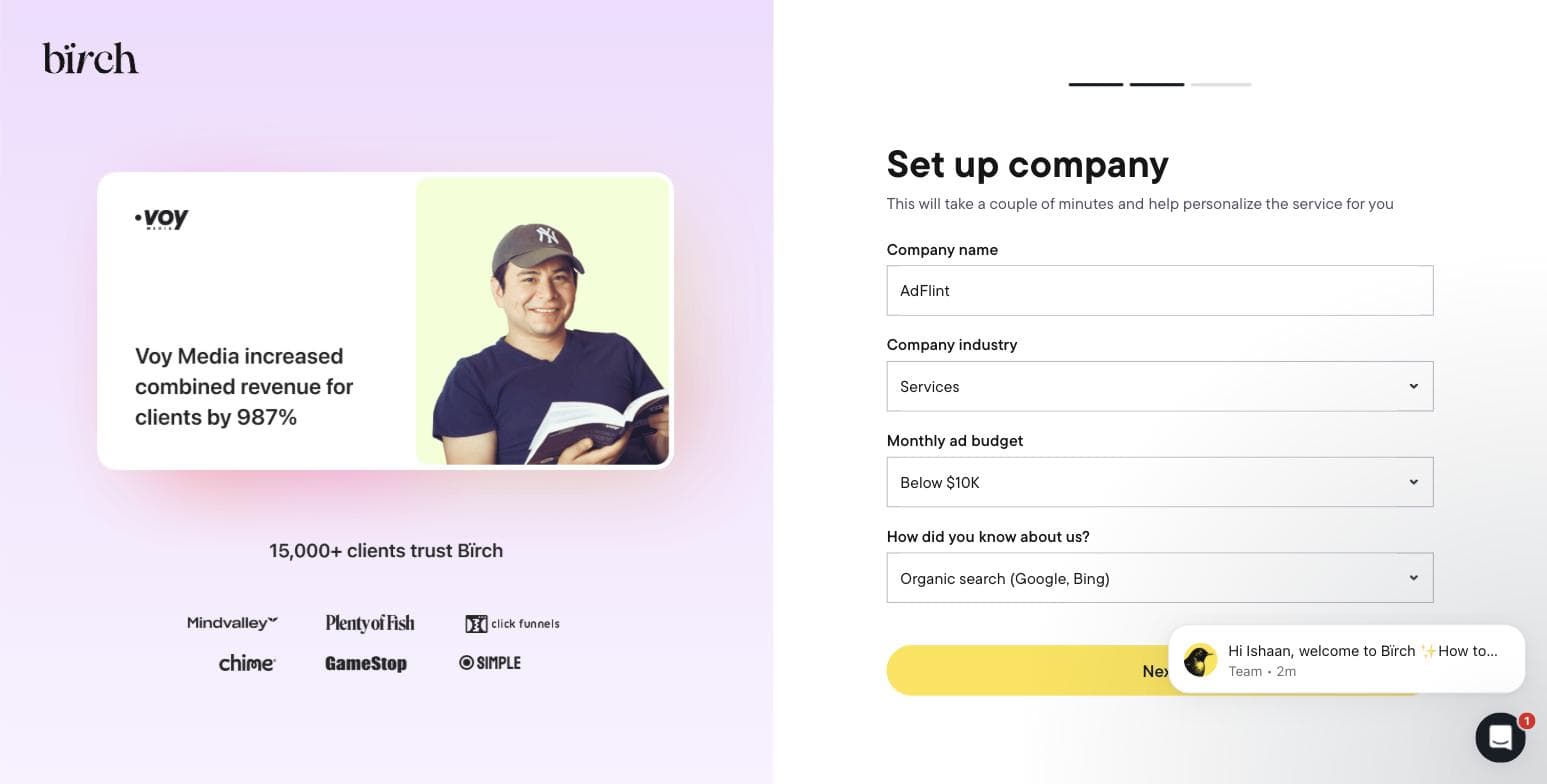
Step two of Birch's onboarding, captured during our own signup on 30 July 2026. - 03
Connect an ad platform — or don't, and see what breaks
Step three asks you to connect Meta Ads, TikTok, Google Ads, or Snapchat before you reach the product. Meta is presented first and most prominently, matching Birch's heritage. We skipped it deliberately, to find out how much of the product survives without granting a third party access to a live ad account. The answer is: the shell, but not the substance.
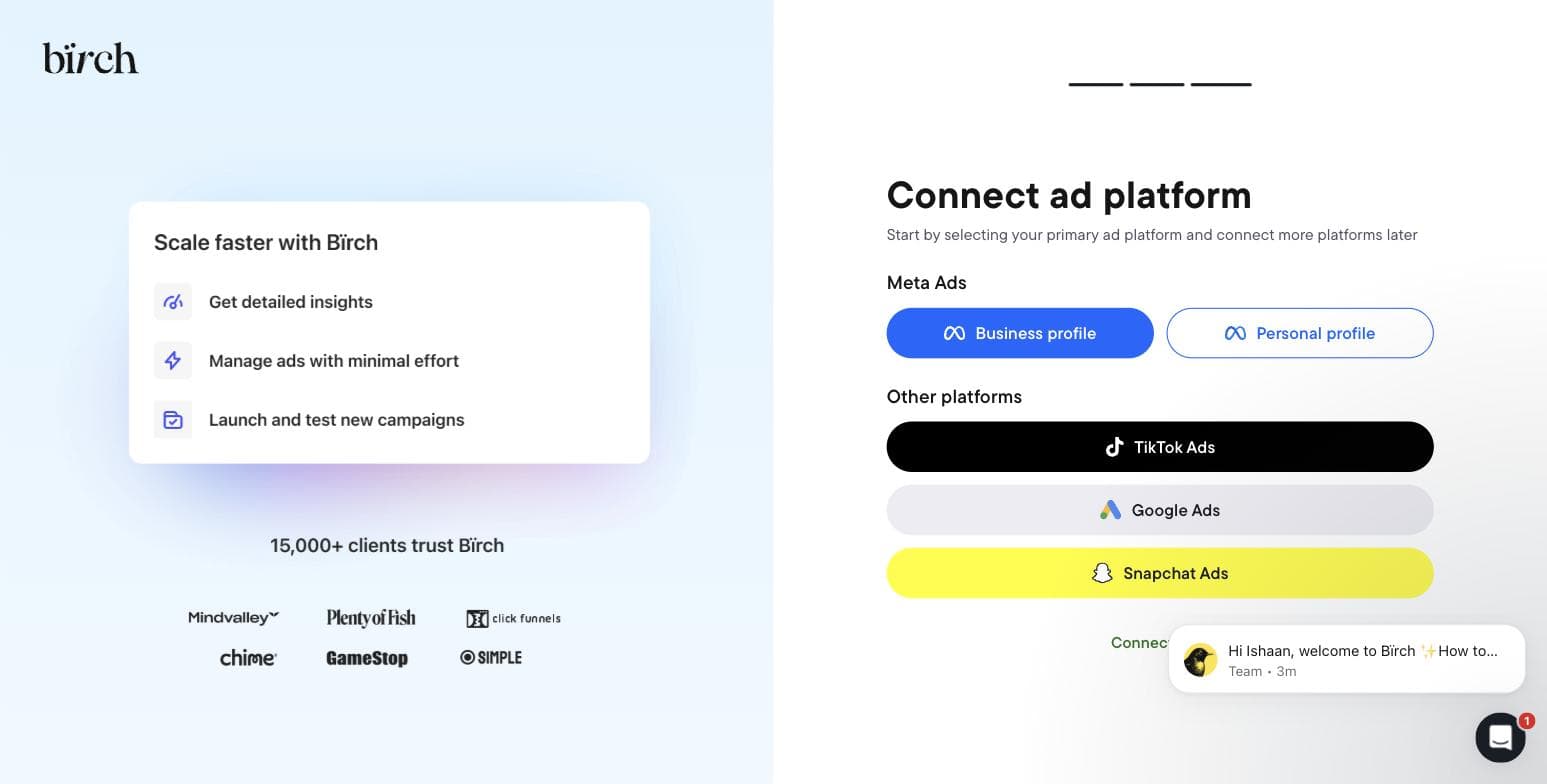
Birch's final onboarding step. Captured 30 July 2026. - 04
Open the Rules engine — the feature it is famous for
The automation screen is the reason most people arrive at Birch. Without a connected account it is a single button reading Connect ad account, over an illustration of the three action types it offers — increase bid, duplicate, notify. That is the entire surface available to an unconnected trial. There is no sandbox and no demo dataset, so you cannot evaluate the rule builder against sample data before handing over access to real campaigns.
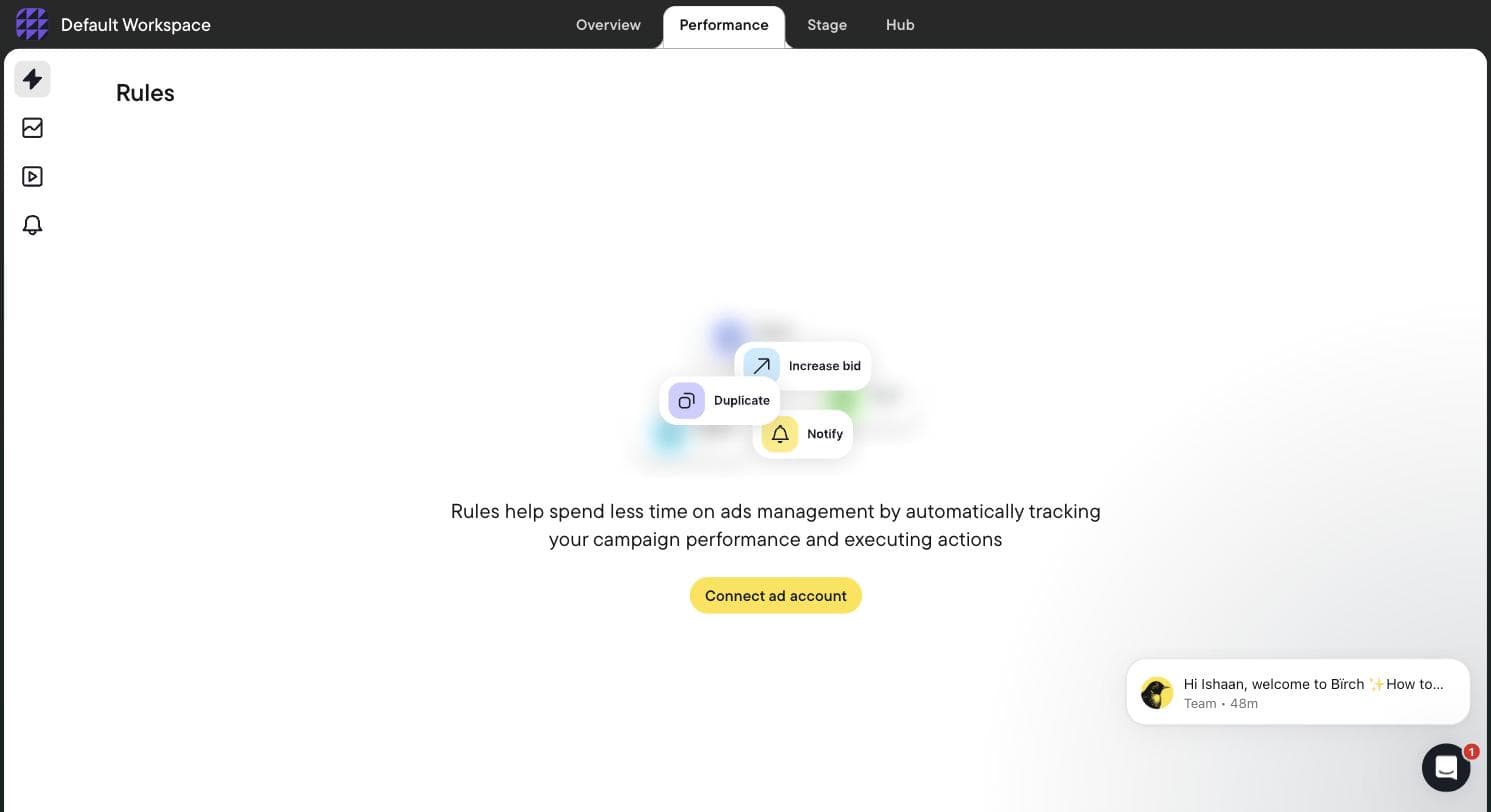
Birch's Rules screen with no ad account connected — the rule builder is entirely gated. Captured 30 July 2026. - 05
Find Stage, the product nobody has reviewed
Stage is a bulk creative launcher: you connect a planning Google Sheet and your Drive folders, and it builds the ads from there — launching creative tests from the sheet, mirroring your Drive folder structure into ad structure, duplicating winning setups with new creative swapped in, and working across multiple Drives and platforms at once. It targets Meta, TikTok and Snapchat. Birch states plainly that its Drive access is read-only and it cannot edit or delete anything. We could not find a single published roundup that mentions this exists.
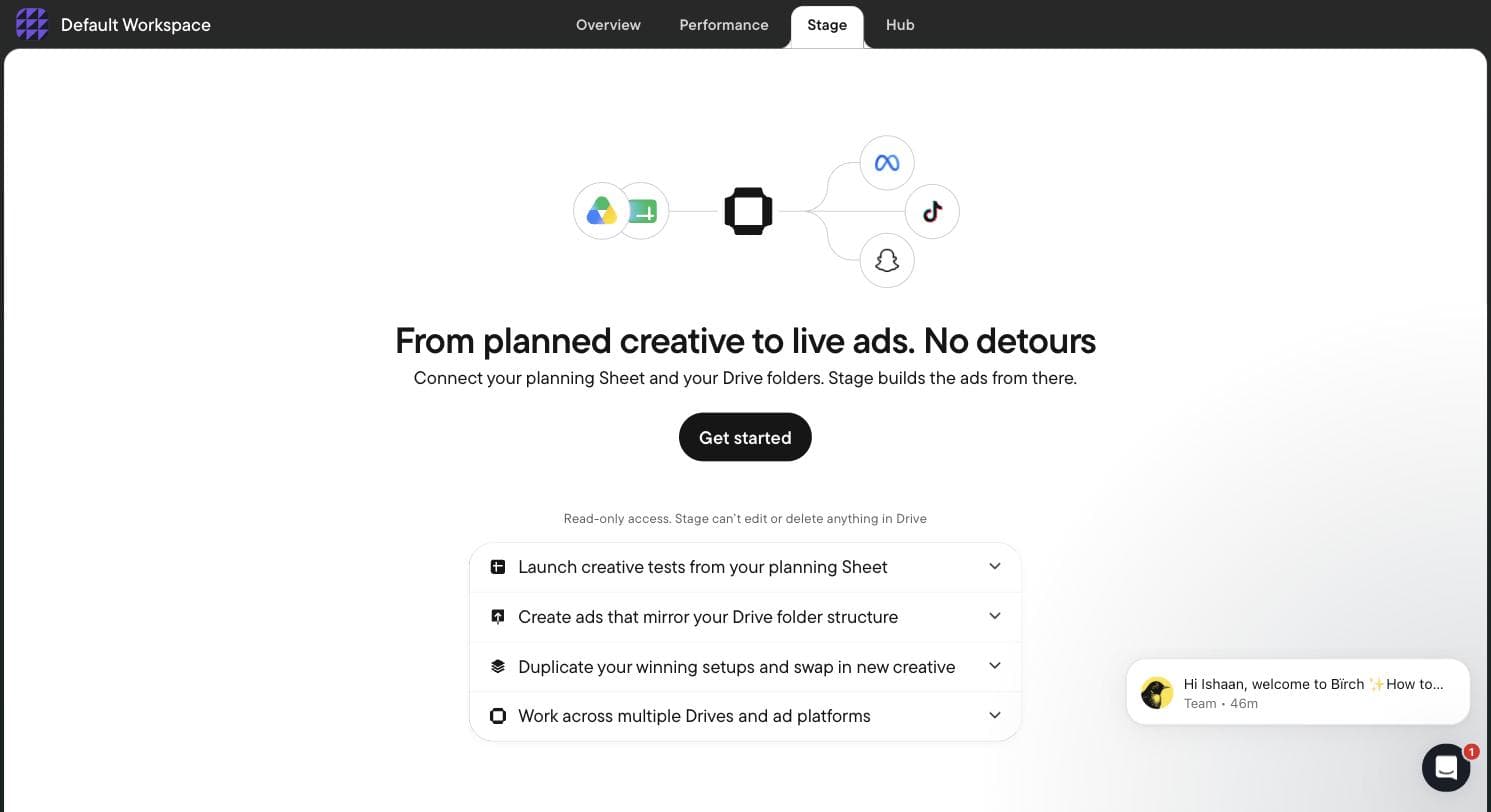
Birch Stage — a Sheet-and-Drive bulk ad launcher absent from every Revealbot-era review. Captured 30 July 2026. - 06
Find Hub, which is not an ads tool at all
Hub is server-side tracking infrastructure. You create a Signals Gateway, pick a hosting region, point it at your primary website, and it collects first-party data and forwards it to the ad platforms — the category occupied by conversions-API and server-side GTM setups. A company that used to sell Facebook rule automation now also sells you the tracking layer underneath it. That is a strategic move worth understanding before you compare Birch to anything on price alone.
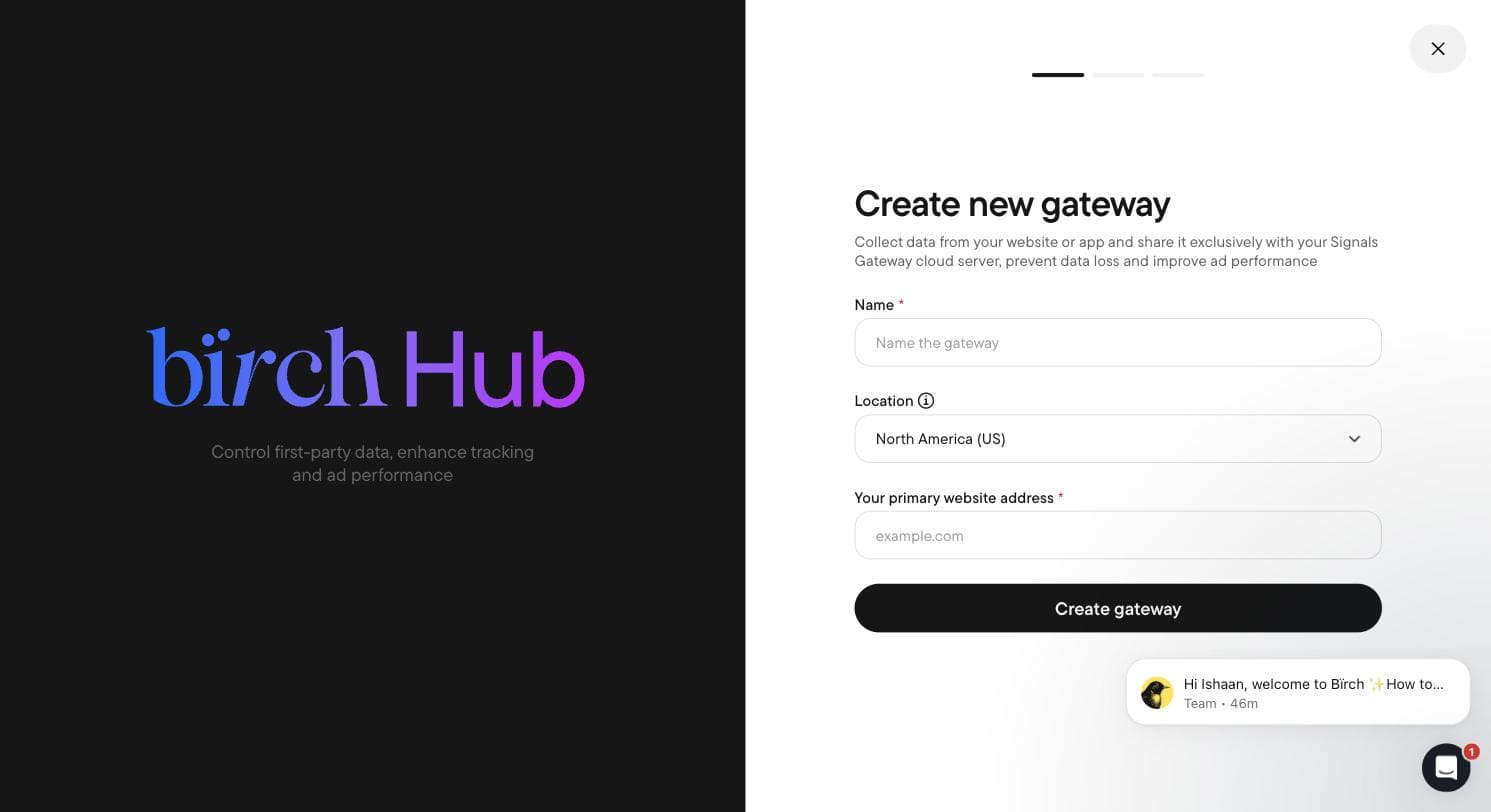
Birch Hub's Signals Gateway — server-side first-party data collection. Captured 30 July 2026. - 07
Read the integration list
Birch connects twelve services: Meta Ads, Google Ads & Google Drive, Snapchat Ads, TikTok Ads, YouTube, Google Analytics, Google Sheets, Slack, and — telling for who it is built for — the attribution stack of AppsFlyer, Adjust (in beta), Hyros and Wicked Reports. There is no Microsoft Ads, no Amazon and no LinkedIn. Set that against Optmyzr's Amazon, Microsoft, LinkedIn and Search Ads 360 and the two products stop looking like competitors at all: Optmyzr is built for search, Birch is built for paid social and direct-to-consumer attribution.
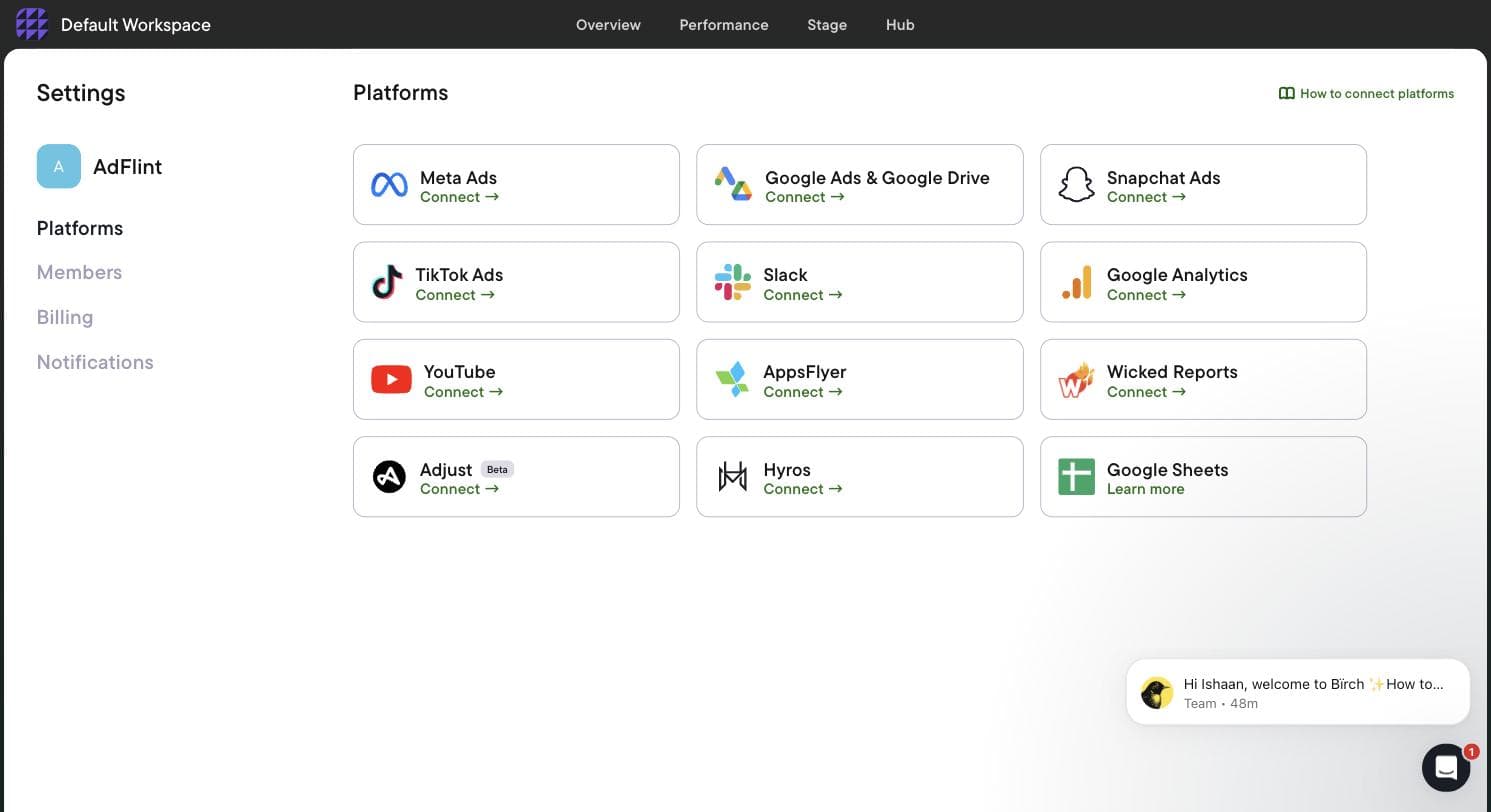
Birch's twelve integrations, heavy on paid social and attribution. Captured 30 July 2026. - 08
Read the real price off the billing screen
Birch does not have a flat price. The billing screen tracks cumulative spend across your connected accounts and charges you against it, with a slider that recalculates every plan as you move up the spend ladder. We walked the whole slider and wrote down every number. Two things matter more than the prices themselves: automated rules — the feature Revealbot was known for — are not in the entry plan at all, and above roughly $150K in monthly spend the entry plan stops being offered.
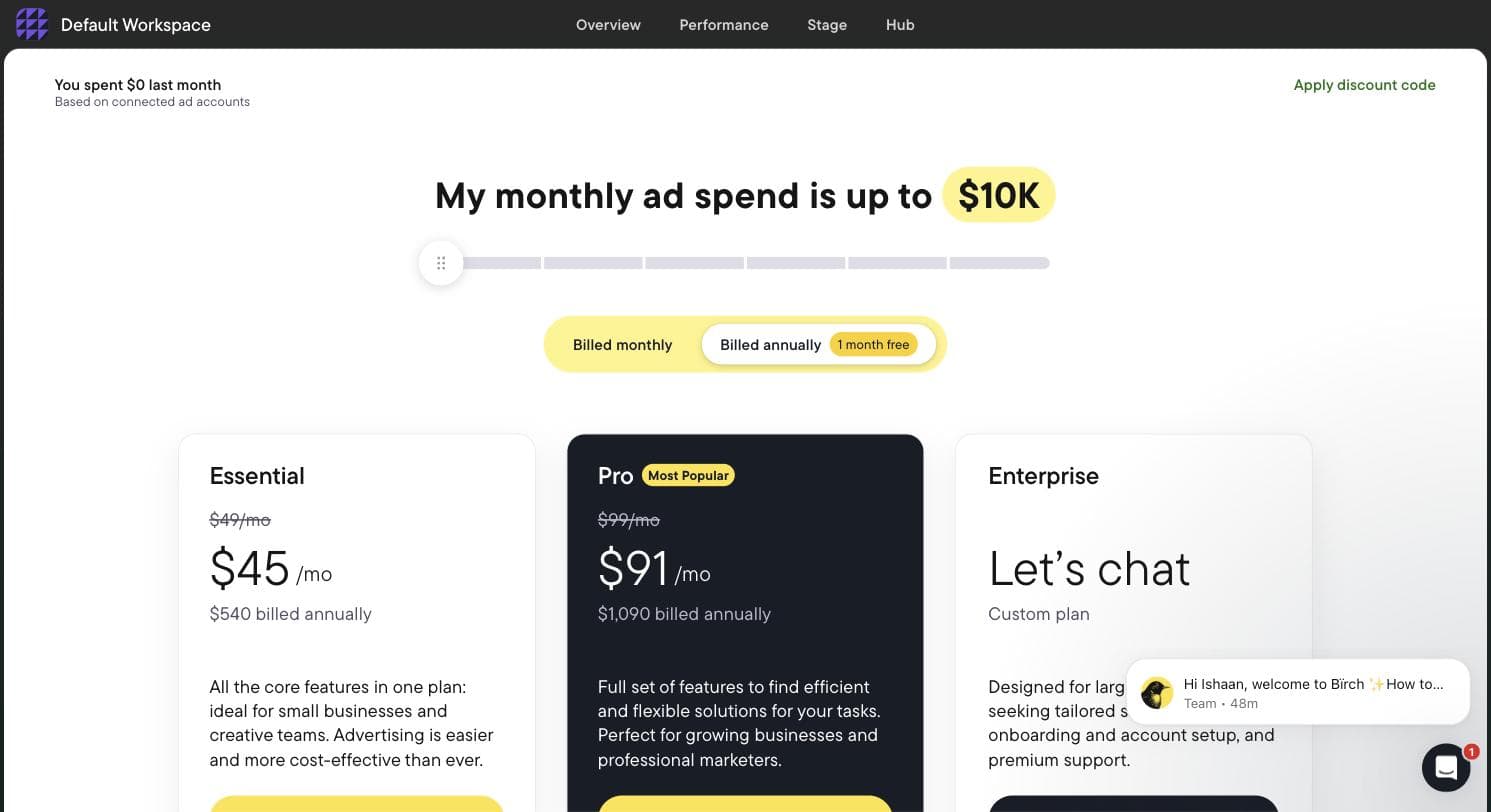
Birch's in-app pricing at the lowest spend tier. The slider above recalculates every plan. Captured 30 July 2026.
What the signup told us
- — Genuinely fast: account creation to the connect screen took under two minutes, with no phone number and no credit card.
- — The rebrand is badly signposted. Arriving from an older article pointing at revealbot.com or bir.ch/signup gets you a 404 before you find the app.
- — No sandbox and no demo data. The rule builder — the main reason to evaluate Birch — is completely inaccessible until you grant access to a live ad account.
- — Pricing is tied to your ad spend, not to seats or usage of the tool, so your bill grows as your campaigns do even if your use of Birch never changes.
- — The entry plan excludes automation entirely, which makes the widely quoted 'from $49' figure misleading for anyone arriving for the rules engine.
- — Meta is the default and most prominent option; Google Ads is present but visually secondary. Treat this as a Meta-first tool that also does Google.
- — One URL we tried inside the app hung on a loading spinner indefinitely rather than resolving or erroring.
Pricing, read off the in-app billing screen
Every figure below was read directly off Birch's own in-app billing slider on 30 July 2026, at each spend tier in turn. Monthly prices are the headline rate; annual prices are the discounted equivalent, billed once a year.
| Your monthly ad spend | Essential | Pro | Annual (Essential / Pro) |
|---|---|---|---|
| Up to $10K | $49/mo | $99/mo | $540 / $1,090 |
| Up to $30K | $149/mo | $249/mo | $1,640 / $2,740 |
| Up to $75K | $299/mo | $499/mo | $3,290 / $5,490 |
| Up to $150K | $499/mo | $799/mo | $5,490 / $8,790 |
| Up to $300K | Not offered | $1,299/mo | — / $14,290 |
| $500K+ | Not offered | Not offered | Enterprise, custom quote |
- — Essential does not include automated rules. This is the single most important line on the page: the feature Revealbot built its reputation on sits behind the Pro tier. Essential buys you workspaces, post boosting, reports, an activity page, Slack and email support — and nothing that automates a campaign.
- — Pro adds automated rules and strategies, Explorer, top audiences, Launcher, Stage, custom metrics and timeframes, the custom and lookalike audience builder, the Sheets/AppsFlyer/Hyros integrations, and live chat support.
- — Price is set by total monthly ad budget across every ad account you connect. If your spend rises past your tier, Birch states you are charged an overage fee through Stripe and notified by email; your features keep working.
- — Annual billing is described as twelve months for the price of eleven.
- — The trial is 14 days with full feature access. When it expires, your rules and reports are disabled rather than deleted, and come back when you pick a plan.
Where this stops: We did not connect a live Meta or Google account, so we have not watched a Birch rule evaluate or fire against real campaigns, and we have not seen Explorer, Stage or Hub populated with real data. Everything above is what the product does and costs, verified in-app; how well its automation actually performs on live spend is not something this walkthrough can tell you.
Meta Advantage+ (native automation)
Best free automation to turn on firstBefore comparing any paid tool, know what Meta already gives you. The Advantage+ suite is Meta's own automation layer inside Ads Manager. Per Meta's official page, Advantage+ shopping campaigns are automated sales campaigns that use machine learning to serve your ads to the audiences most likely to convert while making better use of your budget, and the suite as a whole automates core campaign creation steps: audience, budget and bidding, placement, and creative. Advantage+ catalog ads (formerly dynamic ads) automate product promotion from your catalog, and Advantage+ app campaigns do the same for app installs.
This is the automation everything else builds on. Third-party tools do not replace Meta's delivery machine learning; they sit on top of it. That is why the consistent practitioner advice, including in the communities that rank for this exact search, is to switch on Advantage+ first and only add paid software once you know what gap you are paying to fill.
The tradeoff is control and visibility. Handing audience, placement, and budget allocation to Advantage+ means accepting limited insight into exactly who your ads reached and fewer levers when something underperforms. It also automates none of the strategy: you still choose the offer, write or supply the creative, set the budget, and judge the results. Advantage+ is a delivery engine, not an ads manager.
Pros
- + Free, built into Ads Manager, and works in every account with no setup fee
- + Automates targeting, placements, budget allocation, and bidding with Meta's own delivery data, which no third party can match
- + Advantage+ catalog ads keep product ads current automatically from your catalog
- + Fewer campaign-structure decisions to get wrong for beginners
Cons
- − Limited transparency and control: you cede audience and placement decisions with restricted breakdowns in reporting
- − Does not write ads, set strategy, or watch your account for you; it only automates delivery
- − When performance dips, there are fewer levers to pull than in a manual campaign structure
Ideal for
- Every Meta advertiser, as the default starting point
- Ecommerce stores with a product catalog
- Beginners who would otherwise misconfigure manual targeting
Pricing: Free. Advantage+ features are built into Meta Ads Manager; you pay only your ad spend. Checked July 2026 at facebook.com/business/ads/automation.
Visit Meta Advantage+ (native automation)AdFlint
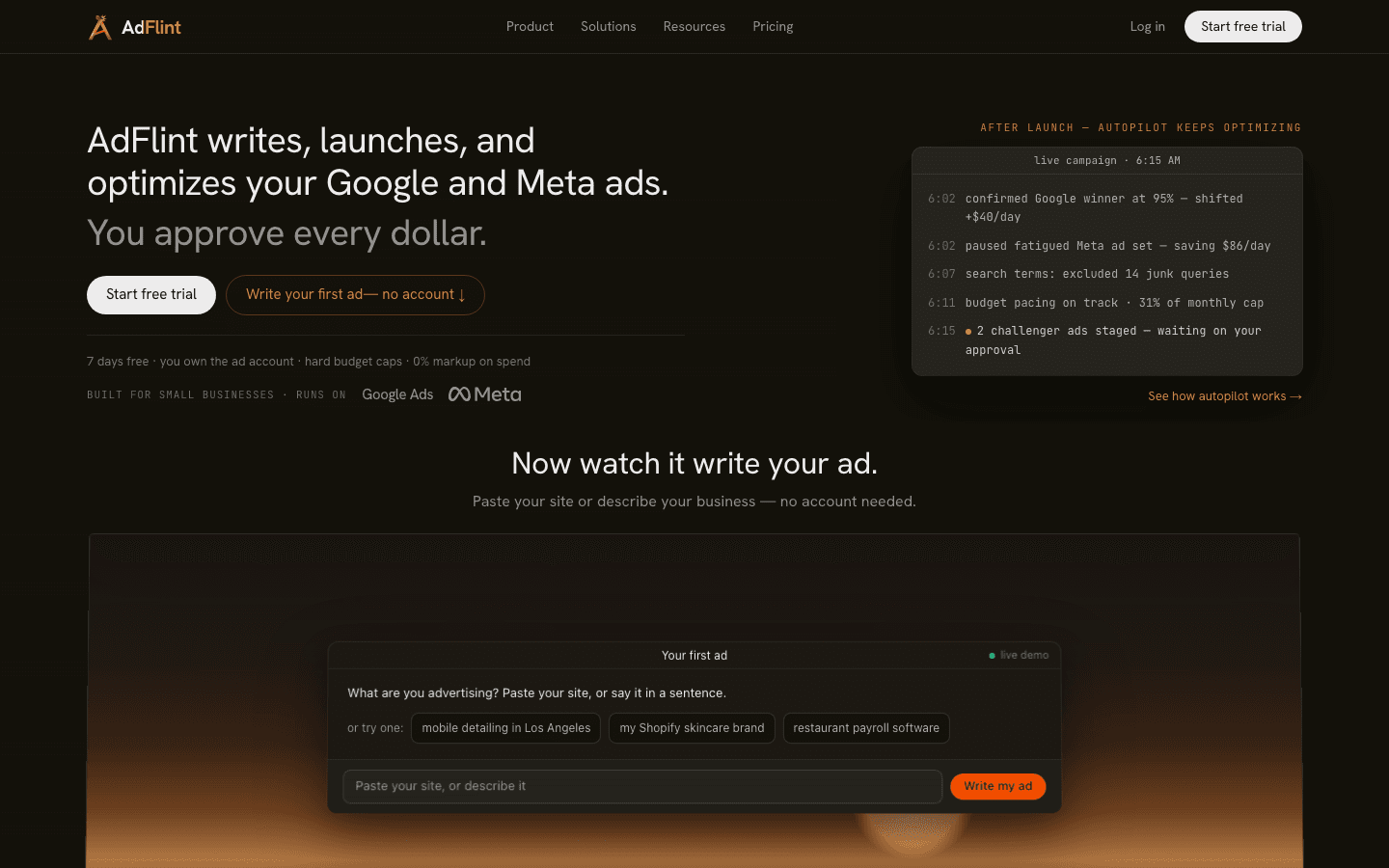
Best done-for-you automation for small businessesOur product — disclosureDisclosure up front: AdFlint is our product, so read this entry as the maker's case, checked against the same criteria as everyone else. AdFlint automates the layer the other tools on this page do not: the workflow itself. The AI writes the ad copy, builds and launches campaigns on Google and Meta, tracks conversions, and applies optimization changes, while on the self-serve plans every ad passes through human approval before it spends money. It runs inside your own ad account, connected via OAuth, so your card pays Meta directly, you keep the account history, and you can disconnect at any time.
The pricing model is the other deliberate difference: a flat monthly software fee with no percentage of ad spend. Self-serve plans are sized by monthly ad spend: Launch at $40 per month covers up to $1,000 in monthly spend, and Growth at $89 covers up to $2,500 with priority optimization checks and weekly summaries. A custom-priced Managed tier has AdFlint running Google and Meta end to end with approval-by-exception. Every plan starts with a 7-day free trial with a card required.
Where it is honestly not the right fit: AdFlint covers Google and Meta only, so multi-channel teams running TikTok or Snapchat need something like Birch alongside it. The self-serve tiers cap out at $2,500 per month in ad spend before you are into the custom Managed tier, which tells you who it is built for: small businesses, not agencies. And it is a younger product than Madgicx or Birch with a smaller public review footprint, which is exactly why this entry carries no review quote.
Pros
- + Automates the full workflow: writes ad copy, launches campaigns, and applies optimizations, not just monitoring rules
- + Runs inside your own ad account; on self-serve plans every ad needs your approval before it spends
- + Flat fee from $40 per month with no percentage-of-spend markup
- + Hard budget caps per plan tier, so automation cannot outspend what you agreed to
- + Covers Google and Meta from one place, useful when Facebook is only half your ad budget
Cons
- − Google and Meta only; no TikTok, Snapchat, or Pinterest support
- − Self-serve plans cap monthly ad spend at $2,500, so larger advertisers must go to the custom Managed tier
- − Younger product with a small public review footprint compared to Madgicx or Birch
- − Approval-first design means it will not act on your account without you, which is a feature for safety but not for speed
Ideal for
- Small businesses that want ads written, launched, and optimized without learning Ads Manager
- Owners spending under $2,500 per month across Google and Meta
- Anyone burned by percentage-of-spend agency pricing
Pricing: Launch $40/mo (up to $1,000/mo ad spend), Growth $89/mo (up to $2,500), Managed tier custom-priced. 7-day free trial, card required. Flat fee, no percentage of ad spend. Checked July 2026 at adflint.com/pricing.
Try AdFlint freeBirch (formerly Revealbot)
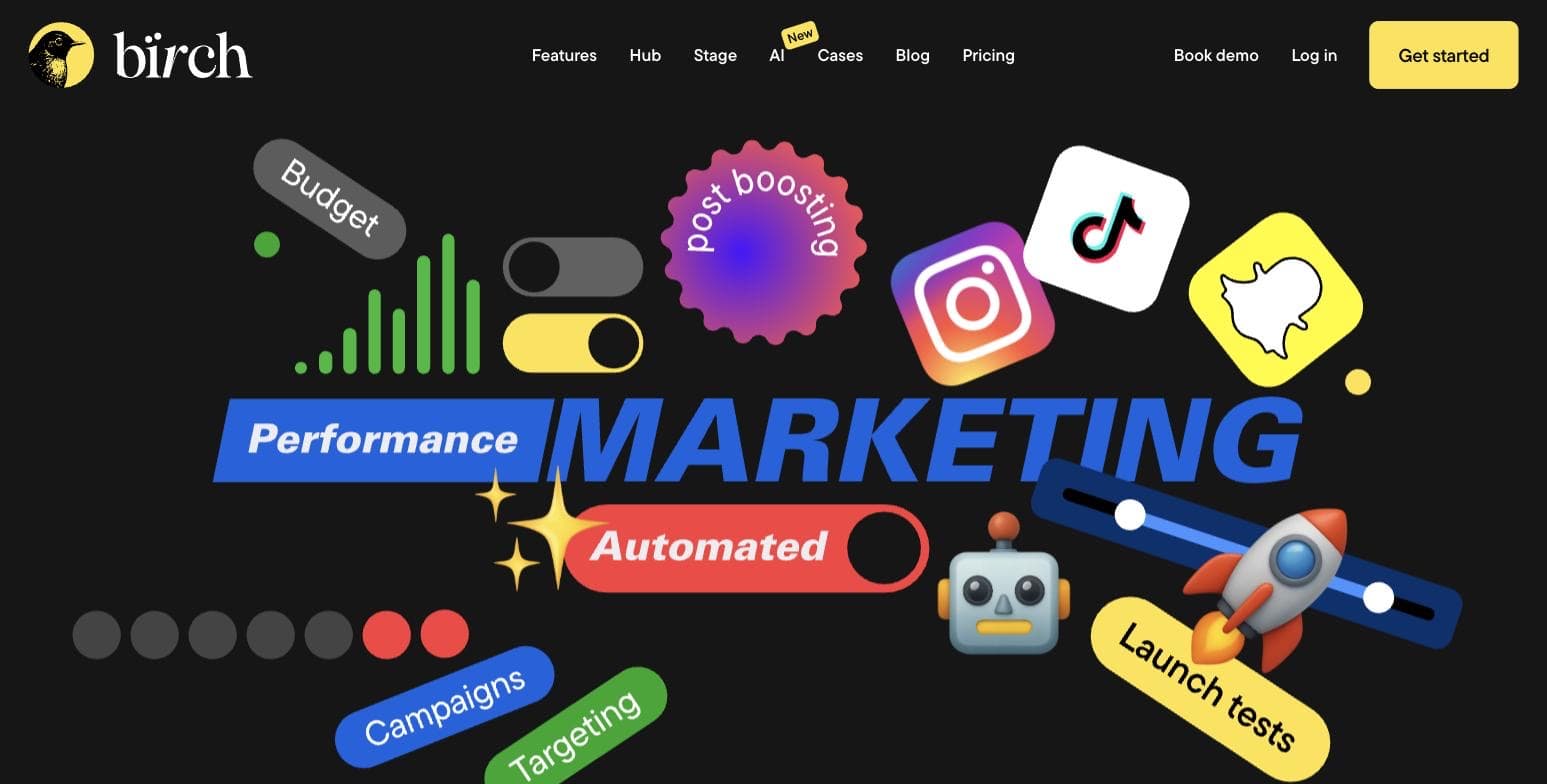
Best rule-based automation for agencies and power usersBirch, which longtime Facebook advertisers will know under its old name Revealbot, is the specialist for management automation: if-this-then-that rules that watch your campaigns around the clock and act on the conditions you define. This is the same category as Meta's free automated rules, but with more granular conditions, faster checking intervals, and coverage across Meta, Instagram, Google Ads, TikTok, and Snapchat from one rule builder, which is precisely what agencies running dozens of accounts pay for.
Pricing on Birch's site in July 2026 starts at $49 per month for the Essential plan and $99 per month for the Pro plan on monthly billing, covering up to $10,000 in monthly ad spend, with the price scaling as spend grows, an annual-billing discount, and a custom Enterprise tier above that. There is a genuine 14-day free trial with no card required, which is the friendliest trial on this list. A separate server-side tracking product, Signals Gateway, is priced by event volume starting free at 10,000 events per month.
The honest caveats: a rules engine automates decisions you design, so you need to already know what a good stop-loss or scaling rule looks like; it will faithfully execute a bad rule too. Cost scales with ad spend, so the sticker price is the floor. And the 2025-2026 rebrand from Revealbot to Birch means much of the public review history and third-party documentation lives under the old name. We could not access its G2 or Capterra listings during research and its Product Hunt page has no reviews, so this entry carries no review quote.
Pros
- + Deep rule builder with more conditions and tighter intervals than Meta's free automated rules
- + Multi-platform: one automation layer across Meta, Google, TikTok, and Snapchat
- + 14-day free trial with no card required
- + Long-established rules engine, still branded Birch (Revealbot) on its own site, with agency-oriented features like bulk actions
Cons
- − It executes your strategy rather than supplying one; bad rules get automated just as reliably as good ones
- − Pricing scales with ad spend, and overage fees can apply beyond your plan's spend tier
- − The Revealbot-to-Birch rebrand makes current reviews and docs harder to find under one name
Ideal for
- Agencies and media buyers managing many campaigns or accounts
- Power users who already know exactly which rules they want enforced
- Teams running paid social beyond Meta (TikTok, Snapchat) who want one rules layer
Pricing: Essential from $49/mo and Pro from $99/mo on monthly billing at up to $10,000/mo ad spend; price scales with spend, discount for annual billing, Enterprise custom. 14-day free trial, no card required. Checked July 2026 at bir.ch/pricing.
Visit Birch (formerly Revealbot)Madgicx
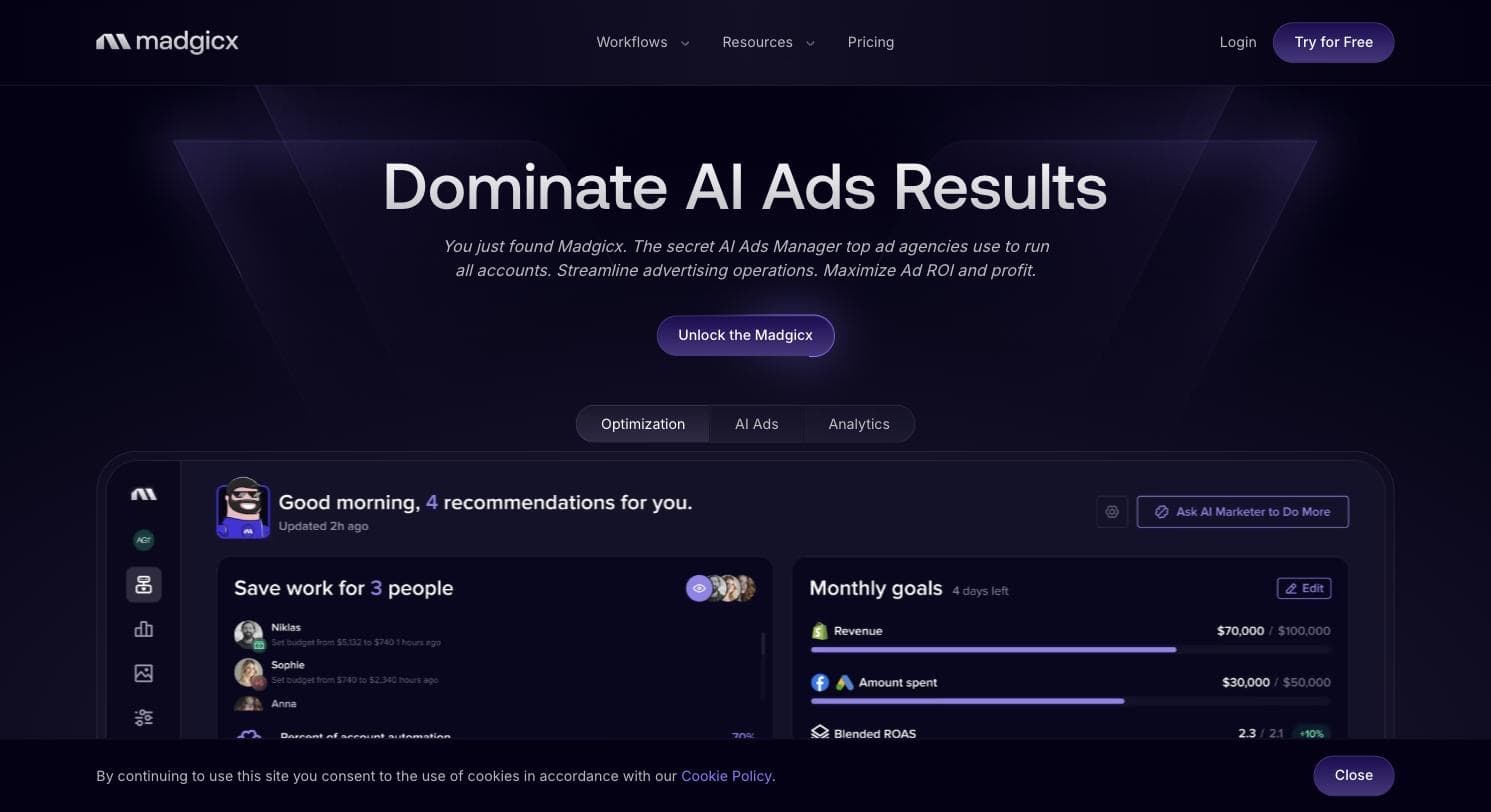
Best all-in-one Meta toolkit for ecommerce teamsMadgicx is the broadest Meta-focused platform on this list: automation tactics, AI ad creation, audience targeting, analytics dashboards, and a paid tracking add-on, all in one subscription. Its homepage positions it as an agentic Meta ads management AI platform and carries a 4.5-star badge citing 380+ reviews. For an ecommerce team that lives inside Meta ads daily and wants one tool for automation plus creative plus attribution, the breadth is the pitch.
The pricing is the least transparent on this page, and that matters. As of July 2026 the pricing page lists the main plan (shown as Madgicx Pro Complete with AI) at $0/mo alongside the note to see the price inside the app: cost is sized to your monthly ad spend across tiers running from under $1,000 to over $30,000 per month, and you find your number after signing up for the 7-day free trial. The visible figures are the $49 per month Tracking Pro add-on and a $29 per month early-bird offer on the homepage that applies to its reporting product, not the full platform.
Public reviews are genuinely mixed. On the Shopify App Store it holds 4 out of 5 stars across 13 reviews, and the split is polarized: nine 5-star reviews against three 1-star ones. The positive reviews praise how much the platform consolidates Facebook ad management; the 1-star reviews criticize the quality of its human managed service, its customer support, and in one case the software experience and billing. For a small advertiser, the practical questions are whether you will use enough of the toolkit to beat the price you are quoted in-app, and whether you want a Meta-only platform when your budget also runs on Google.
Pros
- + Widest feature set of the paid tools here: automation, AI creative generation, audiences, and analytics in one place
- + Purpose-built for Meta with ecommerce integrations including Shopify, Klaviyo, and GA4 data
- + 7-day free trial of the full platform
- + Optional Tracking Pro add-on ($49/mo) for server-side conversion tracking
Cons
- − Platform pricing is not published; the pricing page shows the real number only inside the app, sized to your ad spend
- − Core automation is Meta-only, so Google-side budgets need a second tool
- − Public reviews are polarized: three of thirteen Shopify App Store reviews are 1-star, faulting its managed service, support, and billing
- − Feature breadth carries a real learning curve for a solo operator who wanted less work, not more dashboards
Ideal for
- Ecommerce brands whose paid budget is concentrated on Meta
- Teams that want automation, creative, and attribution consolidated into one subscription
- Advertisers with enough spend to justify usage-tiered SaaS pricing
Pricing: Main platform price not published: shown in-app after signup, sized to monthly ad spend (tiers from under $1K to $30K+). 7-day free trial. Tracking Pro add-on $49/mo; a $29/mo early-bird homepage offer applies to its reporting product. Checked July 2026 at madgicx.com/pricing.
Visit Madgicx“I have been using Madgicx for a year now, and it's an amazing platform. It has greatly simplified the management of my Facebook ad accounts, providing me with clear insights and useful suggestions through its AI marketer tools.”
— Jet Italian Deli, Shopify App Store review, November 2023
Meta automated rules
Best free guardrails inside Ads ManagerMeta's automated rules are the free, native version of what Birch sells: conditions attached to your campaigns, ad sets, or ads that act automatically when performance crosses a line you set, for example pausing an ad set or simply sending you a notification when a threshold is hit. Rules come in two flavors: schedule-based rules, which check your campaigns at a set interval, and trigger-based rules, which act as soon as a condition is met.
For a small advertiser, one or two rules cover the highest-value automation there is: a stop-loss that pauses anything spending with no results, and a notification when spend or cost per result jumps. That safety net costs nothing and takes minutes to set up in Ads Manager, and you should have it in place whether or not you ever buy a third-party tool.
The limits are structural. Rules can only act on campaigns that already exist; they create nothing and write nothing. Conditions are limited to the metrics and check intervals Meta exposes, which is exactly the gap tools like Birch fill with finer conditions and faster checks. And rules do not think: a rule will keep enforcing yesterday's threshold in today's conditions until you revisit it.
Pros
- + Free and native to Ads Manager, with no third-party account access required
- + Covers the essential safety net: stop-loss pauses and spend or performance alerts
- + Both scheduled checks and condition-triggered actions
Cons
- − Only acts on existing campaigns; it cannot create, edit creative, or restructure anything
- − Conditions and check intervals are coarser than paid rules engines
- − Set-and-forget rules quietly enforce stale thresholds unless you review them
Ideal for
- Every advertiser running Meta campaigns manually, as basic insurance
- Small budgets that need a stop-loss more than they need software
- Anyone evaluating whether they need a paid rules tool: try the free one first
Pricing: Free. Automated rules are built into Meta Ads Manager at no charge; you pay only your ad spend. Checked July 2026.
Visit Meta automated rulesAutomated post-boosting (the one to avoid)
Best kept to occasional engagement pushesThe Boost button under a Facebook or Instagram post is the most-used ad automation there is, and putting it on autopilot, whether through scheduler tools that auto-boost every new post or simply by habit, is where more small-business ad money quietly dies than anywhere else on this page. A boost is a simplified ad created from the post itself: you pick a budget, a duration, and a broad audience, and Meta handles the rest. That simplicity is real, and for a local event or an awareness push it is a legitimate lightweight option.
The problem is what boosting optimizes for. Boosted posts are engagement-first by design: likes, comments, and reach, not purchases or leads. The full campaign objectives, conversion optimization, placement control, and testing tools live in Ads Manager, and that gap is the practical difference between boosting a post and building an ad. An automation that boosts every post is therefore an automation that buys engagement on autopilot regardless of whether any given post has a business reason to be promoted.
Our advice is not never boost. It is: never automate boosting. If a post is worth paid distribution toward an actual outcome, it is worth the extra minutes to run it through Ads Manager with a conversion objective, or to let a workflow tool do that for you. Treat the Boost button as an occasional, deliberate engagement purchase, and treat any tool whose automation story is auto-boosting your posts as a red flag.
Pros
- + Fastest possible way to put budget behind a post, directly from the page
- + Reasonable for deliberate, occasional awareness or local-event pushes
- + No tool cost; you pay only the boost budget
Cons
- − Optimizes for engagement rather than conversions, so it rarely produces sales or leads efficiently
- − Far fewer objectives, placement controls, and testing options than Ads Manager campaigns
- − Auto-boosting every post spends money with no per-post business case, which is the definition of waste
Ideal for
- Local businesses promoting an event or announcement to a nearby audience
- Pages that occasionally want extra reach on a post that is already performing organically
Pricing: No software fee; you pay Meta the boost budget you choose per post. The real cost is opportunity cost versus a conversion-optimized campaign. Reference: Meta Business Help Center, About Boosted Posts, July 2026.
Visit Automated post-boosting (the one to avoid)Side by side.
| Tool | Best for | Starting price | Platforms covered | Standout limitation |
|---|---|---|---|---|
| Meta Advantage+ | Free delivery automation, on by default | Free (built into Ads Manager) | Facebook, Instagram | Automates delivery only; no strategy, creative, or monitoring |
| AdFlint | Done-for-you ads for small businesses | $40/mo (up to $1,000/mo ad spend) | Google, Meta | Self-serve tiers cap at $2,500/mo ad spend |
| Birch (Revealbot) | Rule-based automation at scale | $49/mo (monthly billing) | Meta, Google, TikTok, Snapchat | Automates your rules, not your strategy; cost scales with spend |
| Madgicx | All-in-one Meta toolkit for ecommerce | Not published; shown in-app by spend tier | Meta (plus data integrations) | Platform pricing hidden until signup |
| Meta automated rules | Free guardrails and stop-losses | Free (built into Ads Manager) | Facebook, Instagram | Acts only on existing campaigns; coarse conditions |
| Automated post-boosting | Occasional engagement pushes only | Ad budget only | Facebook, Instagram | Engagement-optimized; wasteful when automated |
How we chose.
This is a researched comparison, not a hands-on test, and we want to be precise about what that means. We did not run paid campaigns through Madgicx or Birch to produce this page. What we did do: read each product's official documentation, fetch every vendor's live pricing page in July 2026 and quote the figures as displayed, review Meta's own Advantage+ and Ads Manager documentation, and read public, attributed user reviews on third-party platforms. Where this page describes hands-on experience, it is quoting a named reviewer, verbatim, with a link to the source.
Some things we could not verify, and we say so inline rather than papering over them. Madgicx does not publish its full platform pricing (its pricing page says the price is shown inside the app, sized to your ad spend), so we report the visible figures and the tiers, not a guessed number. For Birch, the major review platforms were not accessible to us during research and its Product Hunt listing has no reviews yet, so its entry carries no review quote rather than an invented one.
Disclosure: AdFlint is our product. Its entry is marked with a disclosure tag, it is ranked by the same criteria as everything else, and we have tried to write its cons the way a competitor would. If you think we got a ranking wrong, the comparison table has everything you need to overrule us.
- — Live pricing, checked in July 2026 on each vendor's own pricing page, including trial terms and how cost scales with ad spend. No figures from aggregator databases or memory.
- — What actually gets automated: delivery, guardrails, or the full create-launch-optimize workflow. We rank tools against the job they claim, not against a generic feature list.
- — Fit for small budgets: what the tool costs and whether it makes sense at under $1,000 per month in ad spend, since that is who searches for this query most.
- — Control and safety: whether automation runs inside your own ad account, whether a human can approve or override actions, and whether spend is capped.
- — Real user evidence: attributed public reviews quoted verbatim with a source link. Entries where we could not obtain one say so.
- — Overlap with free native features: a paid tool had to do something Meta's own Advantage+ and automated rules do not already do for free.
Common questions.
Can Facebook ads run fully automatically?
The delivery layer already does: Meta's Advantage+ automation decides who sees your ads, where, and at what bid. But something still has to choose the offer, write the creative, set budgets, and judge results. Free native features leave that to you; rules engines like Birch or Meta's automated rules execute decisions you predefine; workflow tools like AdFlint make and apply those decisions with your approval. Fully automatic with zero human involvement does not exist honestly at any price, and practitioners are consistent that a human should stay in the loop.
Is Meta Advantage+ free?
Yes. Advantage+ shopping campaigns, catalog ads, audience, placements, and creative enhancements are all built into Meta Ads Manager at no software cost. You pay only your ad spend. That is why our first recommendation for anyone searching for automated Facebook ads is to switch on the free native automation before evaluating any paid tool.
What is the difference between boosted posts and automated ads?
A boosted post is a simplified ad created from an existing post, optimized for engagement like reach and reactions. Automated ads and Advantage+ campaigns are built in Ads Manager and can optimize for business outcomes such as purchases or leads, with full objective, placement, and testing options. Boosting occasionally is fine; automating boosts means buying engagement on autopilot, which is the one automation pattern this page recommends against.
How much does Facebook ad automation software cost in 2026?
Checked on live pricing pages in July 2026: Meta's Advantage+ and automated rules are free inside Ads Manager. AdFlint runs $40 to $89 per month on self-serve plans sized by ad spend, with a custom managed tier. Birch (formerly Revealbot) starts at $49 per month on monthly billing and scales with ad spend. Madgicx does not publish its main platform price; it is shown in-app, sized to your spend tier, with a $49 per month tracking add-on. Most paid tools price by your ad spend, so the sticker price is usually the floor.
Do these tools run inside my own ad account?
Yes, every tool on this page works in your own ad account: Meta's features natively, and AdFlint, Madgicx, and Birch by connecting to your account with permissions you grant. That matters because you keep the account history, pixel data, and billing relationship, and you can revoke access without losing your ads. Be cautious with any service that instead runs your ads from an ad account you do not own.
Should I use Meta's free automated rules or pay for a tool like Birch?
Start with the free ones. One stop-loss rule and one spend alert cover the highest-value guardrails for a small account, and they cost nothing. Paying for Birch makes sense when you hit the native limits in practice: you need finer conditions, faster check intervals, bulk management across many campaigns or accounts, or one rules layer spanning Meta, Google, TikTok, and Snapchat. If you cannot name the native limit you are hitting, you do not need the paid tool yet.
Keep reading
- AI Ad Automation: What to Let It Change, and Not
- Special Ad Categories: Setup on Meta and Google
- Facebook Ads Without a Page: What Meta Allows
- Native Ad AI vs Third-Party Tools in 2026
- Guide: Meta Ads Objectives and Bidding: The Complete Guide
- Guide: Ad Budgets, Pacing, and What Ad Management Costs
- Advantage+ Shopping vs Manual Sales Campaigns on Meta
- Advantage+ Audience vs Broad Targeting
- Advantage+ Placements vs Manual Placements: Who Controls Where Ads Run
- Boosted Posts vs Meta Ads Manager: When to Graduate to the Full Console
- AI Ad Management Software vs DIY Ad Management
- Done-For-You Ad Management vs a PPC Agency
- Free tool: Meta Lifetime Budget Pacing Calculator
- Free tool: Meta Ad Copy Preview & Character Checker
- Free tool: Ad Budget Calculator
- Free tool: ROAS Calculator
- Free tool: Meta Learning Phase Budget Calculator