Trapica Alternatives for Small Businesses (2026): Ranked by the One Thing Trapica Doesn't Publish — a Price
By the AdFlint research team · We run live campaigns on these platforms; every screenshot is from our own sessions · Published August 3, 2026 · Updated August 3, 2026
TL;DR
- Trapica is built for a buyer you probably aren't. Its homepage calls it "the AI marketing operating system for retail, e-commerce and B2B enterprises," cites "2,000+ Enterprise brands" and "$2B+ Ad spend optimized," and pitches "Go from $50K to $500K/month without the usual growing pains." Its pricing page shows three tiers — Automation, Intelligence, Enterprise — with no dollar figures on any of them and Get Started / Get a Demo / Contact Sales as the only routes forward (we checked both pages on 3 August 2026).
- If you want Trapica's actual job — campaigns written, launched and optimized — done at a small-business budget: AdFlint (our product; disclosure). It is the only tool on this page that both publishes its complete price list ($40 to $319/mo flat, 0% of ad spend on self-serve, 7-day free trial) and does the work rather than suggesting it. Google Ads and Meta only, and it is a young product with no third-party review base.
- If you want to start free: Adzooma has a genuine free-forever plan — "No credit card required," unlimited connected ad accounts — then Silver at $69/mo and Gold at $179/mo across Google, Microsoft and Meta ads. It surfaces one-click fixes; it does not run the account for you.
- If you are a PPC-literate operator heading toward $10K/mo in spend: Optmyzr — the one third-party tool here we used hands-on (trial account, 30-31 July 2026, revisited 3 August 2026). Essentials was $299/mo billed monthly or $209/mo billed annually when we read the pricing page in July 2026. Its own signup form's spend brackets start at "Under $10,000/mo," which tells you who it is really built for.
- groas offers Google-focused AI agents with a 7-day free trial but publishes no pricing we could find — groas.com/pricing returned a 404 when we checked on 3 August 2026 — so it fails the transparency test this page ranks by. WordStream no longer sells self-serve software: wordstream.com today is free grader tools plus demo-gated LocaliQ managed services.
- The technical point nobody selling "AI optimization" leads with: autonomy runs on conversion volume, and small budgets don't produce much. At $1,500/mo you are likely generating a handful of conversions a week — below the 3-5/week floor Optmyzr's own AI assistant cited to us for automated bidding, and far below the ~50 events per ad set per week Meta documents for leaving the learning phase. At that scale, approval gates and hard caps beat black-box autonomy.
This page is for a small business — call it $500 to $10,000 a month in ad spend — that found Trapica, liked the pitch of AI running the campaigns, and then hit the wall every small advertiser hits: a pricing page with three plan names and zero numbers, where the only path forward is a sales demo. Trapica is not hiding what it is. Its homepage says it plainly: "the AI marketing operating system for retail, e-commerce and B2B enterprises," with "2,000+ Enterprise brands" and "$2B+ Ad spend optimized." The line that settles the question is its own growth pitch: "Go from $50K to $500K/month without the usual growing pains." If your budget is $2,000 a month, you are not a smaller version of that customer. You are two orders of magnitude below the account size the product is engineered and priced around.
The competing lists we read while researching this in July and August 2026 do not deal with that. They recycle the same alternatives — enterprise optimization suites, agency platforms, demo-gated "AI marketing clouds" — that court the same $50K-and-up buyer Trapica already serves, and almost none of them prints a price. So we made published self-serve pricing the ranking spine of this page: can a small business see a number, judge it against its budget, and start without a sales call? Trapica cannot pass that test. Neither, it turns out, can two of the "small business friendly" names that appear on nearly every competing list.
There is also a technical reason a small business should not want a shrunken Trapica, and it is the part no vendor pitch leads with: autonomous optimization runs on conversion volume, and small budgets do not produce much of it. Do the arithmetic on a $1,500/mo local-services account. At a $5 cost per click — ordinary for competitive local service search — that is roughly 300 clicks a month; convert 5% of them and you have about 15 leads, three or four a week. That sits right at the floor Optmyzr's own AI assistant gave us when we asked it a real bidding question during our trial: roughly 3-5 conversions per week before automated bidding has enough signal to work with. It is also far below the roughly 50 optimization events per ad set per week that Meta's own documentation describes as the bar for exiting the learning phase. Two different systems, same message: at $1,500 a month you are data-poor, and no amount of model sophistication invents conversions you did not get. What protects your money at that volume is clean conversion tracking, hard budget caps, and a human approving what goes live.
One disclosure before the list: AdFlint, ranked first, is our product, and its own card repeats that. It is ranked on the two criteria this page states — published pricing and how much of Trapica's job it actually performs at small budgets — not on a track record, because it does not have one yet. Its cons are written as bluntly as everyone else's, including the ones a competitor would lead with, and the one tool we tested most deeply (Optmyzr) sits at number three for a stated reason: price relative to a small budget. Weigh the self-interest accordingly.
AdFlint
Best for small businesses that want Trapica's job done at a small-business priceOur product — disclosureAdFlint is our product — read this entry knowing that. It sits first because it is the only tool on this page that passes both tests this page ranks by: it publishes its complete price list, entry to ceiling, and it performs the job Trapica actually sells — writing, launching and optimizing the campaigns — rather than handing you recommendations to implement yourself. Trapica's homepage pitch is "Go from $50K to $500K/month." AdFlint's entry tier manages up to $1,000 a month of spend for a $40 flat fee. Those are not competing products; they are the same job sold to opposite ends of the market, and this page exists because search engines keep sending the second buyer to the first product.
The model: you connect your own Google Ads and Meta accounts with one-click OAuth. The accounts stay yours, your card pays Google and Meta directly, and AdFlint charges a flat monthly fee with 0% of your ad spend on every self-serve tier. The full ladder, published on our pricing page: Launch $40/mo (up to $1,000/mo ad spend), Growth $89 (up to $2,500), Scale $109 (up to $5,000), Accelerate $119 (up to $10,000), Performance $219 (up to $20,000), Premium $319 (up to $30,000), custom above that. Entry is a 7-day free trial. There is also a managed done-for-you tier starting at $249/mo plus a share of managed spend, for owners who want zero involvement — it costs meaningfully more than self-serve and we say so rather than burying it.
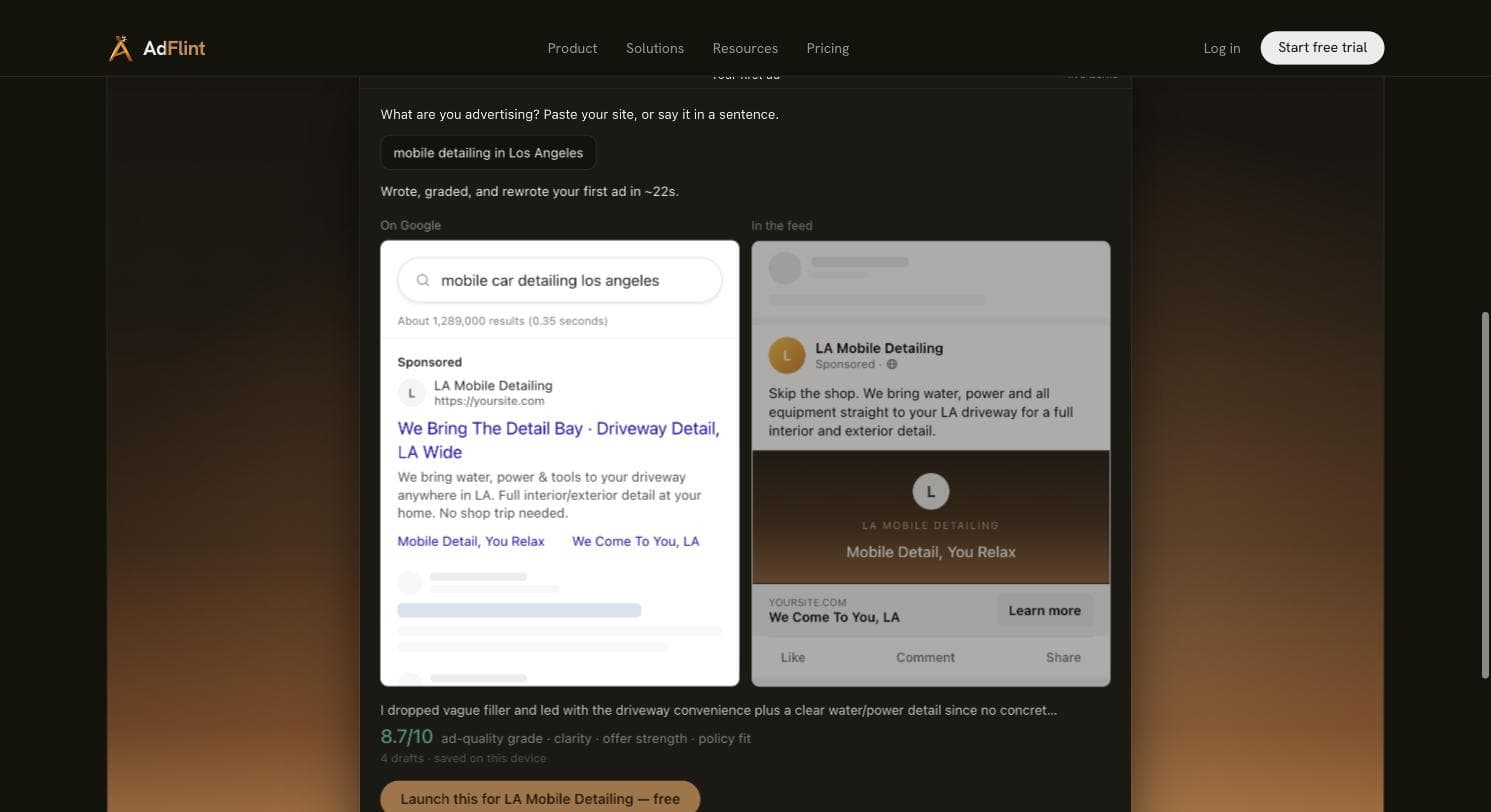
The design philosophy is the deliberate inverse of Trapica's, and it follows from the conversion-volume arithmetic in the intro. Trapica sells autonomy — "10,000+ daily optimizations autonomously," per its homepage — which is rational when an account generates enough conversions for models to learn from. A $1,500/mo account does not. So AdFlint puts the AI where data volume doesn't matter (writing the ads, structuring the campaigns, watching budgets and pacing) and puts a human gate where it does: hard budget caps are enforced, and nothing goes live until you approve it. You can judge the output before trialing — our public demo takes a plain-language business description (we use "mobile detailing in Los Angeles") and produces a Google search ad and a Meta feed preview in about 22 seconds, self-graded 8.7/10 across four drafts.
What we will not claim, because it would not be true: AdFlint has no multi-year track record of managed spend, no published ROAS case studies, no campaign history in any specific trade or vertical, and no third-party review base on G2 or Capterra yet — you cannot check us against strangers' experiences the way you can with Optmyzr or Adzooma, and that is a real reason to treat the free trial, not this page, as your evidence. And it is Google Ads and Meta only. Trapica's "20+ advertising platforms" breadth is genuine; if you need TikTok, LinkedIn or programmatic, nothing at this price point replaces it.
Pros
- + Only tool on this page that both publishes every price and does the campaign work itself — writes, launches and optimizes rather than recommending
- + Flat fees from $40 to $319/mo with 0% of ad spend on all self-serve tiers; the software bill does not climb because your budget did
- + You own the ad accounts: one-click OAuth to your own Google and Meta accounts, your card pays the platforms directly
- + Hard budget caps plus approval-before-launch — the right risk model at low conversion volume, where autonomous optimization has too little data to be trusted
- + 7-day free trial, and a public demo shows you real ad output before you even start it
Cons
- − Google Ads and Meta only — none of the TikTok, LinkedIn or programmatic breadth Trapica's 20+ platform list covers
- − Young product with no third-party review presence on G2 or Capterra yet, so you cannot verify us through strangers' reviews the way you can the older tools here
- − No published performance track record, client case studies or vertical-specific campaign history — we have not run sustained live spend at scale and refuse to invent numbers
- − Not autonomous: every campaign waits for your approval before launch, which is a deliberate safety choice but means it will not run truly hands-free the way Trapica pitches
- − The managed done-for-you tier starts at $249/mo plus a share of managed spend — a real cost jump over self-serve
Ideal for
- Small businesses on $100-$30,000/mo in ad spend who want campaigns built and optimized for them, not a dashboard of suggestions
- Owners who typed "Trapica for small business" and mainly meant "AI that does the ad work without an agency retainer"
- Anyone burned by percentage-of-spend pricing who wants a flat, published number
Pricing: Published in full at adflint.com/pricing (checked 3 August 2026): self-serve flat fee, 0% of ad spend on every self-serve tier — Launch $40/mo (up to $1,000/mo spend), Growth $89 (up to $2,500), Scale $109 (up to $5,000), Accelerate $119 (up to $10,000), Performance $219 (up to $20,000), Premium $319 (up to $30,000), custom above. Managed done-for-you starts at $249/mo plus a share of managed spend. Entry is a 7-day free trial.
Try AdFlint freeAdzooma
Best free starting point across Google, Microsoft and MetaAdzooma is the one name on this page with a genuine free-forever plan, and for a small business testing whether it even wants PPC software, that matters more than any feature list. We have not tested Adzooma hands-on — this entry is built from its own homepage and pricing page as displayed on 3 August 2026 — but what it documents is clear: an opportunities engine that scans connected Google, Microsoft and Meta ad accounts to "Instantly audit PPC accounts to spot wasted spend, disapprovals, and broken tracking" and then "Apply performance fixes, improve bidding, and clean up campaign structure fast," plus "30 pre-built alerts for key PPC risks," automation rules and scheduled reports. Its homepage names its audiences: agencies, eCommerce brands, in-house marketers and freelancers.
Pricing, exactly as its pricing page showed on 3 August 2026: a Free plan at $0 with monthly PPC performance reports, a limited number of visible opportunities, 3 PPC alerts, 1 SEO profile, 1 web metrics profile and one user seat; Silver at $69/mo (or $700/yr, a stated 20% saving) with weekly reports, all available opportunities, 10 alerts, 5 SEO and 5 web metrics profiles, unlimited seats and custom alerts; Gold at $179/mo (or $1,800/yr) with daily reports, unlimited alerts and profiles, unlimited seats and priority support. Notably, every tier — including Free — allows unlimited connected ad accounts, and the site says "No credit card required," which makes the free plan a working tool rather than a locked demo. The catch worth naming: the free tier shows a "limited number of opportunities," meaning it rations exactly the thing the product exists to provide. Treat it as an extended trial with no clock.
Against Trapica, the honest framing is that Adzooma is a different kind of product wearing the same "optimization" label. Trapica sells autonomous execution; Adzooma sells informed suggestions that you review and apply. For a small account with thin conversion data that is arguably the safer posture — you stay the decision-maker, and at three or four conversions a week there is not much for a black box to learn from anyway — but if you arrived here wanting the machine to run the account while you run the business, Adzooma is not that, and its own marketing does not really claim otherwise. It is the audit layer and the nagging colleague, not the operator.
Pros
- + Real free-forever plan with unlimited connected ad accounts and "No credit card required" per its own site — the only true $0 entry on this page
- + Published, small-business-sized pricing: $0, $69/mo, $179/mo, with annual rates shown on the page
- + Covers Microsoft Ads alongside Google and Meta — the one budget tool here that does, useful if Bing search traffic matters in your niche
- + One-click application of recommendations lowers the skill floor for a non-specialist owner
Cons
- − We have not tested it hands-on — this assessment is from Adzooma's own homepage and pricing pages, read 3 August 2026
- − It recommends; you execute. There is no autonomous campaign management here, so it replaces Trapica's audit function, not its operator function
- − The free plan deliberately limits how many opportunities you can see — the core feature is what's rationed
- − Paid tiers mostly add report frequency, alert counts, seats and SEO/web-metrics profiles rather than new optimization capability, which makes $179 Gold hard to justify for a single small account
Ideal for
- Small businesses that want a $0 way to find out what is wrong with their accounts before paying anyone
- DIY advertisers running Google plus Microsoft plus Meta who will act on suggestions themselves
- Freelancers and tiny agencies juggling several small client accounts on a thin software budget
Pricing: Read from adzooma.com/pricing on 3 August 2026: Free $0 (limited opportunities, 3 alerts, 1 seat, 1 SEO and 1 web metrics profile, monthly reports); Silver $69/mo or $700/yr (all opportunities, weekly reports, 10 alerts, 5 profiles, unlimited seats); Gold $179/mo or $1,800/yr (daily reports, unlimited alerts and profiles, priority support). Unlimited connected ad accounts on every tier, including Free; the site states no credit card is required to start.
Visit AdzoomaOptmyzr
Best for PPC-literate operators heading toward $10K/monthOptmyzr is the one third-party tool on this page we have actually worked inside: we created a real trial account on 30-31 July 2026 and went back in on 3 August 2026. The signup itself answers this page's question before the product does. Five mandatory qualification fields, then a phone number and SMS verification wall before you ever see the app — and the monthly ad spend dropdown starts at "Under $10,000/mo" and climbs to "$500,000+." When the bottom bracket of the qualification form is five times your entire budget, you have learned who the roadmap is built for. (Two smaller oddities we hit: Optmyzr's own /free-trial/ URL returned a 404, and the in-product trial banner said 15 days while the marketing site says 14.)
Once inside, the depth is real and the trial behavior is unusually respectful. Optmyzr let us into the full application with no ad account connected at all — rare in this category, where most tools gate everything behind OAuth — so you can inspect the entire toolset before granting anything access to your money. What you find is a working professional's bench: an Audits & Insights suite (PPC Investigator, Account Health & Audits, Ads & Creatives Analysis, Search Term Analysis, Spend Projection, Competitive & Auction Insights, Shopping), a Monitor suite (KPI tracking and alerts, an anomaly detector script, auto budget tracking, a Sale Day Command Center, a landing page URL checker), workflow "Account Blueprints" including AI-generated ones, and a Rule Engine stocked with pre-built strategies across Google, Microsoft and Amazon Ads — including two recent Performance Max placement-exclusion strategies for gaming and kids' content. Every tool that would touch a campaign bounced us back to the All Accounts screen until an account was connected: you can look at everything, touch nothing.
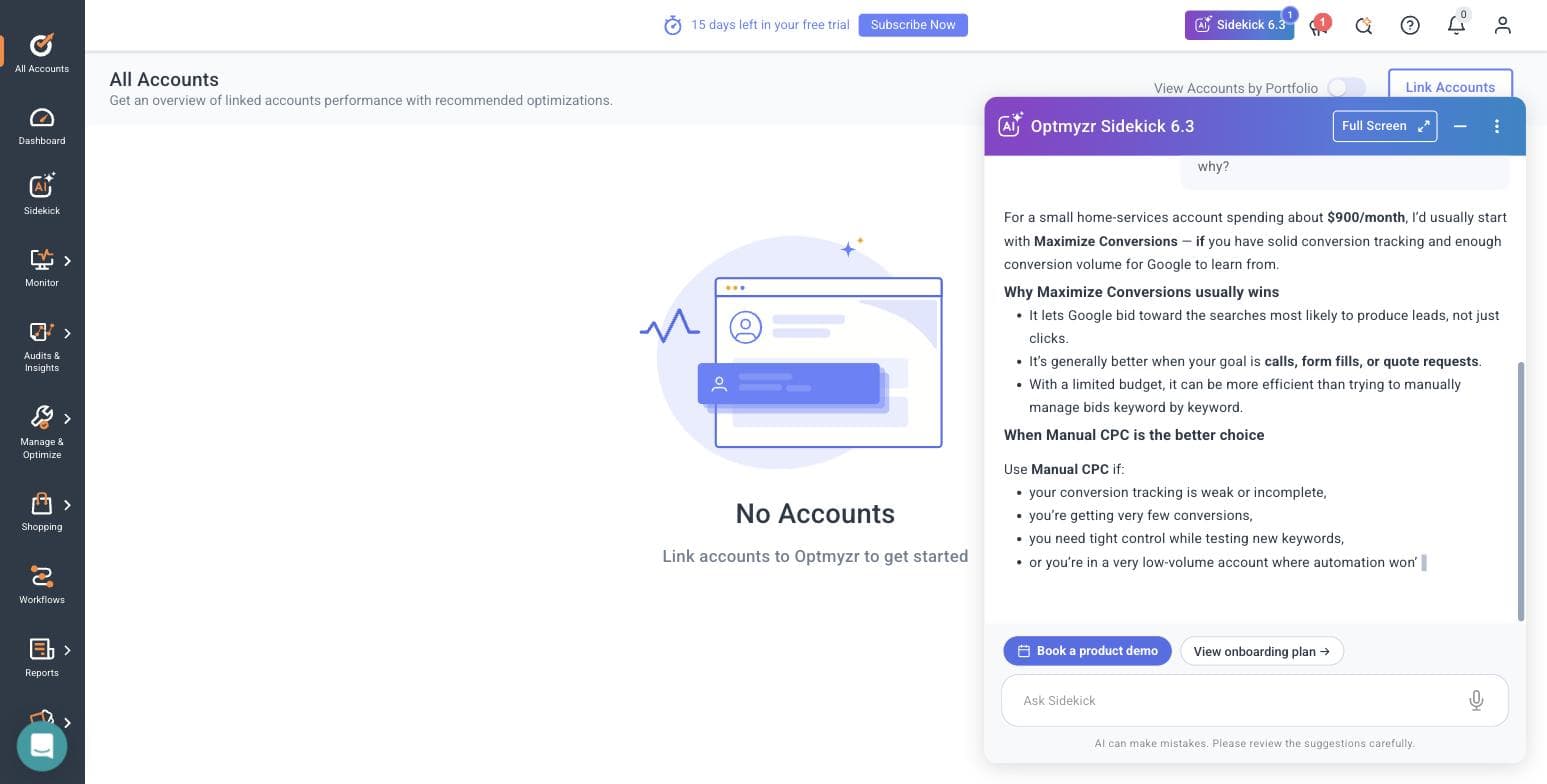
The moment most relevant to this page came from Sidekick, its built-in AI assistant (version 6.3 during our session). With no account connected, we asked it a real small-advertiser question — Maximize Conversions versus Manual CPC — and it gave the answer a good consultant would: fix conversion tracking first, use Maximize Conversions on core lead campaigns, fall back to Manual CPC where volume is too low, and treat roughly 3-5 conversions a week as the point where automated bidding has enough signal. We did not ask for a volume threshold; it offered one, and that number is the quiet indictment of the whole "autonomous AI for small budgets" pitch, delivered by a vendor's own AI. Also notable: its optional MCC-link dialog makes you type CONNECT to proceed and warns that Google auto-emails everyone with account access — it explicitly advises against agencies linking client accounts without approval. That is more care about account access than most of this market shows.
So why third on a small-business page? Price relative to budget. When we read Optmyzr's pricing page in July 2026, Essentials was $299/mo billed monthly or $209/mo billed annually, with a 14-day no-credit-card trial (the page also advertises a 30-day money-back guarantee and a 30% annual saving, and its spend selector runs to $500K+). For a $1,500/mo advertiser, $209-$299 is 14-20% of total ad budget spent on tooling — and the tool assumes you already know what a search-terms n-gram analysis is for. For an operator at $8,000-$10,000/mo who lives in Google Ads (its 11 integrations skew hard to search: Google Ads, Microsoft Ads, Amazon Ads and Amazon Seller Central, Search Ads 360, Google Analytics, Google Merchant Center, Yahoo Japan, plus Meta, LinkedIn and HubSpot), it is the strongest professional-grade option on this page, and we say that from use rather than from its brochure.
Pros
- + Publishes real prices — $299/mo monthly, $209/mo annual for Essentials when we read the page in July 2026 — with a genuine 14-day, no-credit-card trial
- + Lets you explore the full app with no ad account connected, so you can evaluate everything before granting OAuth access to live campaigns (we verified this ourselves)
- + Sidekick AI gave a correct, appropriately conservative answer to a real bidding question — including honesty about when automation lacks data
- + Unusually careful with account access: type-CONNECT confirmation, explicit warnings about Google's access-notification emails, and advice against linking client accounts without approval
- + Deep, mature audit/monitor/rule tooling that professional PPC managers genuinely use, including current PMax placement-exclusion strategies
Cons
- − Priced and designed for accounts bigger than most small businesses: its own qualification form's spend brackets start at "Under $10,000/mo"
- − $209-$299/mo is a large share of a small ad budget — at $1,500/mo spend it can exceed what many owners pay for all other software combined
- − Phone number plus SMS verification wall before you see the product, and its own /free-trial/ URL 404'd during our sessions
- − Assumes PPC literacy — it is a power tool for practitioners, not a do-it-for-you service; nothing executes for you until you build and babysit the automations
- − Search-first DNA: Meta and LinkedIn are integrations, not the center of gravity, so social-heavy small businesses are buying depth they won't use
Ideal for
- Owner-operators or in-house marketers at $8,000-$10,000+/mo spend who actively manage Google Ads themselves
- Small agencies and freelancers managing several search accounts who need audits, monitoring and rule automation in one place
- Anyone who wants to inspect a serious PPC tool end-to-end before connecting an ad account — the unconnected trial is genuinely rare
Pricing: Read from optmyzr.com/pricing in July 2026: Essentials $299/mo billed monthly or $209/mo billed annually; Premium and Enterprise tiers scale with ad spend (the selector runs to $500K+). 14-day free trial, no credit card required, plus a 30-day money-back guarantee for first-time subscriptions; the in-product banner told us 15 days. Tiers are spend-linked, so verify current figures on their page.
Visit Optmyzrgroas
Best Google-focused AI agents — if you'll trial before seeing a pricegroas (the groas.ai domain 301-redirects to groas.com — we followed it on 3 August 2026) is the entry here that most resembles Trapica's pitch shrunk down: AI agents that optimize Google Ads campaigns — conversion copy agents, budgeting agents, search-intent analysis, opportunity discovery — plus dynamically generated landing pages that adapt to search intent. That last piece is genuinely interesting for a small advertiser, because for local and lead-gen businesses the landing page, not the campaign settings, is usually the real conversion bottleneck: when 300 clicks a month is your whole traffic budget, moving the page's conversion rate from 4% to 6% is worth more than any bid tweak. We have not tested groas; everything in this entry comes from its own website as displayed on 3 August 2026.
Its marketing claims are big and unverifiable from the outside. Verbatim from the homepage: "Spending $100m+ On Google Per Year For 500+ Businesses & Agencies" and "Trained on $500B+ in Profitable Search Ad Spend to generate ad and landing page copy that converts at 2-3x industry average." We report those as the vendor's claims, not as findings — we have no way to check any of them. What we can verify is the pricing posture, and it is why groas ranks fourth on a page whose spine is pricing transparency: there is no published price. The homepage shows a 7-day free trial button and no numbers, and groas.com/pricing returned a 404 when we checked it on 3 August 2026. A trial-first model with no sales call is meaningfully better than Trapica's demo wall — but you are still committing time and connecting an account before you know what the bill is.
Fit: groas is built around Google search (its homepage headline also names "ChatGPT Ads"), and there is no Meta. For most local small businesses that means it can only ever be half a solution — the half where customers are actively searching, not the half where you reach them before they look. If your business lives on high-intent search — emergency services, urgent repairs, anything someone types at the moment of need — and you are comfortable trialing before pricing, it is worth a look. If your customers have to be interrupted rather than intercepted, you will still need a second tool.
Pros
- + Closest architectural match to Trapica's agent-based autonomous pitch at apparent small-business scale
- + Dynamic landing pages attack the actual weak point of most small-budget accounts — the page after the click, where a small traffic volume is won or lost
- + 7-day free trial with no sales demo required, unlike Trapica's contact-sales wall
- + Google-search focus means the depth sits where high-intent advertisers need it
Cons
- − No published pricing anywhere we could find — groas.com/pricing 404'd on 3 August 2026 — which fails the exact test that sent you away from Trapica
- − We have not tested it hands-on; every claim in this entry is the vendor's own or a check of its URLs
- − Headline claims ("$500B+ in Profitable Search Ad Spend," copy converting at "2-3x industry average") are not independently verifiable
- − No Meta, so most local businesses running both networks would still need a second tool
- − Thin third-party review footprint compared with the older tools on this page, so there is little outside experience to check it against
Ideal for
- Search-dependent small businesses — emergency and high-intent local services — that spend only on Google
- Advertisers whose landing pages are the known weak point
- People willing to spend a 7-day trial finding out the price
Pricing: Not published. As of 3 August 2026 the homepage shows a 7-day free trial and no plan prices, and groas.com/pricing returns a 404. Expect to learn the actual cost inside the trial or from sales. groas.ai 301-redirects to groas.com.
Visit groasWordStream (LOCALiQ)
The name you remember — no longer the software you rememberWordStream appears on nearly every Trapica-alternatives list still in Google's index, and nearly all of them describe a product that is no longer on offer. WordStream Advisor — the self-serve "20-minute work week" PPC software that made the brand synonymous with small-business PPC for a decade — appears nowhere on the current site. What wordstream.com sells today, as displayed on 3 August 2026, is two things: a set of genuinely free diagnostic tools, and managed marketing services under LocaliQ, the USA TODAY Network's marketing arm. We have not been LocaliQ customers; this entry is from the sites themselves.
The free tools are worth your time regardless of what you buy: the Google Ads Performance Grader, the Facebook Ads Performance Grader, the Free Keyword Tool with volume and cost data, and a Website Grader. Running the two ad graders on your existing accounts before trialing anything on this page is close to a free second opinion, and it costs you an email address. For a small advertiser the grader output is also the fastest way to find the thing that actually breaks small accounts — untracked conversions and wasted search terms — before you pay any tool to optimize toward numbers that were never recorded properly. That is the part of old WordStream that survived, and it is the best reason the brand still belongs on this list.
As an actual Trapica alternative, though, the current WordStream ranks last by this page's own test, and it is not close: there is no self-serve software product and no published price. LocaliQ's services sit behind "Let's Talk" demo scheduling — the same sales-gated, quote-based model whose opacity likely sent you searching for alternatives in the first place. That does not make it bad; it makes it a managed service, which is a different purchase. If a conversation with LocaliQ appeals to you, the honest comparison set is independent agencies and done-for-you services (including AdFlint's own managed tier, disclosed above) — priced retainers versus quoted ones — not PPC software.
Pros
- + Free Google Ads and Facebook Ads graders are legitimately useful audits — run them before buying anything on this page
- + Free Keyword Tool with volume and cost data, plus a Website Grader, still hold up for small-business research
- + Backed by a large organization (LocaliQ / USA TODAY Network) that is not going to vanish mid-contract
- + A managed service is the honest answer for owners who, after reading this far, realize they do not want software at all
Cons
- − WordStream Advisor, the software every stale listicle still recommends, is not offered on the current site — today it is free tools plus services
- − No published pricing anywhere: LocaliQ services are demo-gated and quote-based, the same opacity that makes Trapica a dead end for small budgets
- − The free tools function as the top of a sales funnel for those services — useful, but understand what they are for
- − We have not used LocaliQ's managed service and found no self-serve way to evaluate it without a sales conversation
Ideal for
- Owners who want free, no-commitment audits of their existing Google and Facebook accounts today
- Businesses that have concluded they want humans running their marketing and are willing to take sales calls to price it
- Anyone verifying for themselves that the WordStream in old roundups no longer exists
Pricing: No published pricing. As of 3 August 2026, wordstream.com offers free tools (Google Ads Performance Grader, Facebook Ads Performance Grader, Free Keyword Tool, Website Grader) and routes service inquiries to LocaliQ demo scheduling; no rates are shown anywhere on the site. We found no self-serve WordStream Advisor product or price.
Visit WordStream (LOCALiQ)Side by side.
| Tool | Published self-serve price? (Jul-Aug 2026) | Best for | Platforms | The catch |
|---|---|---|---|---|
| Trapica (the tool you're replacing) | No — three tiers (Automation, Intelligence, Enterprise), zero prices, demo/sales only | Enterprise brands scaling "$50K to $500K/month" (its own homepage) | "Meta, Google, TikTok, and 20+ advertising platforms" | Its stated customer is "2,000+ Enterprise brands"; we found no small-business tier and no price |
| AdFlint (our product) | Yes — full ladder: $40-$319/mo flat, 0% of spend on self-serve, 7-day trial | Small businesses that want campaigns written, launched and optimized for them | Google Ads + Meta only | Young product: no third-party reviews, no performance track record to show, no TikTok/LinkedIn |
| Adzooma | Yes — Free $0; Silver $69/mo; Gold $179/mo (3 Aug 2026) | DIY advertisers who want a free health check and one-click fixes | Google, Microsoft, Meta | Recommends rather than runs; the free tier rations how many opportunities you can see |
| Optmyzr | Yes — Essentials $299/mo monthly, $209/mo annual (July 2026), 14-day trial | PPC-literate operators near $10K/mo (the one third-party tool we used hands-on) | Google, Microsoft, Amazon, Yahoo Japan search-first; Meta and LinkedIn integrations | Its own signup brackets start at "Under $10,000/mo" — small accounts are the bottom of its range |
| groas | No — 7-day trial but no price shown; /pricing 404'd (3 Aug 2026) | Google-search advertisers willing to trial before seeing a number | Google Ads (its headline also names "ChatGPT Ads"); no Meta | No Meta, no published pricing, and big claims we cannot verify |
| WordStream (LOCALiQ) | No — no self-serve software on the site; managed services are demo-gated | Free account graders now; a managed-service sales talk if you want one | Free tools cover Google + Facebook; services vary | The Advisor software in every old roundup is not sold on the current site |
How we chose.
Hands-on, and when: we created a real Optmyzr trial account and worked inside the product on 30-31 July 2026, returning on 3 August 2026 — full signup, the phone/SMS wall, the onboarding wizard, module-by-module exploration, and a real strategy question put to its AI assistant. The Optmyzr screenshot on this page is from our own session. AdFlint is our own product; we operate it daily and its entry is marked with a disclosure.
Researched, not tested: Adzooma, groas, WordStream/LocaliQ — and Trapica itself. We did not create accounts with any of them. For these we read the vendors' live homepages and pricing pages on 3 August 2026 and quote figures and phrases exactly as displayed. Nothing in those entries is a hands-on claim.
Every price on this page was read off the vendor's own site and is dated. Where a vendor publishes no number — Trapica, groas, LocaliQ — we say "no published pricing" rather than guessing or repeating third-party estimates, and the ranking reflects it, because pricing opacity is the reason most readers of this page are here.
No performance claims for our own product: AdFlint has not run sustained live ad spend at scale, so you will find no ROAS figures, client results or case studies in its entry, and we have no campaign track record in any particular industry. Where we describe output quality, it is from our live public demo, which you can run yourself, and we label its score as self-graded.
No review quotes appear on this page. The review platforms we attempted to verify quotes against blocked automated access during research, and we do not paraphrase or reconstruct reviews we cannot link to. We would rather publish no quote than an unverifiable one.
Where we cite a benchmark — conversion volume thresholds, learning-phase requirements — it comes from platform documentation or from what a vendor's own tool told us, and we say which. The budget arithmetic in this page is arithmetic, illustrated with round numbers, not measured results from accounts we ran.
No affiliate links, no pay-to-play. No vendor on this page knows it is on this page.
- — Published self-serve pricing was the gate, because it is the exact thing Trapica withholds: we checked every vendor's live pricing page in July-August 2026 and ranked by whether a small business can see a number and act on it without a sales call. Two famous names on competing lists fail that test outright, and we ranked them accordingly instead of quietly relisting them.
- — How much of Trapica's actual job the tool performs at small budgets: doing the work (writing, launching, optimizing) ranked above recommending the work, which ranked above professional tooling that assumes you are already the operator.
- — Hands-on evidence where we could get it: we ran a real Optmyzr trial (30-31 July, revisited 3 August 2026) and we operate AdFlint ourselves. Adzooma, groas, WordStream/LocaliQ and Trapica are assessed from their own published pages, and each entry says which kind of evidence it rests on.
- — Small-budget data reality over feature count: autonomous optimization needs conversion volume that $500-$5,000/mo accounts rarely produce (roughly 3-5 conversions a week is the working floor Optmyzr's own assistant cited for automated bidding; Meta documents about 50 events per ad set per week to exit the learning phase). We favored tools whose control model — approval gates, caps, human-applied suggestions — matches thin data, rather than rewarding the loudest autonomy claims.
- — Platform breadth counted only where a small business would actually use it: Trapica's 20+ platforms sound like a loss until you notice most small budgets run entirely on Google and Meta, because splitting $1,500 six ways starves every channel of data. We noted every tool's coverage honestly, including our own product's two-platform limit.
- — Self-interest declared, not hidden: AdFlint is ours and is ranked first on stated, checkable criteria — published pricing and doing the work — while the tool we know best from the inside, Optmyzr, sits third for a stated reason (its price is a punishing share of a small budget). No pay-to-play, no affiliate links, and no review quotes we could not verify at the source, so this page carries none.
Common questions.
How much does Trapica actually cost?
Trapica does not publish pricing. When we checked its pricing page on 3 August 2026 it listed three tiers — Automation, Intelligence (marked most popular) and Enterprise — with no dollar figures on any of them; every call to action is Get Started, Get a Demo or Contact Sales. Third-party sites circulate various estimates, but we found no number on Trapica's own site and will not repeat guesses. What its homepage does tell you is the intended customer: "2,000+ Enterprise brands," "$2B+ Ad spend optimized," and a growth pitch of "Go from $50K to $500K/month."
Is Trapica suitable for small businesses at all?
Its own positioning says no — the homepage describes "the AI marketing operating system for retail, e-commerce and B2B enterprises." Beyond positioning there is a technical mismatch: Trapica's value is autonomous optimization at scale ("10,000+ daily optimizations autonomously"), and autonomy needs conversion volume to learn from. An account spending $1,000-$5,000/mo typically generates a few conversions a week, which is not enough signal for that model of optimization to beat simple caps, clean tracking and human review.
What is the closest free Trapica alternative?
Two different answers for two different jobs. For software, Adzooma's free-forever plan is the only true $0 tool on this page — unlimited connected Google, Microsoft and Meta ad accounts, no credit card per its own site, with a limited number of visible recommendations. For automation itself, the platforms' native tools — Google's automated bidding and Performance Max, Meta's Advantage+ — are free with any ad account and are, honestly, where much of the "AI optimization" this category sells now lives natively. The free path's real cost is your time and the absence of guardrails anyone configures for you.
Can AI ad optimization even work on $1,000-$2,000 a month?
Autonomous bid-and-budget optimization mostly cannot — not because the AI is bad, but because the data is thin. Run the numbers: $1,500 a month at a $5 CPC is about 300 clicks; at a 5% conversion rate that is roughly 15 leads, three or four a week. Optmyzr's own AI assistant told us during our hands-on test that automated bidding wants roughly 3-5 conversions per week minimum, and Meta documents around 50 optimization events per ad set per week to exit the learning phase. Small budgets sit at or below both bars. What does work at that scale: AI writing and structuring the campaigns (a task that needs no conversion data), clean conversion tracking, hard budget caps, and human approval on changes. That is the design logic behind ranking do-the-work tools with guardrails above autonomy-pitch tools on this page.
What should I fix before I buy any of these tools?
Conversion tracking, and specifically phone calls. For most small businesses the money event is a call, not a form fill, and calls are the event most often missing from the account — which means every automated bidding strategy, every AI recommendation and every tool on this page is optimizing toward an incomplete picture. Before you pay anyone: get Google Ads call reporting and call-from-ads conversions turned on, make sure form submissions fire a real conversion action rather than a pageview, and make sure the same events are set up on the Meta side. At three or four conversions a week, losing even one to broken tracking is a quarter of your signal. WordStream's free Google Ads Performance Grader will flag tracking problems for nothing, which is why it is on this list at all.
Is WordStream Advisor still available for small businesses?
Not on the current site. We found no self-serve WordStream Advisor product or price on wordstream.com as of 3 August 2026. What the site provides is free tools — the Google Ads Performance Grader, Facebook Ads Performance Grader, Free Keyword Tool and a Website Grader — plus managed marketing services under LocaliQ with demo-gated, unpublished pricing. The free graders remain genuinely useful; the self-serve software product that older roundups recommend is not on offer.
Which of these tools did you actually test?
Optmyzr, hands-on: we created a real trial account on 30-31 July 2026 and returned on 3 August 2026 — through the qualification form and phone/SMS wall, into the full app (which it opens without an ad account connected), across its audit, monitor, blueprint and rule-engine modules, including putting a real bidding question to its Sidekick assistant. AdFlint is our own product, which we operate daily — and we have not run sustained live spend at scale, so its entry makes no performance claims and cites no client results. Adzooma, groas, WordStream/LocaliQ and Trapica itself we researched from their own live homepages and pricing pages in July-August 2026 without creating accounts, and each entry says so.
Do any of these alternatives match Trapica's 20+ platform coverage?
No, and it is worth being clear-eyed about that. Trapica's breadth — its homepage cites "Meta, Google, TikTok, and 20+ advertising platforms" — is real, and none of these five replaces it. Optmyzr comes closest on the search side (Google, Microsoft, Amazon and Yahoo Japan, with Meta and LinkedIn integrations). Adzooma covers Google, Microsoft and Meta. AdFlint covers Google and Meta only; groas is Google-focused. The practical question is whether your budget uses that breadth: most sub-$10K/mo advertisers concentrate on Google and Meta because splitting a small budget six ways starves every channel of the data its algorithms need. If you genuinely need TikTok or programmatic at enterprise scale, you are Trapica's actual customer, and this page is not your list.
Keep reading
- AI Ad Tool Pricing in 2026: What It Really Costs
- Native Ad AI vs Third-Party Tools in 2026
- AI Ad Automation: What to Let It Change, and Not
- DIY vs Agency vs AI: What Ad Management Costs
- Google or Meta Ads First? Decide by Budget
- Conversion Tracking Setup for Google and Meta
- Free tool: Ad Budget Calculator
- Free tool: ROAS Calculator
- Free tool: Google vs Meta Budget Split Calculator
- Free tool: Meta Learning Phase Budget Calculator
- Free tool: Ad Management Cost Calculator